

Introduction
As AI becomes deeply embedded in GRC platforms, it is no longer just assisting decision-making — it is actively influencing it.
From predicting risk and flagging control failures to recommending corrective actions, AI now plays a central role in governance.
But with this power comes a critical challenge:
Can users trust AI-driven decisions if they don’t understand them?
In regulated environments, trust is not optional — it is a requirement.
This is where Explainable UX (XUX) becomes essential.
Explainable UX ensures that AI-driven insights are not only accurate, but also transparent, interpretable, and defensible. Today, trust in GRC systems is shaped not just by algorithms — but by design.
What Is Explainable GRC?
Explainable GRC refers to governance, risk, and compliance systems where:
-
AI-driven insights are clearly explained
-
Decision logic is visible and traceable
-
Users understand why a risk was flagged or an action was recommended
-
Regulators and auditors can follow the reasoning
UX plays a critical role in translating complex AI outputs into human-readable explanations that support confidence, accountability, and compliance.
At Timus Consulting, we view explainability not as a technical feature — but as a design responsibility.
Why Explainability Matters in AI-Driven GRC
Traditional GRC systems focused on documentation and reporting.
Modern AI-powered systems focus on prediction and automation.
Without explainable UX, AI decisions can feel like a “black box,” leading to:
-
Low user adoption
-
Manual overrides
-
Distrust in recommendations
-
Compliance and audit challenges
-
Regulatory risk
Explainable UX matters because it:
-
Builds confidence in AI-generated insights
-
Supports regulatory defensibility
-
Enables faster and more confident decisions
-
Reduces resistance to automation
-
Strengthens governance accountability
In high-stakes environments, understanding is as important as accuracy.
How UX Makes AI Decisions Explainable
Below are six UX principles that turn AI-driven GRC systems into trustworthy, transparent platforms.
1. Clear “Why” Behind Every AI Recommendation
Users should never wonder why an AI recommendation appeared.
Explainable UX ensures:
-
Every alert includes a clear explanation
-
Key contributing factors are highlighted
-
Supporting data points are visible
Example:
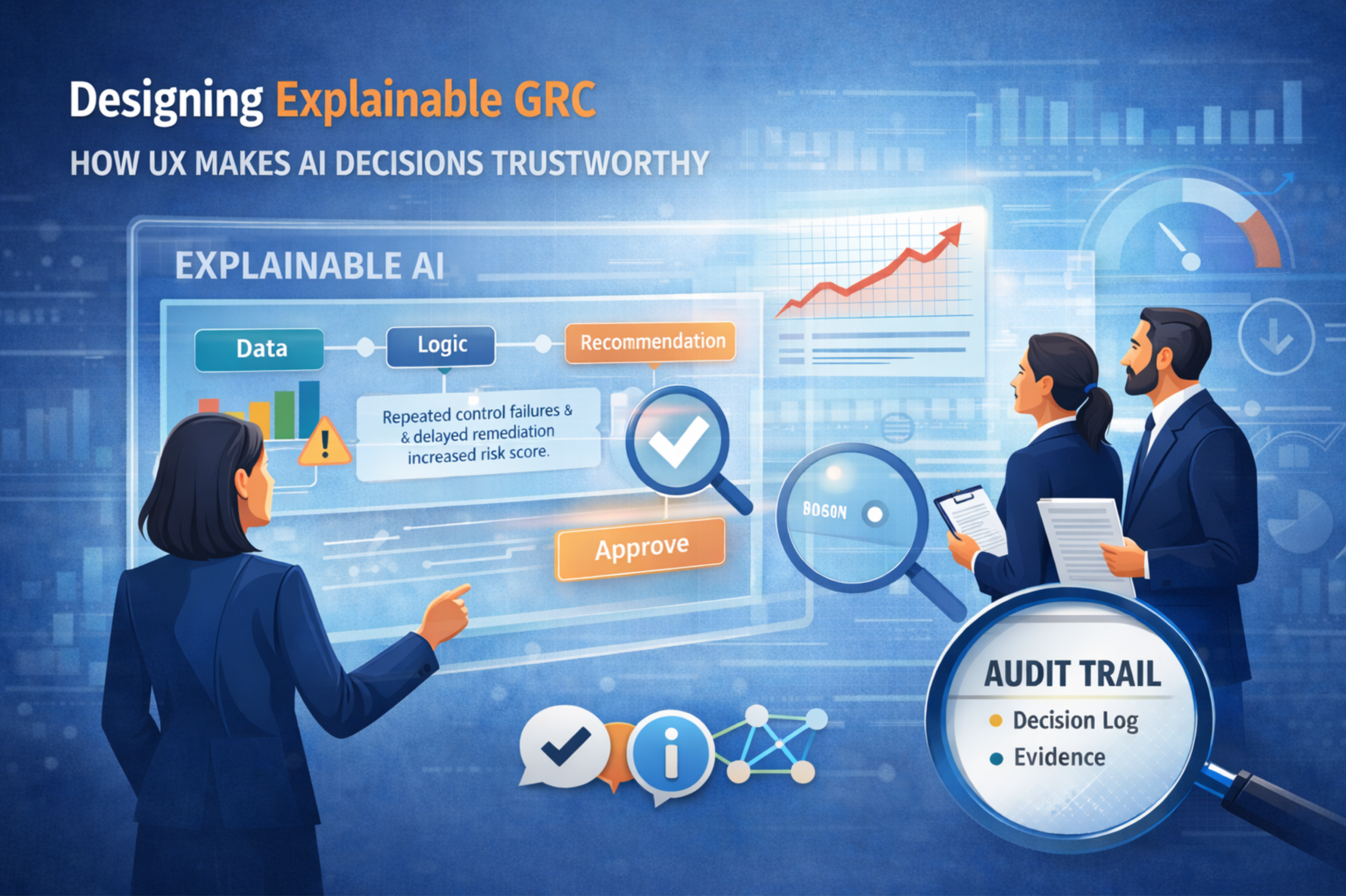
“Risk score increased due to repeated control failures, delayed remediation, and rising incident frequency.”
Result: Users trust the system because they understand its logic.
2. Visual Transparency Instead of Technical Jargon
Raw AI outputs are complex — UX simplifies them visually.
Effective explainable design uses:
-
Visual breakdowns of contributing factors
-
Confidence indicators
-
Risk trend visuals
-
Explainability tooltips
Instead of showing model complexity, the interface shows meaning.
Result: Insights are accessible to all users, not just technical experts.
3. Confidence Indicators That Guide Judgment
Not all predictions are equal — users need context.
Explainable UX introduces:
-
Confidence levels (High / Medium / Low)
-
Data completeness indicators
-
Model reliability cues
Example:
“This prediction is based on 92% data completeness and historical trends.”
Result: Users apply the right level of scrutiny to each insight.
4. Traceable Decision Paths for Audit & Compliance
In GRC, explainability must extend beyond daily use to audits and regulatory reviews.
UX supports this by enabling:
-
Click-through explanations
-
Historical decision timelines
-
Evidence-linked predictions
-
Traceable recommendation logs
Auditors don’t just see what happened — they see how the decision was made.
Result: Stronger audit readiness and regulatory confidence.
5. Human-Centered Language That Builds Trust
Explainable UX replaces technical language with human-friendly communication.
Instead of:
“Anomaly detected via multivariate analysis”
Users see:
“This activity differs from normal patterns and may indicate increased risk.”
Result: AI feels supportive — not intimidating.
6. Design That Encourages Human Oversight, Not Blind Automation
Explainable UX reinforces that AI supports decisions — it doesn’t replace accountability.
Well-designed systems:
-
Invite review before action
-
Provide override options
-
Clearly distinguish AI suggestions from final decisions
Result: Responsible automation with clear ownership.
What This Means for GRC Teams
For GRC, risk, and compliance professionals, explainable UX delivers practical, everyday benefits:
-
Faster decision-making: Users spend less time questioning AI outputs and more time acting on them
-
Stronger audit readiness: Clear decision trails simplify audits and regulatory reviews
-
Higher adoption of AI tools: Teams trust and use AI recommendations more consistently
-
Reduced manual rework: Fewer overrides, fewer clarifications, fewer escalations
In short, explainable UX turns AI from a black box into a trusted partner.
From Black-Box AI to Trusted Governance
When UX makes AI explainable, GRC platforms transform into early-warning, decision-support systems.
Organizations benefit by:
-
Increasing adoption of AI recommendations
-
Improving decision accuracy and confidence
-
Strengthening compliance defensibility
-
Enhancing trust across teams and stakeholders
Explainable UX doesn’t slow down AI — it enables it to scale responsibly.
Conclusion
In today’s AI-driven GRC landscape, trust is the true currency.
Algorithms may power predictions — but UX earns confidence.
At Timus Consulting, we believe explainability must be designed into every AI-driven GRC system. By making decisions transparent, interpretable, and human-centered, organizations can unlock the full potential of AI — without compromising governance, accountability, or trust.
The future of GRC isn’t just intelligent.
It’s explainable by design.