

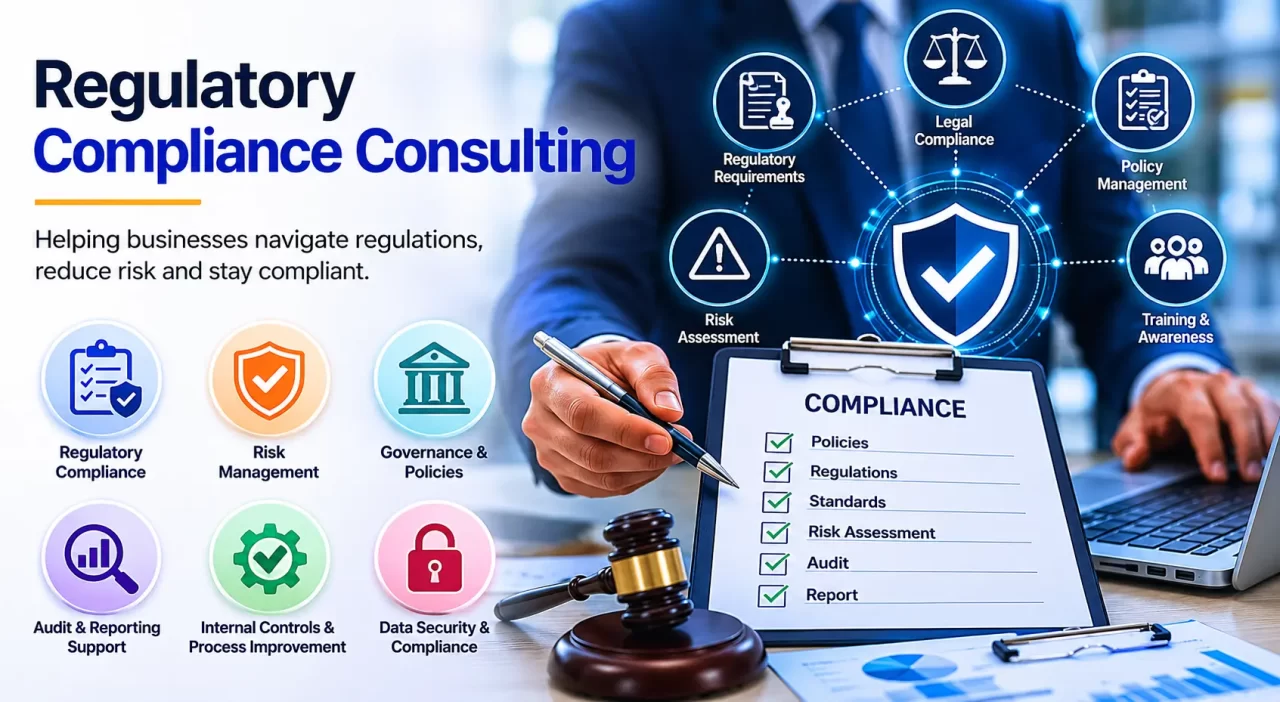
Why Businesses Need Regulatory Compliance Consulting
Many organizations struggle to keep up with changing regulations. Different industries have different compliance requirements. As a result, businesses often face operational and security risks.
Regulatory compliance consulting helps companies stay compliant and reduce risks. It also improves governance, reporting, and internal processes.
In addition, compliance consulting helps organizations avoid penalties and improve customer trust.
Common Compliance Challenges
Businesses face several compliance challenges today. Some of the most common include:
- Frequent regulatory updates
- Manual compliance tracking
- Limited risk visibility
- Data security concerns
- Lack of centralized reporting
- Complex audit processes
Therefore, companies need modern compliance solutions to manage these challenges effectively.
How Compliance Consulting Improves Business Operations
Compliance consulting improves both security and operational efficiency. It helps organizations build strong internal controls and better compliance processes.
For example, businesses can:
- Automate compliance workflows
- Monitor risks continuously
- Improve audit readiness
- Simplify reporting processes
- Strengthen data protection
As a result, organizations can focus more on business growth and less on compliance issues.
Importance of Governance, Risk, and Compliance (GRC)
Governance, Risk, and Compliance (GRC) plays a major role in modern businesses. It helps organizations manage policies, risks, and regulations from a single platform.
Solutions like IBM OpenPages help businesses improve compliance visibility and operational risk management.
Moreover, centralized GRC platforms improve decision-making and regulatory reporting.
Best Practices for Regulatory Compliance
Organizations can improve compliance by following these best practices:
- Conduct regular compliance audits
- Train employees on security policies
- Monitor regulatory updates continuously
- Use automated compliance tools
- Maintain proper documentation
- Implement risk management strategies
These steps help businesses maintain long-term compliance and reduce operational risks.
Regulatory compliance consulting Management (RCM) refers to the systematic approach of ensuring that a business adheres to all applicable laws, regulations, and industry standards. Given India’s complex regulatory environment—spanning taxation, labour laws, environmental rules, and corporate governance—compliance management is essential for smooth and lawful operations.
There are 1500+ laws and over 31000 Compliance items based on the nature of business and location/s that the industry needs to comply within India.
What does it include?
For Indian SMEs, compliance management typically covers:
- Corporate laws under the Companies Act, 2013
- Tax compliance, including Goods and Services Tax (GST), income tax filings, TDS, etc.
- Labor laws, such as Employees’ Provident Fund and Employees’ State Insurance
- Environmental and safety regulations
- Industry-specific licenses and permits, such as The Shops and Establishments Act, FSSAI licensing for food business, Liquor licences, etc.
It involves tracking deadlines, maintaining records, filing returns, and ensuring internal policies align with legal requirements.
Why it matters for SMEs
Many SMEs Regulatory compliance consulting assume compliance is only for large corporations—but that’s risky. Indian regulators have increasingly digitized systems and tightened enforcement, making non-compliance easier to detect.
Key Benefits
- Avoidance of Penalties and Legal Trouble
Non-compliance can lead to fines, prosecution, or even business closure. A proper system helps SMEs stay ahead of deadlines and requirements.
- Improved Business Credibility
Being compliant Regulatory compliance consulting enhances trust with:
- Investors
- Banks and NBFCs
- Customers and vendors
This is especially important when applying for loans or entering partnerships and M&A (Merger and Acquisition) deals
- Easier Access to Funding
Financial institutions often check compliance history before approving loans. Clean records improve chances of funding and better credit terms.
- Operational Efficiency
Structured compliance systems:
- Reduce last-minute rush
- Improve documentation
- Streamline internal processes
- Better Risk Management
Identifying regulatory risks early helps avoid sudden disruptions, inspections, or legal notices.
- Scalability and Growth
As SMEs expand, compliance complexity increases. Having systems in place early makes scaling smoother.
- Government Incentives and Schemes
Many Indian government schemes require strict compliance eligibility. Staying compliant ensures access to subsidies and benefits.
Common Challenges SMEs Face
- Frequent regulatory changes
- Lack of in-house legal expertise
- Manual tracking (spreadsheets, E-mails, reminders, manual scattered documents)
- Cost concerns
How SMEs Manage Compliance Today
- Hiring Chartered Accountants (CAs) or Company Secretaries
- Using compliance software tools
- Outsourcing to professional firms
- Implementing internal compliance calendars
Bottom Line
Regulatory compliance management is not just a legal obligation—it’s a strategic advantage for SMEs in India. Businesses that treat compliance as a core function tend to be more resilient, trustworthy, and growth-ready.Top of Form
Companies providing GRC solutions need to embrace changes and provide Regulatory compliance.
Solution
Contact us to help you better classify, organize, store your Compliance artefacts. We help you comply with all the Regulatory requirements and help your business stay compliant. Compliance – Simplified!!
FAQs for Regulatory compliance consulting
1. What is regulatory compliance consulting?
Regulatory compliance consulting helps organizations understand, implement, and maintain compliance with industry regulations, legal requirements, and security standards.
2. Why is regulatory compliance important for businesses?
Regulatory compliance helps businesses avoid legal penalties, protect sensitive data, improve operational efficiency, and build customer trust.
3. What industries require regulatory compliance consulting?
Industries such as healthcare, finance, banking, insurance, manufacturing, IT, and pharmaceuticals commonly require compliance consulting services.
4. What services are included in regulatory compliance consulting?
Common services include:
- Risk assessments
- Compliance audits
- Policy development
- Regulatory reporting
- Governance and risk management
- Security and data protection consulting
5. How does IBM OpenPages support compliance management?
IBM OpenPages helps organizations streamline governance, risk management, compliance tracking, audit management, and regulatory reporting through a centralized platform.
6. What are the benefits of regulatory compliance consulting?
Benefits include:
- Reduced compliance risks
- Improved operational efficiency
- Better governance and transparency
- Enhanced data security
- Faster audit preparation
- Improved regulatory readiness
7. What challenges do organizations face in compliance management?
Organizations often struggle with changing regulations, manual processes, data management, lack of visibility, and integrating compliance across departments.
8. How can businesses improve regulatory compliance?
Businesses can improve compliance by:
- Conducting regular audits
- Implementing automated compliance tools
- Training employees
- Monitoring regulatory updates
- Using centralized GRC platforms