

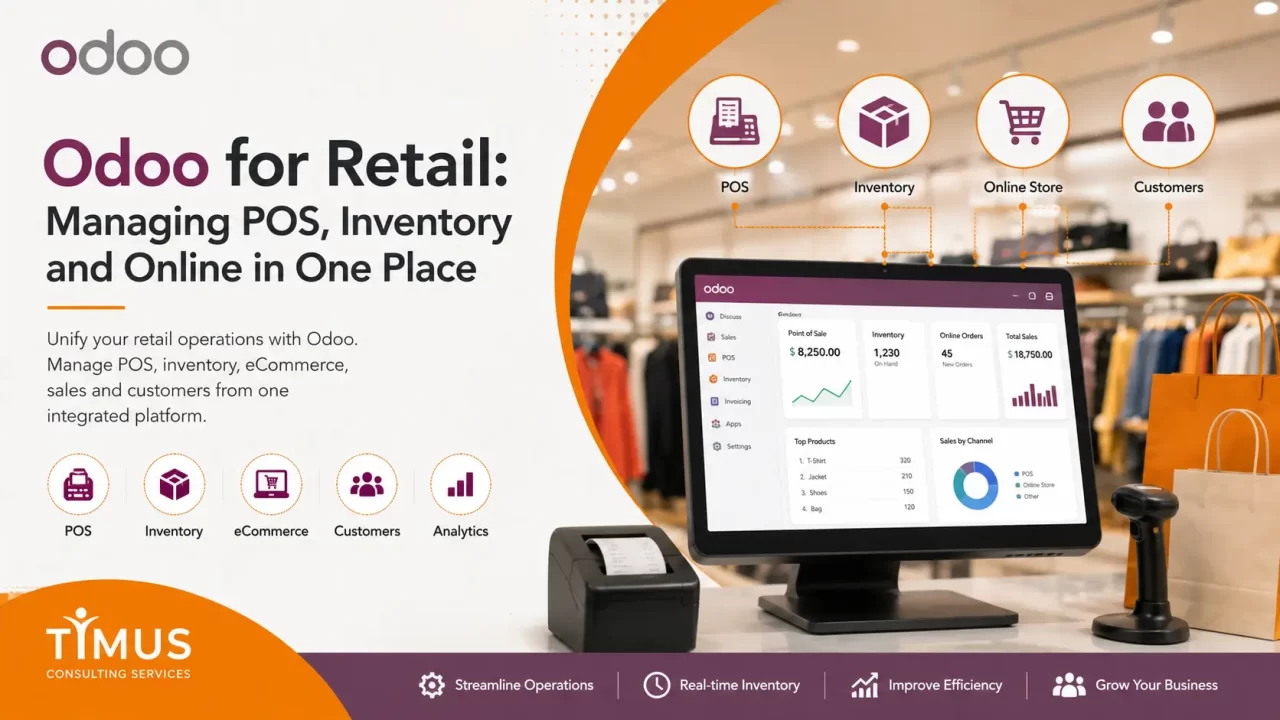
Running a retail business today means selling everywhere at once — at the counter, on your website, and sometimes through a marketplace or social media. That’s exciting for growth, but it creates a familiar headache: your point of sale doesn’t talk to your online store, your inventory counts never quite match, and you’re left updating spreadsheets late at night just to figure out what you actually have in stock.
Odoo solves this by bringing your point of sale, inventory, and online store into one connected system. Instead of juggling separate tools that don’t sync, everything updates in real time from a single source of truth. Here’s how it works — and why it matters for your bottom line.
The Real Problem: Disconnected Systems for Odoo
Most retailers don’t start with one system. They add tools as they grow: a POS for the shop, a separate platform for the website, maybe another app for accounting. Each one works fine on its own — but together, they create gaps:
- A product sells online, but your in-store team doesn’t know it’s now out of stock.
- Your bestseller runs out because no one saw the numbers in time.
- Month-end becomes a scramble to reconcile sales from three different places.
Every one of these gaps costs you money — in lost sales, overstocking, wasted staff time, and unhappy customers. Odoo closes those gaps by design.
1. A Point of Sale That Just Works
Odoo POS runs on almost any device — a computer, tablet, or dedicated terminal — and keeps working even if your internet drops, syncing automatically once you’re back online. That reliability alone saves a lot of stress on a busy day.
Beyond ringing up sales, Odoo POS handles the things retailers actually need: fast checkout, multiple payment methods, discounts and promotions, receipts, refunds, and customer loyalty programs. If you run more than one store, you can manage them all from one place.
Why it matters: Faster checkouts mean shorter lines and happier customers, and every sale automatically updates your stock and your books — no manual entry required.
2. Inventory That Stays Accurate — Automatically
This is where the “one place” promise really pays off. In Odoo, every sale — in-store or online — instantly updates your stock levels. Sell a jacket at the counter, and your website reflects it immediately. Sell it online, and your shop staff see the change too.
Odoo’s inventory tools also help you:
- Set automatic reorder rules so you never run out of top sellers
- Track stock across multiple locations or warehouses
- Use barcode scanning for fast, accurate receiving and stock counts
- See what’s selling and what’s sitting, so you buy smarter
Why it matters: No more overselling, no more dead stock tying up cash, and no more guessing. Accurate inventory is one of the biggest profit levers in retail.
3. An Online Store That’s Actually Connected
With Odoo, your eCommerce site isn’t a separate island — it shares the same products, prices, and stock as your physical store. Update a product once, and the change appears everywhere. When something sells online, your inventory and accounting update automatically.
You can build and manage the store yourself with Odoo’s drag-and-drop website builder, no coding required, and connect it to payment providers, shipping options, and promotions.
Why it matters: Selling online becomes an extension of your business, not a second job. One catalog, one stock count, one dashboard — across every channel.
4. One View of Your Whole Business
Because POS, inventory, and eCommerce all feed the same system, you get a single, real-time picture of your retail business: total sales across channels, best- and worst-performing products, stock value, and customer trends — all in one dashboard.
You can even connect Odoo’s accounting, HR, and marketing tools when you’re ready, so your entire operation runs on one platform instead of a patchwork of apps.
Why it matters: You make decisions based on real numbers, not gut feel or outdated reports. And when the whole business speaks the same language, everything runs smoother.
What This Means for Your Business
Bringing POS, inventory, and online sales together in Odoo delivers a few very practical wins:
- Less manual work — sales, stock, and books update themselves
- Fewer costly mistakes — no overselling, no stockouts, no reconciliation nightmares
- Better customer experience — accurate availability and faster service across channels
- Clearer decisions — one real-time view of everything
For a growing retailer, that’s the difference between constantly firefighting and actually running the business.
Getting Started
The good news is you don’t have to switch everything at once. Many retailers start with POS and inventory, then add the online store and other tools as they grow. Odoo scales with you, so you only pay for and use what you need.
If you’re tired of stitching together systems that don’t talk to each other, it might be time to see what a truly connected retail setup looks like.
FAQs Odoo For Retail
1. What is Odoo Retail Management?
Odoo Retail Management is an integrated ERP solution that helps retailers manage POS, inventory, eCommerce, sales, purchasing, and customer relationships from a single platform.
2. How does Odoo POS integrate with inventory?
Every sale made through Odoo POS automatically updates inventory levels in real time, reducing stock discrepancies and improving inventory accuracy.
3. Can Odoo manage both physical and online stores?
Yes. Odoo integrates physical retail stores and eCommerce into one system, allowing businesses to manage products, orders, inventory, and customers centrally.
4. Is Odoo suitable for multi-store retail businesses?
Yes. Odoo supports multiple stores and warehouses, enabling centralized inventory, pricing, reporting, and stock transfers across locations.
5. What are the benefits of using Odoo for retail?
Key benefits include:
- Real-time inventory tracking
- Faster checkout with POS
- Integrated eCommerce
- Automated purchasing
- Centralized customer management
- Detailed sales analytics