

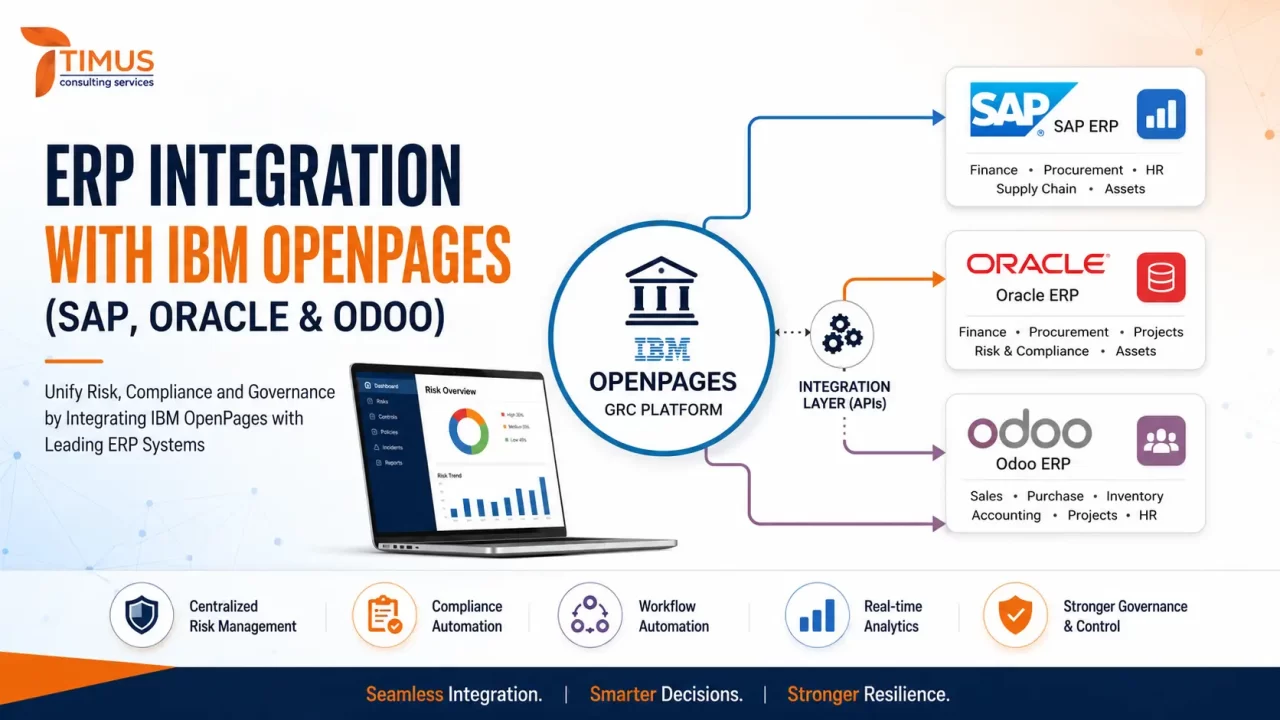
Turning ERP Data into Business Risk Intelligence
Every organization depends on an ERP system. Whether it is SAP, Oracle ERP, or Odoo, these systems manage the most critical business operations—procurement, finance, inventory, suppliers, invoices, contracts, assets, and payments.
But here’s the challenge.
ERP systems are designed to run the business. They are not designed to manage business risks. This creates a gap that many organizations don’t realize until an audit, compliance issue, or operational failure occurs.
This is where IBM OpenPages becomes a game changer.
When ERP systems are integrated with IBM OpenPages, organizations can automatically identify risks, monitor compliance, trigger investigations, and maintain complete governance across their business operations.
Let’s understand how this integration solves real business problems.
Why ERP Alone Isn’t Enough
An ERP system records what happened.
It tells you:
- Which supplier received a purchase order.
- Which invoice was approved.
- Who created the transactions.
- Which department made the purchase.
- When the payment was processed.
But it does not answer questions like:
- Is this supplier considered high risk?
- Is this purchase violating company policy?
- Has this vendor failed previous audits?
- Is this invoice linked to a compliance issue?
- Is this transaction creating financial exposure?
- Does this purchase require additional approvals?
ERP systems store operational data.
IBM OpenPages converts that operational data into actionable risk intelligence.
Common Business Challenges
Many organizations still manage risks manually even though their ERP systems already contain valuable information.
Some common challenges include:
-
Manual Risk Identification
Risk teams export Excel reports from ERP systems every week and manually review thousands of records.
This process is slow, repetitive, and often misses critical issues.
-
Delayed Compliance Monitoring
Compliance violations are usually discovered during quarterly or annual audits.
By then, the financial or operational impact has already occurred.
-
Lack of Vendor Visibility
Procurement teams approve suppliers based on operational needs, while risk teams maintain separate vendor assessments.
Because these systems are disconnected, high-risk suppliers may continue receiving business.
-
Duplicate Data Management
Supplier information, contracts, purchase orders, and invoices are often maintained in multiple systems.
This creates inconsistent data, duplicate records, and additional maintenance effort.
-
Limited Executive Visibility
Business leaders often struggle to answer questions like:
- Which suppliers create the highest operational risk?
- Which business units have the most compliance issues?
- What is our current financial exposure?
- Which vendors require immediate attention?
Without integration, these answers require manual reporting.
How IBM OpenPages Solves These Challenges
IBM OpenPages acts as the organization’s centralized Governance, Risk, and Compliance (GRC) platform.
When integrated with ERP systems, it continuously receives business data and automatically performs risk analysis.
Instead of waiting for audits, organizations can identify risks as business transactions happen.
This transforms compliance from a reactive activity into a proactive process.
How ERP and OpenPages Work Together
Imagine the following business flow.
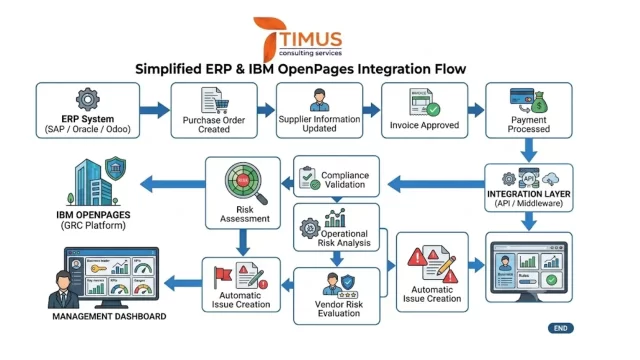
ERP System
↓
Purchase Order Created
↓
Supplier Information Updated
↓
Invoice Approved
↓
Payment Processed
↓
Integration Layer (API / Middleware)
↓
IBM OpenPages
↓
Risk Assessment
↓
Compliance Validation
↓
Operational Risk Analysis
↓
Vendor Risk Evaluation
↓
Automatic Issue Creation
↓
Management Dashboard
Instead of manually reviewing ERP reports, OpenPages automatically evaluates every important business event.
Real Business Use Cases
1. Vendor Risk Management
A new supplier is created inside SAP.
Instead of manually performing a risk assessment later, the supplier information is immediately sent to OpenPages.
OpenPages can automatically:
- Calculate vendor risk score
- Check previous audit history
- Verify regulatory compliance
- Evaluate country risk
- Assess financial exposure
- Trigger due diligence workflows
Result:
Risk teams receive immediate visibility before major purchases begin.
2. Procurement Compliance
A purchase order worth millions of dollars is approved.
OpenPages automatically validates whether:
- Required approvals exist
- Vendor certifications are valid
- Procurement policies are followed
- Contract terms are satisfied
- Spending limits are exceeded
If any policy is violated, OpenPages can automatically create an issue, notify stakeholders, and initiate corrective actions.
3. Financial Compliance
Invoices are continuously processed inside Oracle ERP or SAP.
Instead of waiting for external audits, OpenPages can identify:
- Duplicate payments
- Suspicious transactions
- Approval policy violations
- Segregation of duties conflicts
- Financial control failures
Compliance teams receive alerts immediately.
4. Operational Risk Monitoring
Operational incidents often originate from business transactions.
For example:
- Delayed deliveries
- Contract breaches
- Supplier failures
- Payment delays
- Inventory shortages
ERP provides operational data.
OpenPages converts those events into measurable operational risks and tracks them through their complete lifecycle.
5. Audit Automation
Traditionally, auditors spend weeks collecting ERP reports.
With OpenPages integration:
- ERP data is already available.
- Risk indicators are pre-calculated.
- High-risk transactions are identified automatically.
- Evidence collection becomes significantly easier.
This allows auditors to focus on analysis instead of data collection.
Supported ERP Systems
The integration approach remains similar across different ERP platforms.
-
SAP
Ideal for organizations managing enterprise procurement, finance, manufacturing, and supply chain operations.
Typical integrations include:
- Vendors
- Purchase Orders
- Invoices
- Payments
- Contracts
- Assets
-
Oracle ERP
Frequently integrated for:
- Financial controls
- Regulatory compliance
- Procurement governance
- Internal audit
- Enterprise risk management
-
Odoo ERP
A great option for growing businesses.
Organizations using Odoo can integrate modules such as:
- Purchase
- Accounting
- Inventory
- Manufacturing
- CRM
- HR
This provides enterprise-grade governance without replacing existing ERP investments.
Business Benefits
Organizations integrating ERP systems with IBM OpenPages typically experience:
✔ Faster compliance monitoring
✔ Automated risk identification
✔ Better vendor governance
✔ Improved audit readiness
✔ Reduced manual reporting
✔ Higher data accuracy
✔ Centralized risk visibility
✔ Better executive decision making
Instead of reacting after problems occur, organizations proactively manage risks as business activities happen.
Typical Integration Architecture
A modern ERP integration usually follows this approach:
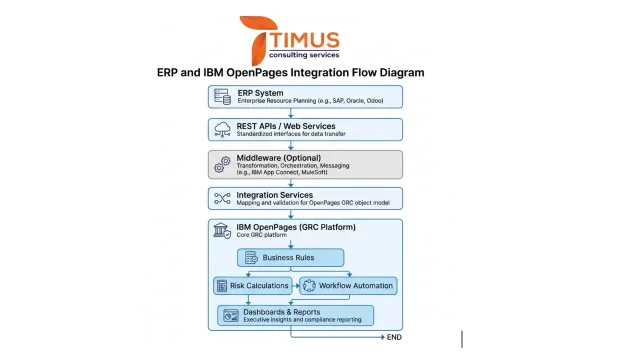
This architecture supports both real-time and scheduled synchronization depending on business requirements.
Why Organizations Choose Timus
At Timus, we understand that successful integration is not just about connecting systems.
It is about solving business problems.
Our team specializes in designing integrations that transform operational data into actionable governance insights.
We help organizations:
- Integrate IBM OpenPages with SAP, Oracle ERP, Odoo, and other enterprise platforms.
- Automate operational, vendor, and financial risk management.
- Build secure REST API-based integrations.
- Implement workflow automation.
- Configure dashboards, reports, and risk calculations.
- Reduce manual effort while improving compliance visibility.
Our goal is to ensure that business users receive meaningful insights—not just synchronized data.
Final Thoughts
ERP systems keep your business running.
IBM OpenPages keeps your business protected.
When these platforms work together, organizations gain real-time visibility into operational risks, vendor performance, financial compliance, and governance activities.
Instead of manually chasing reports and spreadsheets, teams can focus on making informed decisions backed by trusted data.
That is the true value of ERP and IBM OpenPages integration.
What are your thoughts?
Have you integrated IBM OpenPages with SAP, Oracle ERP, Odoo, or any other ERP platform?
What was your biggest challenge during the integration journey?
I’d love to hear your experience.
Should I create a full case study on SAP + IBM OpenPages integration?