
Introduction
In today’s rapidly changing business environment, organizations face increasing challenges related to regulations, cybersecurity, operational risks, compliance requirements, and corporate governance. Managing these areas independently can lead to inefficiencies, duplication of work, and gaps in risk management.
This is where GRC — Governance, Risk, and Compliance — plays an important role.
What is Governance, Risk, and Compliance (GRC)?
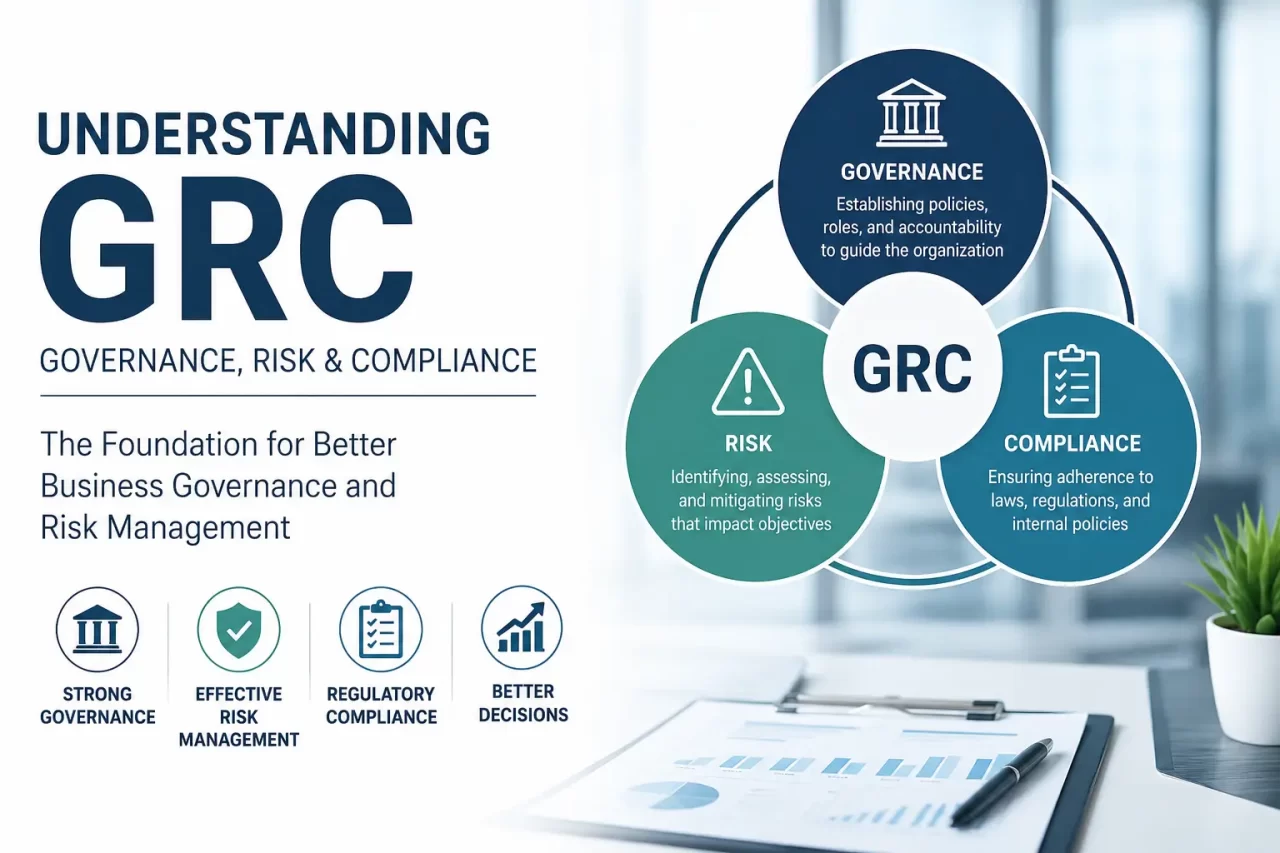
GRC stands for Governance, Risk, and Compliance. It is a structured approach that helps organizations align their business objectives, identify and manage risks, and comply with applicable laws, regulations, standards, and internal policies.
Although Governance, Risk, and Compliance are distinct areas, they are closely connected and work together to support better decision-making and business performance.
Governance
Governance refers to the framework, policies, processes, and structures that guide how an organization operates.
Effective governance helps organizations:
- Define clear roles and responsibilities
- Establish accountability
- Align business activities with organizational objectives
- Improve transparency and decision-making
- Monitor performance and compliance
Strong governance ensures that everyone within the organization understands their responsibilities and works toward common business goals.
Risk Management
Every organization faces risks. These risks may be related to cybersecurity, finance, operations, third-party vendors, technology, regulations, or business strategy.
Risk management helps organizations:
- Identify potential risks
- Assess the likelihood and impact of risks
- Prioritize critical risks
- Implement appropriate controls
- Monitor risks continuously
The objective is not always to eliminate every risk. Instead, organizations need to understand their risks and manage them within an acceptable level.
Compliance
Compliance focuses on ensuring that an organization follows relevant laws, regulations, industry standards, and internal policies.
Depending on the industry and location, organizations may need to comply with requirements related to:
- Data privacy
- Information security
- Financial regulations
- Industry standards
- Internal policies and procedures
Effective compliance management helps reduce legal and regulatory issues while building trust with customers, partners, and stakeholders.
Why is GRC Important?
Without an integrated GRC approach, organizations may manage governance, risk, and compliance activities separately. This can result in duplicated efforts, inconsistent information, and difficulty identifying major risks.
An effective GRC program can help organizations:
1. Improve Decision-Making
GRC provides leadership with better visibility into organizational risks and compliance requirements, enabling informed business decisions.
2. Reduce Risks
By identifying and monitoring risks proactively, organizations can reduce the likelihood and impact of potential incidents.
3. Improve Compliance Management
A centralized approach makes it easier to track regulatory requirements, policies, controls, assessments, and compliance activities.
4. Increase Operational Efficiency
GRC platforms can automate workflows, assessments, reporting, and control monitoring, reducing manual effort and improving consistency.
5. Build Trust
Strong governance and compliance practices help build confidence among customers, employees, investors, regulators, and business partners.
The Role of Technology in GRC
As organizations grow, managing GRC activities through spreadsheets and manual processes can become challenging. Modern GRC technology platforms help organizations centralize and automate various activities.
GRC solutions can support:
- Risk assessments
- Policy management
- Regulatory compliance
- Internal audits
- Control management
- Third-party risk management
- Issue and incident management
- Workflow automation
- Dashboards and reporting
Platforms such as IBM OpenPages, ServiceNow, and other GRC solutions can help organizations establish a more integrated and efficient approach to managing governance, risk, and compliance.
The Future of GRC
The future of GRC is becoming increasingly technology-driven. Organizations are moving toward greater automation, continuous monitoring, integrated risk management, and the use of artificial intelligence to identify potential risks and improve decision-making.
As cyber threats, regulatory requirements, and business complexities continue to increase, GRC will become even more important for organizations of all sizes.
Conclusion
GRC is not simply about meeting compliance requirements. It is a strategic approach that helps organizations operate responsibly, manage uncertainty, and achieve their business objectives.
By integrating Governance, Risk, and Compliance, organizations can gain better visibility into risks, improve accountability, strengthen compliance, and make more informed decisions.
In an increasingly complex business environment, an effective GRC strategy is no longer just an advantage — it is an essential foundation for sustainable business growth.