

Introduction
Artificial intelligence is rapidly changing how organizations make decisions, serve customers, detect risks, and automate business processes. Yet as AI adoption grows, so do concerns about bias, explain ability, privacy, security, regulatory compliance, and accountability.
The challenge is no longer simply whether an organization can build an AI model. The more important question is whether it can demonstrate that the model is trustworthy, appropriately controlled, and continuously monitored throughout its lifecycle.
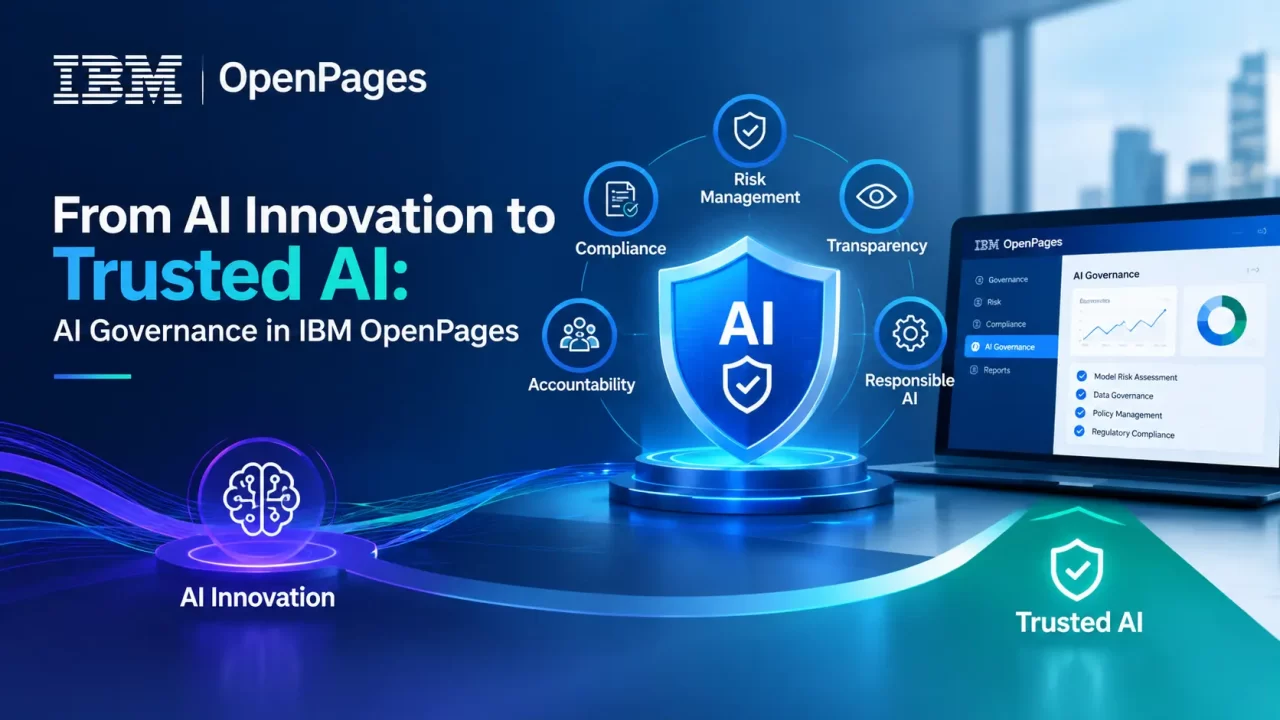
IBM OpenPages can help organizations address this challenge by providing a centralized governance framework in which AI risks, controls, assessments, issues, policies, and approvals can be managed alongside the broader enterprise risk landscape.
What Is AI Governance?
AI governance is the collection of policies, roles, processes, controls, and technologies used to direct and oversee AI systems. It establishes how an organization decides:
- Which AI use cases are acceptable
- Who owns and approves each AI system
- What risks must be assessed before deployment
- What evidence is required to demonstrate compliance
- How models are monitored after deployment
- What action must be taken when performance or risk exceeds an approved threshold
Effective AI governance does not exist to slow innovation. Its purpose is to create clear guardrails so that teams can develop and deploy AI with confidence.
Why Organizations Need a Centralized Approach
AI systems often involve many teams: business owners, data scientists, IT, cybersecurity, privacy, legal, compliance, model-risk specialists, and internal audit. When every team maintains separate spreadsheets, documents, and approval records, leadership lacks a complete view of AI exposure.
This fragmented approach can lead to several problems:
- AI use cases may be deployed without the required review.
- Ownership and accountability may be unclear.
- Similar assessments may be repeated by different teams.
- Evidence may be difficult to retrieve during an audit or regulatory examination.
- High-risk issues may not be escalated consistently.
- Policies and controls may not keep pace with changes to models, data, or regulations.
A governance platform such as IBM OpenPages helps replace disconnected activities with a common operating model and an auditable system of record.
How IBM OpenPages Supports AI Governance
1. Establishing a Central AI Inventory
The foundation of AI governance is knowing where AI is being used. OpenPages can maintain a structured inventory of AI use cases, models, applications, datasets, vendors, and accountable owners.
For each AI system, the organization can capture information such as:
- Business purpose and expected outcome
- Model type and technology
- Data sources and data sensitivity
- Business and technical owners
- Deployment status and geography
- Customer or employee impact
- Third-party dependencies
- Applicable policies, regulations, and risk classifications
This inventory gives management a consolidated view of the organization’s AI footprint and helps identify systems that require enhanced oversight.
2. Applying Risk-Based Classification
Not every AI use case carries the same level of risk. A low-impact internal productivity tool should not necessarily undergo the same review as an AI system used for credit decisions, hiring, healthcare, or fraud detection.
OpenPages workflows and assessments can be configured to classify AI systems based on factors such as decision impact, autonomy, data sensitivity, explainability, regulatory exposure, and potential harm. The resulting classification can determine the depth of review, testing, approval, and monitoring required.
This risk-based approach helps governance teams focus their attention where it matters most.
3. Standardizing Assessments and Approvals
OpenPages can provide structured assessments covering key AI risk domains, including:
- Fairness and bias
- Transparency and explainability
- Data quality and lineage
- Privacy and consent
- Cybersecurity and resilience
- Model performance and robustness
- Human oversight
- Legal and regulatory compliance
- Third-party and concentration risk
Workflow-driven reviews can route an AI system to the appropriate stakeholders, collect evidence, record decisions, and prevent progression until mandatory requirements are completed. This creates a repeatable approval process rather than relying on informal emails and meetings.
4. Connecting Risks, Controls, Policies, and Regulations
One of the strongest advantages of managing AI governance in an enterprise GRC platform is the ability to connect AI-specific information with existing governance structures.
An AI risk can be linked to the relevant policy, control, regulatory obligation, business entity, issue, action plan, or audit finding. If a policy changes or a control fails, the organization can identify the affected AI systems and prioritize remediation.
This connected view helps prevent AI governance from becoming an isolated program and makes it part of the organization’s wider risk-management framework.
5. Managing Issues and Remediation
Assessments and monitoring activities may identify control gaps, unacceptable bias, declining accuracy, missing documentation, or overdue validation. OpenPages can record these findings as formal issues, assign accountable owners, establish target dates, and track corrective actions through closure.
Automated notifications and escalation rules can draw attention to overdue or high-severity items. Management can then see not only which AI systems carry the greatest inherent risk, but also where remediation is delayed or residual risk remains above tolerance.
6. Enabling Continuous Monitoring and Reporting
AI governance must continue after a model is approved. Changes in data, customer behavior, operating conditions, or model performance can alter the risk profile of an AI system.
OpenPages can support ongoing governance by recording monitoring results, triggering periodic reviews, tracking key risk indicators, and initiating reassessment when defined thresholds are breached. Dashboards can provide leadership with information such as:
- AI systems by risk tier and lifecycle stage
- Assessments awaiting review or approval
- High-risk systems with control gaps
- Overdue validations and remediation actions
- Policy and regulatory coverage
- Trends in incidents, exceptions, and residual risk
This converts AI oversight from a one-time compliance exercise into a continuous risk-management process.
A Practical AI Governance Workflow
A typical implementation can follow these stages:
- Register: The business owner submits a proposed AI use case.
- Screen: An initial questionnaire determines whether the use case qualifies as AI and identifies applicable review areas.
- Classify: The system assigns a risk tier based on impact and exposure.
- Assess: Relevant teams complete risk, privacy, security, compliance, and model assessments.
- Review controls: Reviewers verify that required controls and supporting evidence are in place.
- Approve: Authorized stakeholders approve, reject, or conditionally approve the use case.
- Monitor: Performance, risk indicators, incidents, and material changes are tracked after deployment.
- Remediate or retire: Issues are resolved through action plans, or the AI system is formally decommissioned when it is no longer acceptable or required.
OpenPages can automate routing, notifications, stage transitions, reassessments, and escalations across this lifecycle, while retaining a traceable history of actions and decisions.
Example: Governing an AI-Based Customer-Risk Model
Consider a financial institution planning to use AI to assess customer risk. The use case is registered in OpenPages and linked to its business owner, model, application, data sources, and relevant policies.
Because the model influences customer decisions and processes sensitive data, it receives a high-risk classification. The classification automatically triggers model validation, fairness, privacy, security, and explainability assessments. Reviewers upload or reference supporting evidence and document their conclusions.
If testing identifies unacceptable performance differences between customer groups, an issue and remediation plan are created. Approval remains conditional until the weakness is addressed. After deployment, monitoring results are recorded and a threshold breach can trigger reassessment and escalation.
The organization now has a complete governance trail—from initial proposal and risk classification to approval, monitoring, and remediation.
Implementation Considerations
Technology alone cannot create effective AI governance. Organizations should first define clear ownership, decision rights, risk appetite, minimum control requirements, and escalation criteria.
A practical implementation should:
- Begin with a focused set of high-value AI use cases.
- Reuse existing risk, control, issue, and policy structures where appropriate.
- Configure requirements according to risk rather than applying one process to every system.
- Integrate governance activities into development and deployment processes.
- Keep questionnaires concise and assign them to the people best able to answer.
- Define measurable indicators and clear thresholds for escalation.
- Review the governance framework as technology and regulatory expectations evolve.
Conclusion
AI creates significant opportunities, but sustainable adoption depends on trust. Organizations must be able to explain where AI is used, who is accountable, which risks were evaluated, which controls are operating, and how emerging problems are addressed.
IBM OpenPages can provide the governance backbone for this objective by centralizing AI inventories, assessments, approvals, controls, issues, and monitoring within an integrated GRC environment. When supported by clear policies and accountable leadership, this approach allows organizations to move beyond isolated compliance checks and build responsible AI governance into everyday decision-making.