

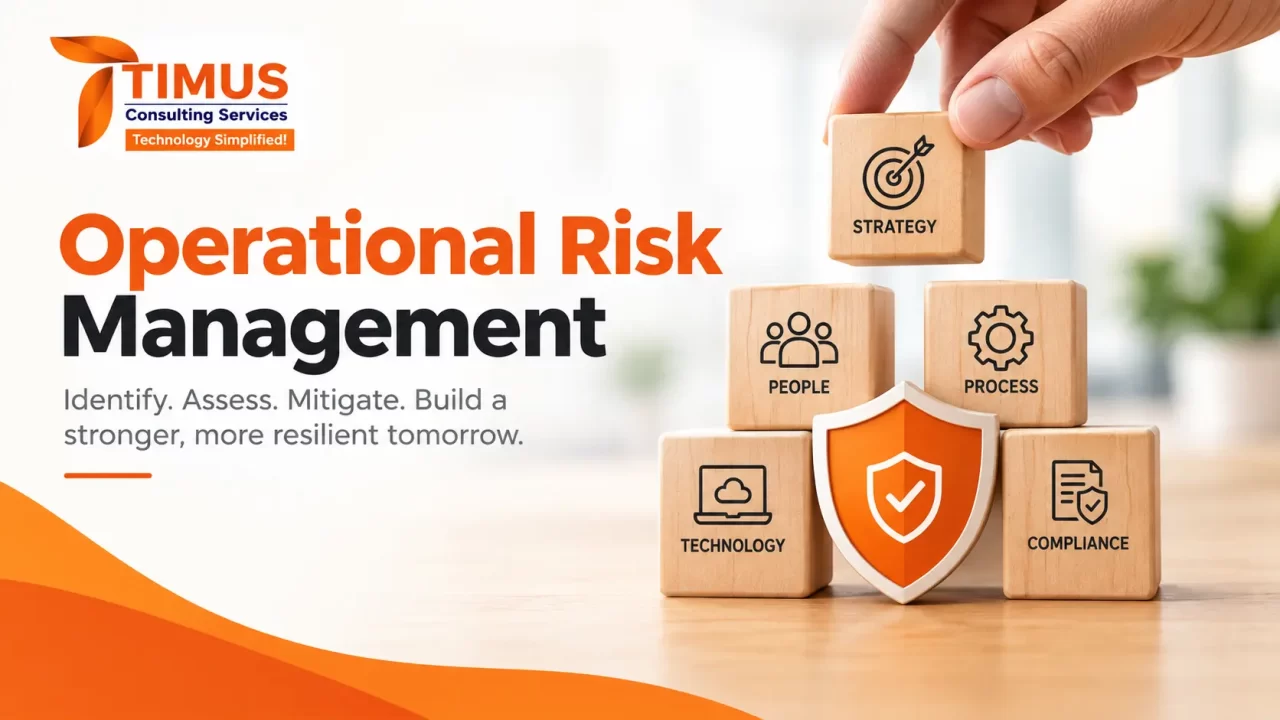
Operational Risk Management: Turning Everyday Vulnerabilities into Business Resilience
Why organizations must look beyond policies and procedures to build operations that can withstand disruption, adapt to change, and keep their promises.
Most organizations do not fail because they lack policies. They fail when the processes behind those policies are not prepared for reality.
A payment is sent to the wrong account. A critical employee is unavailable. A software update disrupts a core service. A supplier misses a delivery, and no backup is ready. Individually, these events may appear manageable. But when several weaknesses connect, a routine problem can quickly become a business crisis.
This is the real challenge of Operational Risk Management (ORM): understanding how an organization works, identifying where it can fail, and building the capabilities to prevent, absorb, and recover from disruption.
Operational risk management is no longer simply a control or compliance function. In an interconnected business environment, it is a fundamental part of sustainable growth, customer trust, and long-term resilience.
What Is Operational Risk Management?
Operational Risk Management (ORM) is the continuous process of identifying, assessing, monitoring, and controlling risks arising from an organization’s people, processes, systems, and external events.
In financial services, operational risk is commonly defined as the risk of loss resulting from inadequate or failed internal processes, people, and systems, or from external events. However, operational risk can affect organizations far beyond financial losses.
An operational failure may lead to:
- Business interruption
- Customer dissatisfaction
- Regulatory penalties
- Data loss or exposure
- Reputational damage
- Employee safety concerns
- Increased operating costs
- Lost revenue and business opportunities
A simple example
Consider an online retailer experiencing a system outage during a major sale.
The immediate issue may appear to be technical, but the consequences can spread across the business:
- Customers cannot complete purchases.
- Customer-service teams lack accurate information.
- Warehouse teams receive incomplete or delayed orders.
- Finance teams face payment-reconciliation challenges.
- Management struggles to estimate the scale of the disruption.
The lesson is simple: operational risk rarely stays confined to the place where it begins.
Why Operational Risk Deserves Strategic Attention
Operational risk is different from many other risk categories because it is embedded in everyday activities. Every transaction, approval, delivery, system change, and customer interaction carries some level of operational exposure.
| Risk Category | Core Question |
|---|---|
| Strategic Risk | Are we making the right long-term decisions? |
| Financial Risk | Could financial or market conditions cause losses? |
| Compliance Risk | Are we meeting legal and regulatory requirements? |
| Cybersecurity Risk | Could our digital assets or systems be compromised? |
| Operational Risk | Could our people, processes, systems, or dependencies fail? |
These categories frequently overlap. For example, a cyberattack may become an operational risk when it prevents employees from accessing essential systems or interrupts customer services.
The distinguishing feature of operational risk is its pervasiveness. It exists wherever work is performed, information is exchanged, decisions are made, or services are delivered.
The Four Core Sources of Operational Risk
A practical ORM framework begins by examining four interconnected sources.
1. People: The Human Element
Employees, contractors, and leadership influence operational risk through their decisions, skills, communication, and behavior.
Potential risks include:
- Inadequate training
- Human error
- Poor communication
- Staff shortages
- Conflicts of interest
- Overdependence on key employees
- Fatigue or excessive workload
However, people are not merely a source of risk. They are also a critical line of defense. An employee who recognizes an unusual transaction, questions an unclear instruction, or reports a control weakness may prevent a serious incident.
A strong risk culture encourages people to identify problems early rather than conceal them.
2. Processes: The Way Work Gets Done
Processes become risky when they are unclear, overly manual, poorly documented, or designed around assumptions that no longer hold true.
Common weaknesses include:
- Incomplete approval workflows
- Unclear ownership
- Duplicate data entry
- Missing quality checks
- Inconsistent escalation procedures
- Outdated operating instructions
A process that depends on one experienced employee “knowing how things work” may appear efficient, but it can become fragile when that person is absent.
Well-designed processes reduce dependence on memory, improvisation, and individual workarounds.
3. Systems and Technology: Efficiency With Exposure
Technology improves speed and accuracy, but it also introduces new dependencies and failure points.
Operational technology risks may arise from:
- System outages
- Software defects
- Incorrect configurations
- Integration failures
- Inadequate backups
- Weak access controls
- Unsupported or outdated infrastructure
Automation can reduce repetitive human errors, but it can also amplify mistakes when incorrect rules or data are applied at scale.
Automation does not eliminate operational risk. It changes the way risk is created, detected, and managed.
4. External Events: Risks Beyond Direct Control
Organizations are also exposed to events outside their immediate control, including:
- Natural disasters
- Power and telecommunications failures
- Supplier disruptions
- Third-party service outages
- Pandemics
- Geopolitical instability
- Regulatory changes
No organization can predict every external event. The objective is to identify critical dependencies, understand potential consequences, and prepare credible response and recovery arrangements.
The Operational Risk Management Lifecycle
Effective ORM is not a one-time exercise. It is a continuous cycle of understanding risks, improving controls, and adapting to change.


Step 1: Identify Risks Before They Become Incidents
Risk identification begins with understanding the organization’s critical activities and dependencies.
Useful questions include:
- Which processes are essential to business operations?
- Where do delays, errors, or exceptions occur most frequently?
- Which activities depend on one person, one system, or one supplier?
- What weaknesses have previous incidents revealed?
- What could go wrong even if it has never happened before?
Organizations can use process mapping, interviews, risk workshops, incident reviews, control assessments, and scenario analysis to identify potential exposures.
Step 2: Assess and Prioritize Exposure
Not every risk requires the same level of investment. Risk assessment helps organizations focus attention where it matters most.
A basic model is:
Risk Exposure = Likelihood × Impact
Although simplified, this approach provides a useful starting point.
| Risk Scenario | Likelihood | Impact | Suggested Priority |
|---|---|---|---|
| Manual invoice-entry error | High | Moderate | High |
| Critical supplier outage | Medium | High | High |
| Minor office equipment failure | Medium | Low | Low |
| Unauthorized access to sensitive data | Low to Medium | Very High | Critical |
A mature assessment may also consider:
- Velocity: How quickly could the risk cause harm?
- Detectability: How likely is the organization to identify it early?
- Control effectiveness: How well do existing controls reduce exposure?
- Interdependency: Could the risk trigger failures elsewhere?
Step 3: Design Controls That Address the Real Risk
Controls are measures designed to prevent, detect, or respond to operational failures.
Examples include:
- Segregation of duties
- Approval thresholds
- Access reviews
- Automated validation
- Reconciliation procedures
- Backup systems
- Incident-response plans
- Employee training
- Vendor oversight
The most effective control is not necessarily the most complex. It is the one that addresses the underlying risk while remaining practical enough to operate consistently.
Step 4: Monitor and Report Meaningfully
Risk conditions change as organizations introduce new products, systems, employees, suppliers, and operating models.
Monitoring may include:
- Key Risk Indicators (KRIs)
- Incident frequency and severity
- Control failures
- Near-miss trends
- Audit findings
- Operational loss events
- Vendor performance
- Recovery-time performance
Risk reporting should not merely describe what has happened. It should help leaders understand what may happen next and what action is required.
Step 5: Respond, Learn, and Improve
When an incident occurs, organizations should look beyond the immediate cause.
A useful post-incident review asks:
- What happened?
- What was the immediate cause?
- What underlying conditions contributed?
- Which controls failed, were bypassed, or were missing?
- What changes are necessary?
- How will the organization verify that those changes work?
The goal is not simply to close an incident. It is to reduce the likelihood of recurrence.
Why Near-Miss Reporting Matters
A near miss is an event that could have caused harm but did not. It is one of the most valuable—and frequently overlooked—sources of operational intelligence.
Imagine a payment that was nearly sent to the wrong account but was intercepted during a final review. No financial loss occurred, yet the event may reveal a weakness in the payment process.
If the organization dismisses it because “nothing happened,” the same weakness may eventually result in a serious incident.
An effective near-miss culture:
- Encourages timely reporting
- Avoids unnecessary blame for honest mistakes
- Distinguishes error from misconduct
- Investigates systemic causes
- Identifies recurring patterns
- Shares lessons across teams
- Tracks corrective actions
A low number of reported incidents does not always mean low risk. It may also indicate that weaknesses are going unreported.
Operational Risk in the Age of AI and Automation
Artificial intelligence and automation are reshaping business operations. They can improve productivity, support decision-making, and reduce repetitive work. At the same time, they introduce new operational questions.
Potential risks include:
- Incorrect automated decisions
- Inaccurate AI-generated information
- Poor-quality input data
- Unclear accountability
- Overreliance on automated outputs
- Model or system failures
- Insufficient human oversight
- Dependence on external technology providers
This leads to an important principle:
The more an organization relies on automation, the more important it becomes to understand how it will respond when that automation produces an unexpected result.
A responsible approach to AI-related operational risk should include:
- Clear ownership of AI-enabled processes
- Defined approval and escalation thresholds
- Human oversight for high-impact decisions
- Testing and validation
- Monitoring for unexpected outcomes
- Documented fallback procedures
- Periodic review of third-party providers
The purpose is not to slow innovation. It is to make innovation dependable.
From Operational Risk Management to Operational Resilience
Traditional risk management often focuses on prevention:
“How can we stop this from happening?”
Operational resilience adds another question:
“If this happens anyway, can we continue delivering our most important services?”
This distinction matters because not every disruption can be prevented.
Operational resilience focuses on:
- Identifying critical business services
- Understanding process and technology dependencies
- Establishing recovery priorities
- Testing disruption scenarios
- Maintaining communication plans
- Defining acceptable levels of disruption
- Strengthening recovery capabilities
For example, a financial institution may not be able to prevent every technology outage. However, it can prepare to ensure that essential customer services remain available or are restored within an acceptable timeframe.
Resilience is not the promise of uninterrupted operations. It is the ability to respond, adapt, and recover while protecting what matters most.
Common Operational Risk Management Mistakes
Even organizations with formal risk frameworks can struggle to turn them into effective practice.
1. Treating ORM as a Compliance Exercise
When risk management becomes a checklist, teams may prioritize completing documentation over reducing actual exposure.
Better approach: Connect risk assessments and controls to real business decisions and outcomes.
2. Maintaining Risk Registers That Nobody Uses
A long risk register is not automatically a strong risk-management program.
Better approach: Keep risks prioritized, assign clear owners, define actions, and review progress regularly.
3. Looking Only at Historical Incidents
Past incidents provide valuable lessons, but they cannot reveal every future vulnerability.
Better approach: Combine historical data with scenario analysis, emerging-risk monitoring, and forward-looking assessments.
4. Relying on Policies Without Testing Execution
A policy explains what should happen. It does not prove that employees can execute it effectively under pressure.
Better approach: Test controls, observe workflows, and conduct realistic exercises.
5. Ignoring Third-Party Dependencies
Outsourcing a process does not eliminate the organization’s exposure to its failure.
Better approach: Assess vendors according to their criticality, monitor their performance, and maintain contingency arrangements.
Building a Strong Operational Risk Culture
Operational risk management becomes effective when it is integrated into everyday decision-making rather than treated as the responsibility of a single department.
Organizations can strengthen their risk culture by:
- Assigning clear ownership
Every significant operational risk should have an accountable owner. - Encouraging early escalation
Employees should feel comfortable raising concerns before they become incidents. - Using data intelligently
KRIs, incident trends, audit findings, and process metrics should support informed decisions. - Testing realistic scenarios
Tabletop exercises and simulations can reveal weaknesses that documents fail to expose. - Reviewing change-related risks
New technologies, products, suppliers, and processes should be assessed before implementation. - Measuring control effectiveness
A control should be evaluated by how well it reduces risk, not merely by whether it exists. - Sharing lessons across departments
Operational insights should not remain isolated within the team where an incident occurred.
A Practical Example: Operational Risk in a Growing E-Commerce Business
Consider an e-commerce company expanding rapidly across several cities. Growth creates new opportunities, but it also increases operational complexity.
Potential risks may include:
- Delivery-partner disruptions
- Inventory inaccuracies
- Payment-processing failures
- Customer-data exposure
- Warehouse errors
- Product-return bottlenecks
- Dependence on a single technology provider
A practical ORM approach would look like this:
Identify: Map the order-to-delivery process and its dependencies.
Assess: Determine which failures could create the greatest customer, financial, or reputational impact.
Control: Introduce inventory reconciliation, payment monitoring, vendor contingency plans, and appropriate access controls.
Monitor: Track failed payments, delayed orders, stock mismatches, and service outages.
Respond: Establish escalation procedures and recovery priorities.
Learn: Analyze recurring issues and redesign weak processes.
The result is more than fewer incidents. It is a business that can scale with greater confidence and fewer avoidable disruptions.
The Future of Operational Risk Management
Operational risk management is evolving from a reactive control function into an integrated discipline that brings together:
- Risk intelligence
- Data analytics
- Cybersecurity
- Third-party risk management
- Business continuity
- Operational resilience
- AI governance
- Process automation
- Organizational culture
Future-ready organizations will increasingly use real-time indicators, scenario testing, and connected risk data to understand how disruptions may spread across the enterprise.
Yet technology alone will not solve operational risk.
The organizations that perform best will combine strong systems, clear accountability, practical controls, informed leadership, and a culture of continuous learning.
Final Thoughts
Operational risk is often invisible when everything works—and impossible to ignore when something fails.
That is why operational risk management should not be viewed merely as a compliance requirement or an administrative function. It is a foundation for sustainable growth, reliable service delivery, and organizational resilience.
The objective is not to eliminate every possible risk. That is neither realistic nor necessary.
The objective is to build an organization that can:
Anticipate what might go wrong.
Act before small weaknesses become major failures.
Respond decisively when disruptions occur.
Learn continuously and become stronger over time.
Ultimately, operational risk management is not just about protecting operations.
It is about protecting the organization’s ability to deliver on its promises.