

Machine learning has become one of the most transformative technologies of our time, powering everything from email spam filters to medical diagnosis tools. Among the various approaches to machine learning, supervised learning stands out as the most widely used and well-understood paradigm. In this post, we’ll break down what supervised learning is, how it works, and where it’s applied in the real world.
What is Supervised Learning?
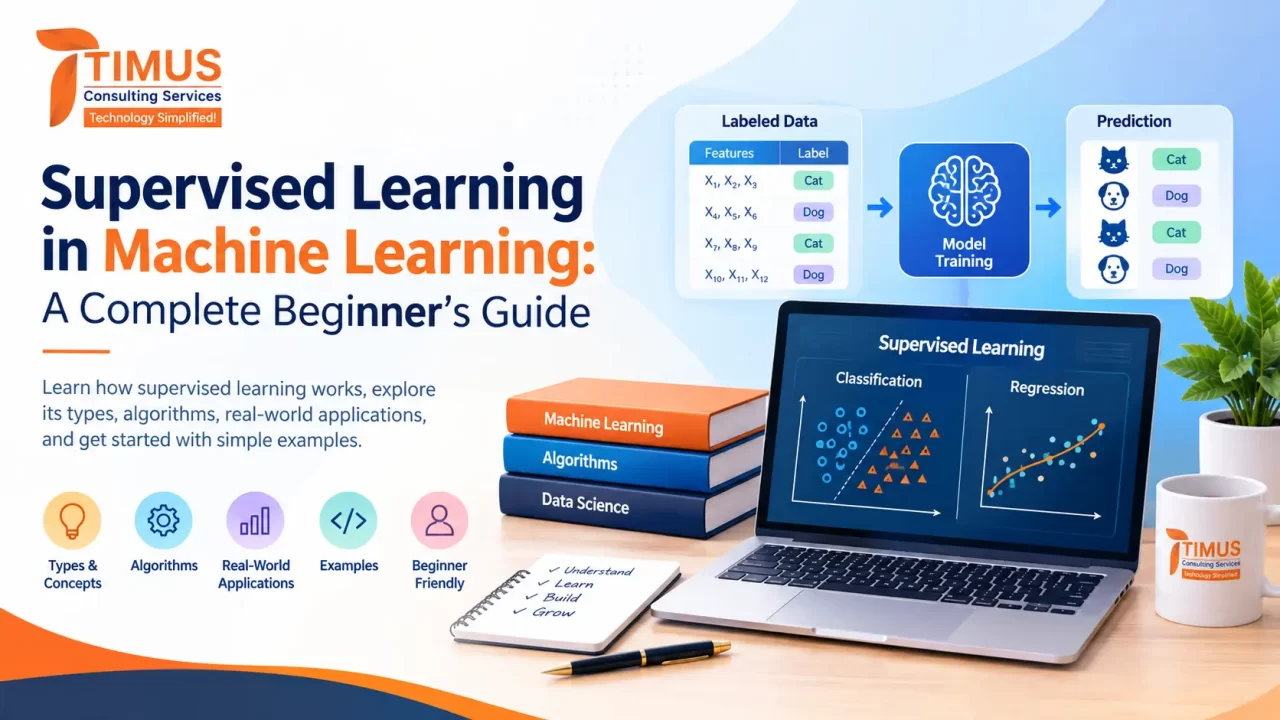
Supervised learning is a type of machine learning where a model learns to make predictions by studying a dataset that already contains the “correct answers.” Think of it like a student learning with a teacher who provides both practice questions and their solutions. The algorithm looks at many examples of inputs paired with their known outputs, and over time, it learns the underlying pattern that connects them.
Once trained, the model can then take new, unseen inputs and predict the corresponding output based on what it learned.
A Simple Analogy
Imagine teaching a child to identify fruits. You show them a picture of an apple and say “this is an apple.” You do this repeatedly with different fruits — bananas, oranges, grapes — each time labeling the fruit correctly. Eventually, the child can look at a new piece of fruit they’ve never seen before and correctly identify it. This is essentially how supervised learning works: learning from labeled examples to generalize to new situations.
How Does Supervised Learning Work?
The supervised learning process typically follows these steps:
- Data Collection – Gather a dataset of input-output pairs (also called features and labels).
- Data Splitting – Divide the data into training and testing sets, so the model can be evaluated on data it hasn’t seen before.
- Model Training – Feed the training data into an algorithm, which adjusts its internal parameters to minimize the difference between its predictions and the actual labels.
- Model Evaluation – Test the trained model on the testing set to measure how well it generalizes to new data.
- Model Tuning – Adjust settings (hyperparameters) and repeat the process to improve accuracy.
- Deployment – Use the finalized model to make predictions on real-world data.
Types of Supervised Learning Problems
Supervised learning problems generally fall into two categories:
1. Classification
In classification tasks, the model predicts a discrete category or class label. Examples include:
- Determining whether an email is “spam” or “not spam”
- Diagnosing whether a tumor is “benign” or “malignant”
- Recognizing handwritten digits (0–9)
2. Regression
In regression tasks, the model predicts a continuous numerical value. Examples include:
- Predicting house prices based on size, location, and features
- Forecasting stock prices
- Estimating a person’s age from a photograph
Common Supervised Learning Algorithms
Several algorithms are commonly used to build supervised learning models, including:
- Linear Regression – Used for predicting continuous values by fitting a straight line to the data.
- Logistic Regression – Despite its name, used for classification tasks like binary outcomes.
- Decision Trees – Models that split data into branches based on feature values to make predictions.
- Random Forests – An ensemble of decision trees that improves accuracy and reduces overfitting.
- Support Vector Machines (SVM) – Effective for classification tasks, especially with clear margins of separation.
- k-Nearest Neighbors (k-NN) – Classifies data points based on the labels of their closest neighbors.
- Neural Networks – Layered models capable of learning complex, non-linear patterns, forming the foundation of deep learning.
Real-World Applications
Supervised learning powers many technologies we use every day:
- Email filtering – Classifying messages as spam or legitimate
- Fraud detection – Identifying suspicious financial transactions
- Medical diagnosis – Predicting diseases from patient data and scans
- Credit scoring – Assessing loan applicants’ creditworthiness
- Recommendation systems – Suggesting products, movies, or content based on user behavior
- Speech recognition – Converting spoken language into text
Advantages and Challenges
Advantages:
- High accuracy when trained on quality, well-labeled data
- Clear performance metrics for evaluation
- Wide range of algorithms suited to different problem types
Challenges:
- Requires large amounts of labeled data, which can be expensive and time-consuming to collect
- Risk of overfitting, where the model performs well on training data but poorly on new data
- Limited ability to handle situations not represented in the training data
Conclusion
Supervised learning remains a cornerstone of modern machine learning, enabling systems to make accurate predictions by learning from labeled historical data. Whether it’s classifying images, predicting prices, or detecting fraud, supervised learning techniques continue to drive innovation across industries. As you explore machine learning further, understanding supervised learning provides a strong foundation for tackling more advanced concepts like unsupervised learning, reinforcement learning, and deep learning.
Frequently Asked Questions (FAQs)
1. What is supervised learning in machine learning?
Supervised learning is a machine learning approach where a model learns from labeled data to make predictions or decisions based on new, unseen data.
2. How does supervised learning work?
Supervised learning works by training a machine learning model using input data and corresponding output labels. The model learns patterns and uses them to predict outcomes for new data.
3. What are the two main types of supervised learning?
The two main types are:
- Classification: Predicts categories or labels, such as spam or not spam.
- Regression: Predicts numerical values, such as house prices or sales revenue.
4. What are some common supervised learning algorithms?
Common algorithms include:
- Linear Regression
- Logistic Regression
- Decision Trees
- Random Forest
- Support Vector Machines (SVM)
- K-Nearest Neighbors (KNN)
- Neural Networks
5. What is the difference between supervised and unsupervised learning?
Supervised learning uses labeled data to train a model, while unsupervised learning identifies patterns or structures in unlabeled data.