

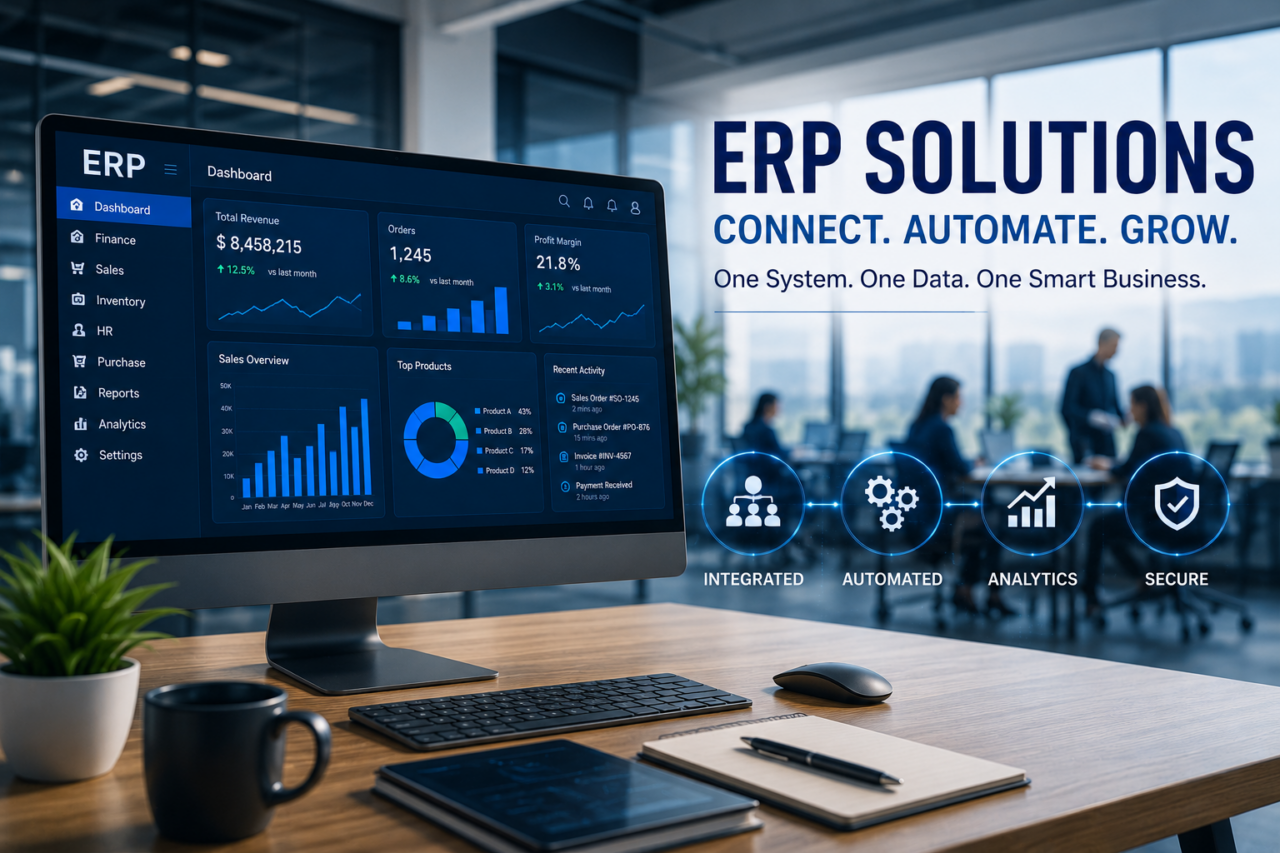
Modern businesses handle a huge amount of information every day. Sales teams manage customers and orders, finance teams track payments and expenses, HR manages employees, while procurement and inventory teams keep operations moving. When every department works with separate software, spreadsheets, or manual records, even simple tasks can become complicated.
This is where ERP solutions can make a real difference. Enterprise Resource Planning (ERP) brings important business processes together on a centralized platform. Instead of information remaining isolated within different departments, teams can work with connected and up-to-date data.
For growing businesses, ERP is not simply about replacing spreadsheets. It is about creating a more organized way to manage operations, automate repetitive activities, and understand what is happening across the company.
What Is an ERP Solution?
ERP stands for Enterprise Resource Planning. It is a software system that helps organizations manage multiple business functions from one integrated environment.
An ERP platform can include finance and accounting, sales, customer relationship management, procurement, inventory, human resources, manufacturing, supply chain management, project management, and reporting.
Imagine a company receiving a large customer order. The sales team needs to confirm availability, the warehouse needs the order details, finance needs to track the transaction, and procurement may need to purchase additional material. Without ERP, employees may have to coordinate these activities through emails, spreadsheets, calls, and separate applications. An ERP system connects these processes so information can move more smoothly between teams.
Why Businesses Need ERP Solutions
Small businesses can often operate successfully with spreadsheets and standalone applications. The challenge begins when the organization grows. More customers, employees, transactions, products, and locations create more information to manage.
Different departments may start maintaining their own versions of the same data. Employees spend time entering information into multiple systems, reports take longer to prepare, and managers may struggle to get a reliable view of overall performance.
ERP solutions provide a common source of business information. This helps reduce duplicate work and allows departments to collaborate using consistent and up-to-date data.
Key Benefits of ERP Solutions
The value of ERP comes from bringing processes, people, and information together. Although the exact benefits depend on how the system is implemented, businesses commonly use ERP to improve several important areas.
- Improved efficiency: Repetitive and rule-based activities can be automated.
- Better visibility: Management can view important business information from a centralized platform.
- Stronger collaboration: Departments can work with shared information instead of isolated records.
- Greater accuracy: Reducing duplicate manual data entry can lower the risk of errors.
- Better decision-making: Current reports and dashboards give managers useful information when making business decisions.
These improvements become increasingly valuable as an organization expands and its operations become more complex.
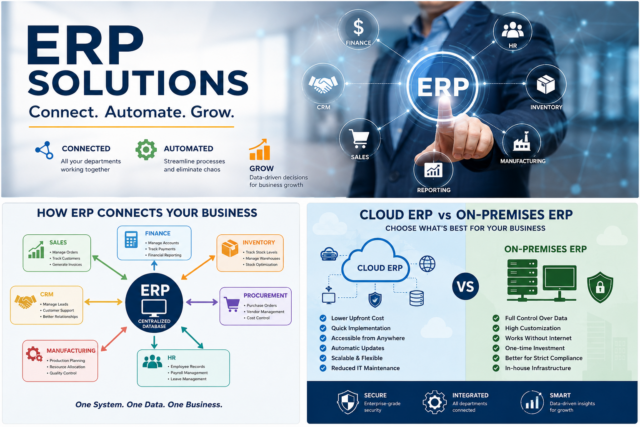
How ERP Connects Different Business Departments
One of the biggest strengths of ERP is integration. Business departments may perform different functions, but their activities are closely related.
A customer order affects inventory. Inventory levels may trigger procurement. Procurement creates financial obligations, while finance needs accurate information about payments and expenses. ERP creates a structured connection between these activities.
For example, if inventory reaches a predefined minimum level, the system can identify the requirement for additional stock. Procurement can begin the purchasing process, finance can track the related cost, and inventory records can be updated when the goods arrive.
Automating Routine Business Processes
Employees in almost every organization perform repetitive administrative work. This may include preparing invoices, updating records, transferring information between systems, processing approvals, or creating recurring reports.
ERP software can automate many of these activities. An invoice may be generated after a transaction is confirmed, an approval request can automatically reach the appropriate manager, and inventory quantities can update when products are received or sold.
Automation does not remove the need for employees. Instead, it reduces unnecessary manual work and gives people more time for activities that require judgment, communication, and problem-solving.
Financial Management with ERP
Finance is one of the most important areas of an ERP system. Organizations need reliable information about revenue, expenses, budgets, payments, taxes, assets, and cash flow.
When financial information is spread across several applications, reconciliation and reporting become more difficult. ERP can connect operational transactions with financial records. A purchase initiated by procurement can be reflected in financial reporting, while customer transactions can flow into accounts receivable and revenue records.
This gives finance teams greater visibility while reducing unnecessary duplicate data entry.
Inventory and Supply Chain Management
Inventory has a direct impact on both profitability and customer satisfaction. Holding too much stock increases storage costs and ties up working capital. Keeping too little stock can result in delayed orders and missed sales opportunities.
ERP solutions can help businesses track stock quantities, warehouses, suppliers, purchase orders, product movement, and customer demand. This makes it easier to understand which products are moving quickly and when additional inventory may be required.
Manufacturing organizations can also connect production planning, raw materials, purchasing, and finished goods, creating better visibility throughout the supply chain.
Human Resource Management
ERP platforms can also simplify HR operations. Depending on the system, HR modules may manage employee records, payroll, attendance, leave requests, recruitment, performance information, and workforce planning.
Employee self-service features can further reduce administrative work. For example, employees can submit leave requests through the system, managers can approve them through a defined workflow, and the records can be maintained automatically.
Cloud ERP vs. On-Premises ERP
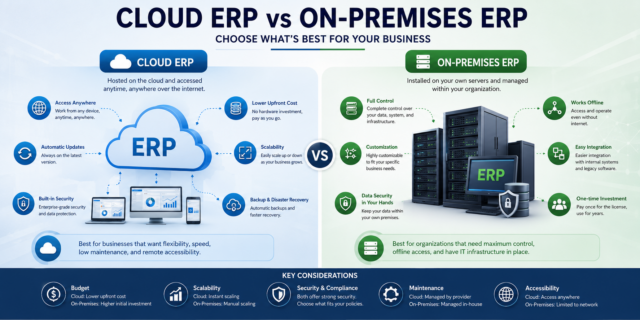
Businesses can choose different ERP deployment models depending on their operational and technical requirements.
Cloud ERP is hosted on cloud infrastructure and is generally accessed through the internet. It can offer easier scalability, remote accessibility, regular updates, and lower infrastructure management requirements.
On-premises ERP runs within infrastructure managed by the organization. Some businesses prefer this approach when they need greater control over their environment, integrations, data, or security configuration.
A hybrid ERP model combines elements of both approaches. The right choice depends on factors such as cost, business requirements, existing infrastructure, security expectations, and regulatory obligations.
ERP Security and Data Protection
ERP systems often contain highly important business information, including financial records, customer details, employee information, supplier data, and operational records. Security therefore needs to be considered throughout the ERP lifecycle.
Organizations should implement appropriate access controls, strong authentication, encryption, logging, monitoring, backups, patch management, and regular security reviews.
Role-based access is particularly important. Employees should only have access to the information and functions required for their responsibilities. Regular access reviews can also help organizations identify unnecessary or outdated permissions.
Choosing the Right ERP Solution
Choosing ERP software should start with understanding the business rather than comparing long lists of features.
Organizations should identify existing processes, operational problems, integration requirements, reporting expectations, security requirements, and future growth plans. The most expensive platform is not automatically the best choice.
Implementation is equally important. Poor data migration, unclear requirements, excessive customization, and insufficient employee training can create problems even when the ERP software itself is capable.
ERP implementation should therefore be treated as a business transformation project rather than simply another software installation.
The Future of ERP Solutions
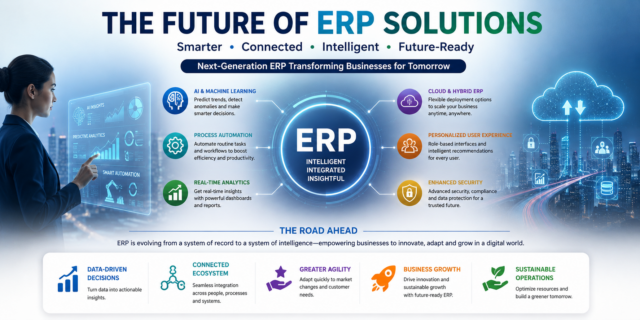
ERP technology continues to evolve as artificial intelligence, machine learning, predictive analytics, automation, and conversational interfaces become part of modern enterprise platforms.
Instead of only recording historical transactions, ERP systems are becoming capable of identifying patterns, forecasting demand, highlighting unusual activity, and helping employees find important information more quickly.
The objective remains straightforward: give organizations better visibility and help people manage business operations more effectively.
Frequently Asked Questions
What is an ERP solution?
An ERP solution is an integrated software platform that helps businesses manage important functions such as finance, sales, inventory, procurement, HR, and reporting from a centralized system.
What are the main benefits of ERP?
ERP can improve operational efficiency, reduce duplicate data entry, automate repetitive activities, improve collaboration between departments, and provide better visibility into business performance.
Is cloud ERP better than on-premises ERP?
Neither option is automatically better. Cloud ERP may provide easier scalability and infrastructure management, while on-premises ERP can provide greater control in certain environments. The right choice depends on the organization’s requirements.
Can ERP solutions support business growth?
Yes. A properly selected and implemented ERP platform can help growing businesses standardize processes, manage larger amounts of information, improve reporting, and support operations across additional teams or locations.
Conclusion
ERP solutions provide businesses with a practical way to connect people, processes, and information. By integrating areas such as finance, sales, procurement, inventory, human resources, and reporting, organizations can reduce fragmented information and improve coordination between departments.
The real value of ERP is not simply having everything in one application. It comes from creating more consistent processes, reducing unnecessary manual work, and giving decision-makers access to reliable information.
Successful ERP implementation still requires careful planning, reliable data, employee involvement, training, and strong security. When these elements are handled properly, ERP can provide a solid foundation for efficient operations and long-term business growth.