
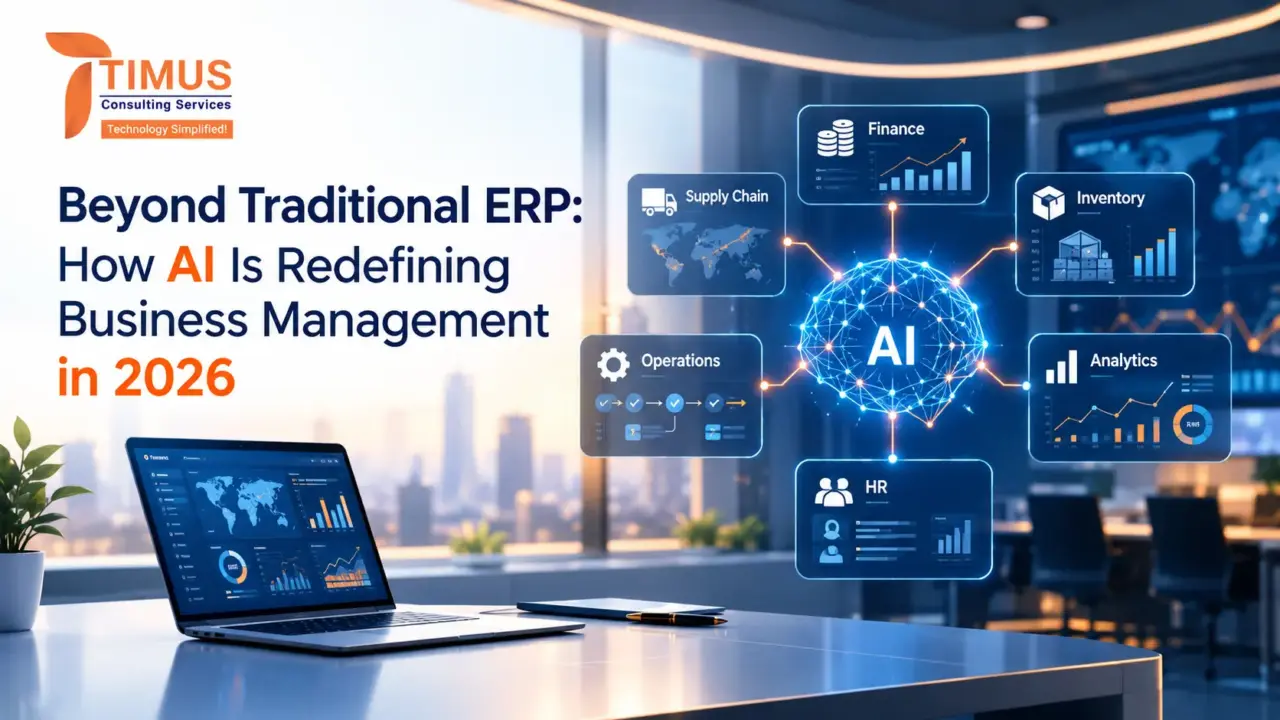
From manual processes to intelligent decisions — discover how AI-powered ERP is shaping the future of business.
Introduction: The Next Era of Business Is Intelligent
Imagine a business where financial reports are generated faster, inventory shortages are predicted before they happen, routine tasks run with minimal manual intervention, and decision-makers have access to meaningful insights when they need them.
This is no longer just a vision of the future. It is the direction in which modern enterprise technology is moving.
As businesses face increasing competition, rising operational costs, and growing customer expectations, traditional methods of managing operations are becoming harder to sustain. Spreadsheets, disconnected applications, and manual workflows can limit visibility and slow down decision-making.
This is where AI-powered Enterprise Resource Planning (ERP) comes in.
By combining integrated business management with artificial intelligence, automation, and data analytics, modern ERP systems are helping organizations rethink how they operate, collaborate, and grow.
What Happens When ERP Meets Artificial Intelligence?
Traditional ERP systems bring core business functions together on a single platform. AI adds another layer of intelligence by helping organizations analyse data, identify patterns, automate selected activities, and generate actionable insights.
Think of ERP as the foundation that connects your business — and AI as a capability that can help you make better use of the information flowing through it.
Together, they can help organizations move beyond simply recording what has happened towards understanding what may happen next.
5 Ways AI-Powered ERP Is Transforming Businesses
- Smarter Decisions, Backed by Data
Business decisions are only as useful as the information behind them.
AI-enabled analytics can help decision-makers identify trends, understand performance gaps, and explore forecasts using operational and financial data. Instead of relying entirely on historical reports, businesses can gain additional insights to support forward-looking decisions.
The business impact: Better visibility, informed planning, and more confident decision-making.
- Automation That Gives Your Team Time Back
How much time does your team spend on repetitive data entry, invoice processing, approvals, and routine reporting?
ERP workflow automation can reduce manual effort, while AI can assist with tasks such as extracting information from documents, classifying transactions, and identifying exceptions for review.
The goal is not simply to work faster. It is to allow employees to spend more time on activities that require human judgment, collaboration, and expertise.
The business impact: Less repetitive work, more efficient workflows, and improved productivity.
- Financial Management With Greater Visibility
Financial management involves more than tracking income and expenses. Businesses also need to monitor cash flow, manage budgets, identify unusual transactions, and plan for future obligations.
AI-assisted analysis and forecasting can help finance teams recognize patterns, investigate potential discrepancies, and assess possible financial scenarios. When connected to reliable ERP data, these capabilities can support a more proactive approach to financial management.
The business impact: Improved financial visibility and stronger planning capabilities.
- Smarter Inventory and Supply Chain Planning
Excess inventory ties up working capital. Insufficient stock can delay orders and affect customer satisfaction.
By analysing historical sales, stock movements, and other relevant business data, forecasting tools can help organizations estimate demand and identify potential inventory issues.
When integrated with purchasing, sales, and warehouse operations, these insights can support better coordination across the supply chain.
The business impact: More informed purchasing decisions, improved stock visibility, and better resource utilization.
- One Connected Business, Not Multiple Disconnected Systems
When finance, HR, payroll, procurement, inventory, and sales operate independently, information can become fragmented. Teams may spend valuable time reconciling records and searching for updates.
An integrated ERP platform creates a more connected environment in which departments can work with consistent information and coordinated processes.
AI capabilities can build on this foundation by helping users retrieve information, interpret data, and streamline selected workflows.
The business impact: Better collaboration, reduced duplication, and a clearer view of overall business performance.
Is Your Business Ready for AI-Powered ERP?
Adopting new technology does not automatically guarantee better results. Successful digital transformation begins with understanding the business problem you want to solve.
Before investing in an ERP solution, consider these questions:
- Are your teams relying heavily on spreadsheets and manual processes?
- Is business information scattered across multiple applications?
- Do you struggle to access accurate, timely reports?
- Are inventory, finance, HR, and sales processes disconnected?
- Is your business finding it difficult to scale existing operations?
If these challenges sound familiar, it may be time to evaluate how an integrated ERP solution could support your next stage of growth.
You do not need to automate everything at once. A practical approach is to establish a reliable ERP foundation, improve data quality, prioritize high-impact processes, and introduce AI capabilities where they deliver measurable value.
The Reality Check: AI Needs the Right Foundation
While AI offers significant opportunities, its effectiveness depends on the quality of the data, the suitability of the technology, and the way it is implemented.
Organizations should consider data security, access permissions, integration requirements, employee training, and human oversight when introducing AI into business-critical processes.
AI should support better decisions, not replace accountability. Financial approvals, sensitive employee information, and other high-impact activities require appropriate controls and review.
The winning strategy is not to adopt AI simply because it is trending. It is to use the right technology to solve the right business problems.
Looking Ahead: ERP Is Becoming More Than a Management System
The role of ERP is evolving. Businesses increasingly expect their systems to do more than store information and process transactions. They want connected operations, meaningful insights, flexible workflows, and technology that can adapt as their needs change.
As AI capabilities continue to develop, ERP systems are positioned to play an increasingly important role in business intelligence, process automation, and operational planning.
For growing organizations, the opportunity lies in building a digital foundation that supports today’s requirements while remaining ready for tomorrow’s possibilities.
Final Thoughts: Turn Business Complexity Into Clarity
Growth brings complexity — more customers, more transactions, more employees, and more information to manage.
The right ERP strategy can help bring these moving parts together. When combined thoughtfully with AI, automation, and analytics, it can help businesses improve visibility, streamline processes, and make more informed decisions.
The future of business management is not just about managing operations. It is about making those operations smarter.
Ready to Take the Next Step in Your Digital Transformation?
At Timus Consulting Services, we help businesses explore ERP solutions and digital transformation strategies aligned with their operational needs and long-term goals.
Whether you are upgrading an existing system, connecting disconnected processes, or exploring intelligent automation, the journey starts with understanding your business.
Let’s discuss how the right ERP strategy can help your business move forward.