
Introduction
Artificial Intelligence (AI) is evolving rapidly. From simple chatbots to generative AI tools, technology has already transformed how businesses operate. However, the next major advancement is Agentic AI, which takes AI beyond generating responses and enables it to independently plan, make decisions, and execute tasks to achieve specific goals.
Unlike traditional AI systems that respond to user instructions, Agentic AI can understand objectives, break them into smaller tasks, select appropriate tools, and take action with minimal human intervention.
What is Agentic AI?
It refers to intelligent AI systems that can operate autonomously to achieve predefined objectives.
An AI agent can:
- Understand user requirements and business objectives.
- Analyze information and identify the next steps.
- Create plans and execute multiple tasks.
- Interact with external applications, APIs, and databases.
- Evaluate results and adjust its approach when necessary.
- Escalate decisions to humans when approval or intervention is required.
For example, a traditional AI chatbot can explain how to prepare a business report. An AI system can collect the required data, analyze it, prepare the report, and share it with the appropriate stakeholders, subject to its permissions.
How Does It Work?
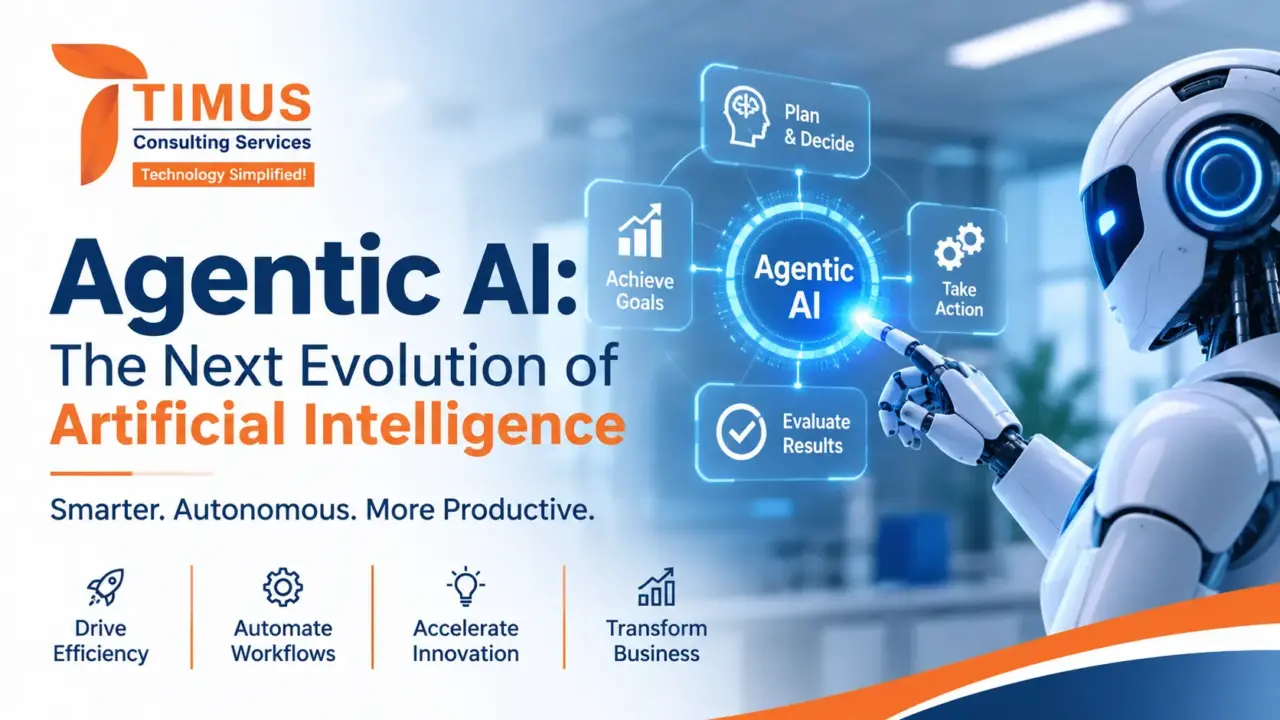
It generally works through a continuous cycle of understanding, planning, execution, and evaluation.
1. Goal Understanding
The AI agent receives a goal or instruction from the user and identifies the expected outcome.
2. Planning
It breaks the objective into smaller tasks and determines the sequence of actions required.
3. Tool Selection
The agent identifies the appropriate tools, applications, APIs, or databases needed to complete the tasks.
4. Execution
It performs the required actions, retrieves information, processes data, and interacts with connected systems.
5. Evaluation and Improvement
The agent reviews the results, identifies errors or incomplete tasks, and adjusts its approach until the objective is achieved or human intervention is needed.
Agentic AI vs Generative AI
Although both technologies use artificial intelligence, their capabilities and objectives differ.
| Generative AI | Agentic AI |
|---|---|
| Generates content and responses | Performs actions to achieve goals |
| Primarily responds to prompts | Can independently plan and execute tasks |
| Focuses on content generation | Focuses on task completion |
| Usually requires repeated user instructions | Can handle multi-step workflows |
| Example: Generating an email | Example: Drafting, reviewing, and sending an email with approval |
Generative AI can also serve as the reasoning engine within an Agentic AI system.
Real-World Applications of Agentic AI
1. Banking and Financial Services
AI agents can monitor transactions, identify unusual activities, analyze potential fraud, and generate investigation reports.
2. Healthcare
AI agents can assist with appointment scheduling, patient information management, administrative workflows, and clinical documentation, with appropriate human oversight.
3. IT Operations
AI agents can monitor IT infrastructure, identify system issues, analyze logs, create incident tickets, and recommend or execute approved resolutions.
4. Governance, Risk and Compliance (GRC)
It can support risk identification, vendor assessments, regulatory monitoring, control evaluation, and compliance reporting.
For example, an AI agent integrated with a Third-Party Risk Management platform could analyze vendor information, identify missing documents, highlight potential risks, and recommend follow-up actions.
5. Customer Support
It can understand customer requests, retrieve relevant information, troubleshoot common issues, update support tickets, and escalate complex cases.
Benefits
- Automation: Reduces repetitive manual activities.
- Efficiency: Executes multiple tasks through coordinated workflows.
- Productivity: Allows employees to focus on strategic activities.
- Decision Support: Analyzes large volumes of information and provides recommendations.
- Scalability: Supports business processes across multiple departments.
- Consistency: Helps standardize repetitive operational activities.
Challenges and Considerations
Despite its potential, It also introduces important challenges.
- Data Security: Agents must access only authorized information.
- Governance: Organizations need clear rules for agent behavior and decision-making.
- Accuracy: Incorrect information can lead to inappropriate actions.
- Human Oversight: Sensitive and high-impact decisions should involve human approval.
- Integration: Connecting AI agents with existing enterprise applications can be complex.
- Monitoring: Organizations need to track agent activities, decisions, and outcomes.
The Future of Agentic AI
It represents an important shift in how organizations use artificial intelligence. Instead of simply asking AI systems questions, businesses can increasingly delegate complete workflows to intelligent agents.
In the coming years, multiple AI agents may collaborate with one another, with each agent responsible for a specific business function. For example, one agent may collect information, another may analyze risks, and a third may prepare reports or initiate approved workflows.
However, successful adoption will depend not only on AI capabilities but also on governance, security, transparency, and responsible implementation.
Conclusion
Agentic AI is more than another advancement in artificial intelligence. It represents a move from AI that generates answers to AI that can take meaningful actions.
Organizations that adopt Agentic AI strategically can improve operational efficiency, automate complex processes, and make better-informed decisions.
The future of AI will not just be about what machines can tell us, but also about what they can accomplish on our behalf.
Frequently Asked Questions (FAQs)
1. What is Agentic AI?
Agentic AI is an advanced form of artificial intelligence that can independently plan, make decisions, and execute tasks to achieve specific goals.
2. How is Agentic AI different from Generative AI?
Generative AI creates content based on prompts, while Agentic AI can plan and execute multi-step tasks with minimal human intervention.
3. How does Agentic AI work?
It uses AI models, data, memory, and external tools to understand objectives, plan actions, execute tasks, and evaluate results.
4. What are the business benefits of Agentic AI?
Agentic AI improves operational efficiency, automates workflows, supports decision-making, reduces repetitive tasks, and enhances productivity.
5. What are the common applications of Agentic AI?
Common applications include customer support, financial analysis, IT operations, workflow automation, supply chain management, and risk monitoring.
6. Is Agentic AI safe for businesses?
Yes, when implemented with proper security, access controls, human oversight, data protection, and governance frameworks.
7. What is the future of Agentic AI?
Agentic AI is expected to transform enterprise operations through autonomous workflows, collaborative AI agents, and smarter business processes.