
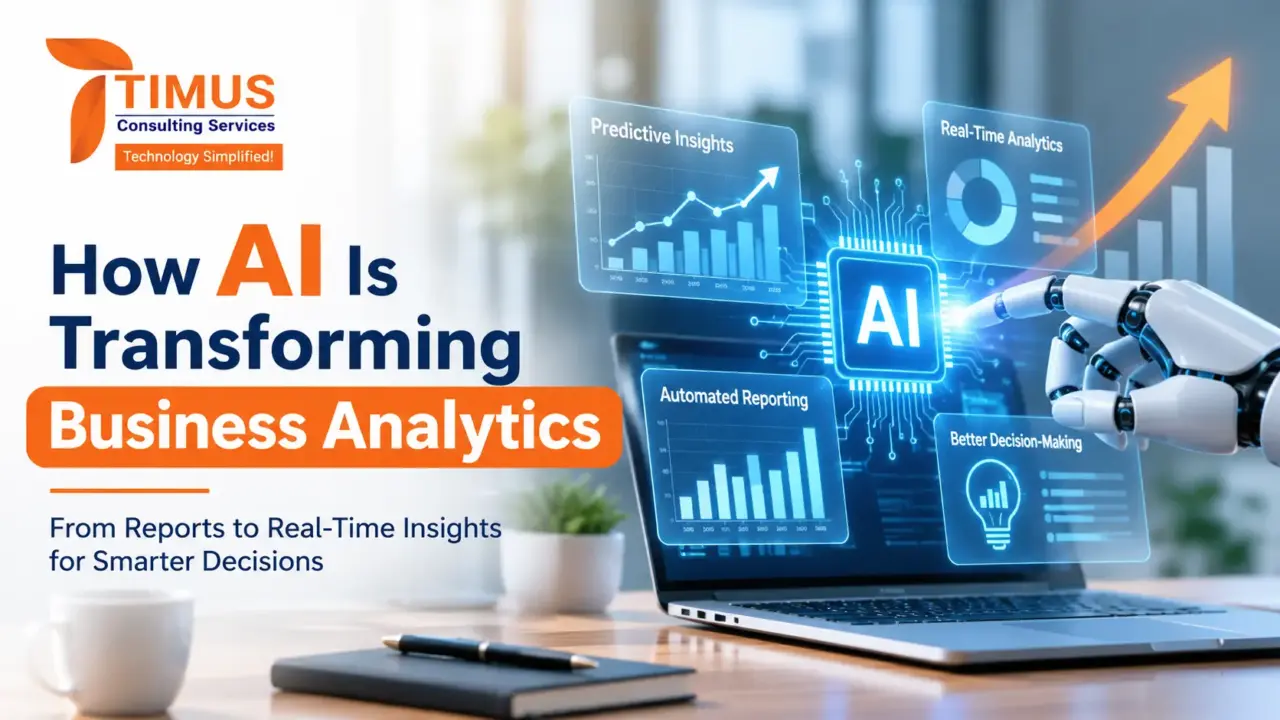
From static reports to intelligent dashboards, natural-language analytics, and automated business insights.
Introduction
In today’s rapidly evolving business environment, data has become one of the most valuable assets for organizations. Businesses generate enormous volumes of data every day, but the real challenge is not collecting information — it is transforming that information into meaningful insights that support better decisions.
Traditional business reporting has helped organizations monitor performance through structured reports, dashboards, and predefined metrics. However, as business requirements become more complex, traditional reporting alone is no longer sufficient.
Artificial Intelligence (AI) is transforming business analytics by introducing intelligent dashboards, natural-language interactions, predictive capabilities, and automated insights. These advancements are helping organizations move beyond understanding what happened to exploring why it happened and what could happen next.
1. The Limitations of Traditional Business Reporting
Traditional reporting systems generally depend on predefined reports, manually configured dashboards, and scheduled data refreshes. Although these solutions provide valuable business information, they often present certain challenges:
- Limited flexibility when business users need new insights.
- Dependence on technical teams for report modifications.
- Time-consuming manual data analysis.
- Difficulty identifying hidden patterns and emerging trends.
- Delays in accessing actionable business information.
As organizations handle increasingly complex datasets, they need more flexible and intelligent analytics solutions.
2. Intelligent Dashboards: Making Data More Meaningful
AI-powered dashboards are changing how organizations interact with business information.
Unlike traditional dashboards that primarily display predefined charts and metrics, intelligent dashboards can help identify unusual patterns, highlight significant changes, and generate insights from business data.
Key capabilities include:
- Automated identification of trends and anomalies.
- Dynamic visualizations based on business requirements.
- Performance monitoring through intelligent KPIs.
- Contextual insights that explain changes in business metrics.
- Faster identification of potential risks and opportunities.
For example, an organization monitoring operational performance can use intelligent analytics to identify unusual increases in expenses, declining performance indicators, or emerging operational risks.
3. Natural-Language Analytics: Ask Questions, Get Insights
One of the most significant developments in AI-driven analytics is natural-language interaction.
Traditionally, users needed knowledge of reporting tools, data models, filters, and query structures to retrieve specific information.
With natural-language analytics, users can ask questions in everyday language, such as:
- What were our highest-performing business units this quarter?
- Which departments have the highest operational risks?
- Show the monthly trend of unresolved issues.
- Which performance indicators have exceeded their thresholds?
AI interprets these questions, identifies the relevant data, and helps generate appropriate visualizations and explanations.
This makes analytics more accessible to business users and reduces their dependence on technical teams for routine information requests.
4. Automated Insights: Moving from Data to Decisions
AI can analyze large datasets to identify patterns, relationships, and unusual changes that may not be immediately visible through conventional reporting.
Automated insights can help organizations:
- Identify unexpected changes in business performance.
- Detect anomalies in operational and financial data.
- Highlight key trends and recurring patterns.
- Summarize complex datasets into understandable observations.
- Support proactive decision-making.
Rather than requiring users to examine multiple reports manually, AI can bring important observations to their attention.
However, AI-generated insights should be validated against reliable data and business context before decisions are made.
5. Predictive Analytics: Understanding What Comes Next
Traditional reporting primarily focuses on historical and current business performance. AI-powered predictive analytics introduces another dimension by using historical data and analytical models to estimate potential future outcomes.
Organizations can apply predictive analytics to:
- Forecast business performance.
- Identify potential operational bottlenecks.
- Anticipate emerging risks.
- Monitor changing customer behaviour.
- Improve resource allocation and planning.
These capabilities help organizations shift from reactive reporting towards more proactive and informed business strategies.
6. The Future of Business Analytics
The future of business analytics is moving towards intelligent, conversational, and automated experiences.
As AI technologies continue to evolve, analytics platforms will increasingly combine traditional reporting capabilities with natural-language interfaces, automated data interpretation, predictive models, and intelligent recommendations.
Organizations adopting these capabilities can make information more accessible, reduce repetitive analytical tasks, and improve the speed at which business decisions are made.
Successful AI adoption will also depend on strong data governance, data quality, security, transparency, and human oversight.
Conclusion
Business analytics is evolving beyond traditional reporting. Intelligent dashboards, natural-language analytics, automated insights, and predictive capabilities are redefining how organizations understand and use their data.
The objective is no longer just to generate reports but to make business information more meaningful, accessible, and actionable.
Organizations that embrace AI-driven analytics can move towards a more proactive approach to decision-making, where data does not simply explain the past but also helps businesses prepare for the future.
At Timus, we believe that the future of business intelligence lies in making data smarter, insights clearer, and decisions more informed.
Frequently Asked Questions
1. What is AI in business analytics?
AI in business analytics refers to using artificial intelligence and machine learning to analyze business data, identify patterns, automate reporting, and generate actionable insights.
2. How is AI changing traditional business reporting?
AI transforms traditional reporting by automating data analysis, generating real-time insights, predicting future trends, and reducing manual reporting activities.
3. What are the benefits of AI-powered business analytics?
Key benefits include faster analysis, improved forecasting, reduced manual work, better decision-making, enhanced productivity, and improved business performance.
4. How does predictive analytics help businesses?
Predictive analytics uses historical data and machine learning to forecast future outcomes, identify potential risks, understand customer behaviour, and support business planning.
5. Can AI automate business reporting?
Yes. AI can automate data processing, report generation, dashboard summaries, and performance analysis, helping teams save time and focus on strategic activities.