
Introduction
Modern businesses need efficient IT operations, seamless workflows, and real-time visibility to stay competitive. However, managing IT services, assets, security, governance, and business processes across disconnected systems can create operational challenges.
ServiceNow provides a unified platform that helps organizations automate workflows, improve service delivery, and connect business functions. With the right implementation and ongoing optimization, businesses can reduce manual work, improve productivity, and achieve greater value from their technology investments.
At Timus Consulting, we help organizations implement, customize, integrate, and optimize ServiceNow solutions to meet their business requirements.
What Are ServiceNow Services?
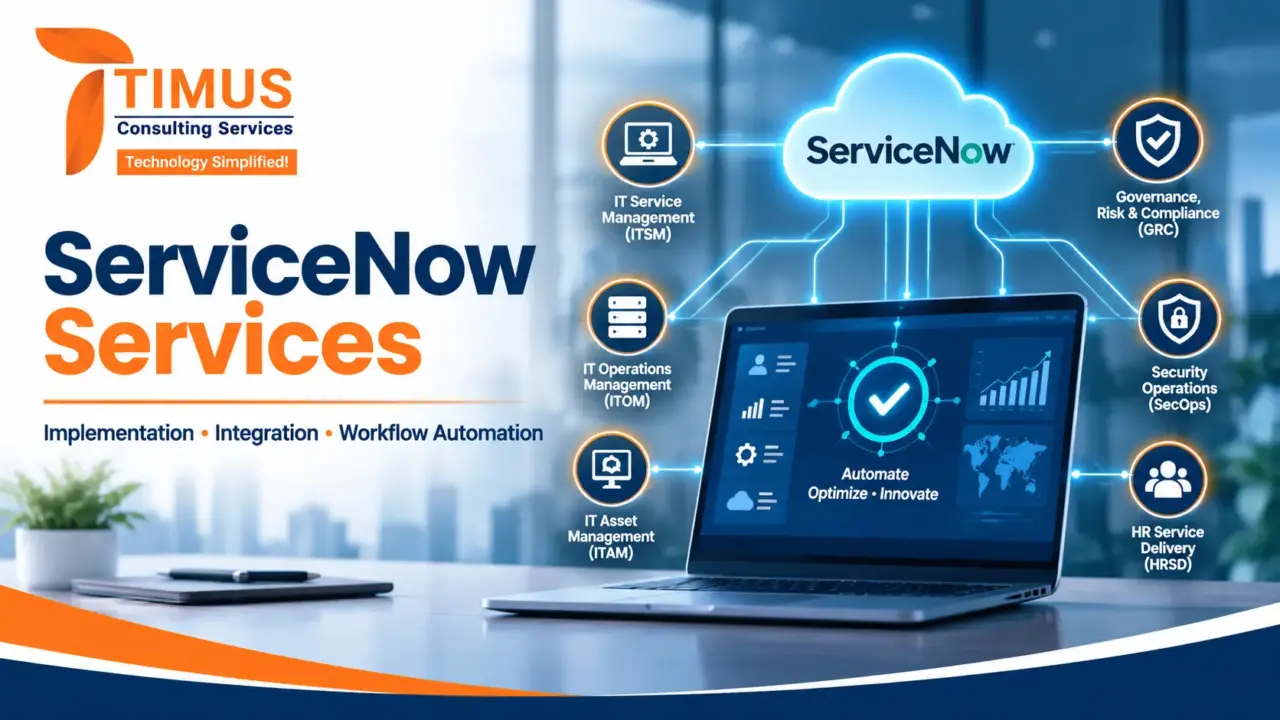
ServiceNow services help organizations use the ServiceNow platform to automate business processes, manage IT operations, and improve enterprise-wide service delivery.
From IT service management to governance, risk, and security, ServiceNow enables businesses to connect people, processes, and systems through a centralized platform.
Timus Consulting provides end-to-end ServiceNow services, helping organizations build scalable and efficient digital operations.
Our ServiceNow Consulting and Implementation Services
1. ServiceNow Implementation
Our ServiceNow implementation services help businesses configure and deploy the platform according to their operational needs. We work with organizations to understand their requirements, establish implementation strategies, and ensure smooth adoption.
2. IT Service Management (ITSM)
We help organizations improve IT service delivery through incident management, problem management, change management, and service request automation. These capabilities help reduce resolution times and enhance employee experiences.
3. IT Operations Management (ITOM)
Our ITOM services help businesses gain better visibility into their IT infrastructure, monitor operational performance, and proactively identify potential issues. This enables more reliable and efficient IT operations.
4. IT Asset Management (ITAM)
We help organizations manage hardware and software assets throughout their lifecycle. By improving asset visibility and tracking, businesses can optimize utilization, control costs, and support compliance requirements.
5. Governance, Risk, and Compliance (GRC)
Our ServiceNow GRC solutions help businesses streamline risk management, compliance monitoring, policy management, and audit processes. Organizations can improve risk visibility and establish more effective governance practices.
6. Security Operations (SecOps)
We help businesses connect security processes with IT operations to improve security incident response, vulnerability management, and coordination between security and IT teams.
7. Third-Party Risk Management (TPRM)
Our TPRM services help organizations assess, monitor, and manage risks associated with vendors and external partners. This supports better oversight and more consistent risk management processes.
8. HR Service Delivery (HRSD)
We help organizations automate HR workflows, simplify employee service requests, and create more efficient employee experiences through ServiceNow HRSD.
ServiceNow Integration and Workflow Automation
Disconnected business systems can create data silos, repetitive tasks, and operational inefficiencies.
Timus Consulting helps integrate with existing enterprise applications and systems, enabling seamless data exchange and improved process coordination.
Our workflow automation services help organizations reduce manual effort, standardize processes, and improve productivity across departments.
Why Choose Timus Consulting for ServiceNow Services?
Choosing the right consulting partner is essential for successful implementation and long-term value.
Timus Consulting combines technical expertise with business-focused consulting to help organizations:
-
Align ServiceNow solutions with business objectives.
-
Improve IT service delivery and operational efficiency.
-
Automate repetitive tasks and workflows.
-
Integrate with existing enterprise systems.
-
Strengthen governance, risk, and compliance processes.
-
Optimize platform performance and support continuous improvement.
Our approach focuses on delivering practical solutions that help businesses maximize their investment.
Conclusion
It enables organizations to transform their IT operations, automate business workflows, and improve enterprise service delivery.
With Timus Consulting’s implementation, integration, customization, and managed support services, businesses can build more connected, efficient, and scalable operations.
Whether you are planning a new implementation or looking to optimize an existing platform, our team can help you identify opportunities for improvement and achieve measurable business outcomes.
Ready to optimize your business operations with it? Connect with Timus Consulting to discuss your requirements.
Frequently Asked Questions
1. What are ServiceNow consulting services?
This consulting services help organizations implement, customize, integrate, and optimize the ServiceNow platform to improve business processes and IT service delivery.
2. What ServiceNow services does Timus Consulting provide?
Timus Consulting offers implementation, ITSM, ITOM, ITAM, GRC, SecOps, TPRM, HRSD, workflow automation, integration, and platform optimization services.
3. How can ServiceNow improve business efficiency?
It helps businesses automate repetitive tasks, streamline workflows, centralize service management, and improve visibility across business operations.
4. Can ServiceNow integrate with existing enterprise applications?
Yes. It can integrate with various enterprise applications and systems to enable data exchange, process automation, and improved operational coordination.
5. Does Timus Consulting provide ServiceNow support and optimization?
Yes. Timus Consulting provides ongoing support, platform optimization, and managed services to help organizations maintain and improve their environments.
6. Which businesses can benefit from ServiceNow?
Organizations of different sizes and industries can benefit, particularly those seeking to improve IT service management, automate workflows, strengthen governance, and streamline enterprise operations.