
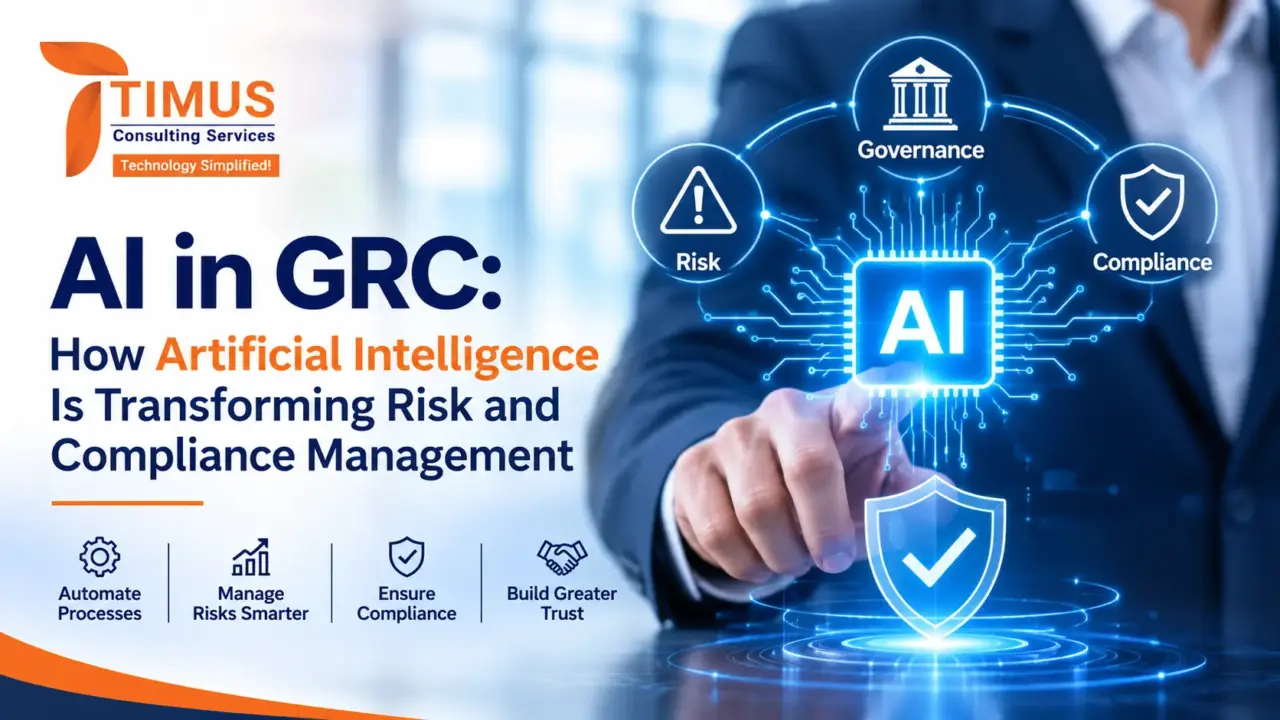
AI in GRC: Transforming Governance, Risk, and Compliance from Reactive to Predictive
Introduction
In today’s rapidly evolving business environment, organizations face an increasingly complex landscape of risks, regulatory requirements, cybersecurity threats, and operational challenges. Traditional Governance, Risk, and Compliance (GRC) frameworks have helped organizations manage these challenges for years. However, manual processes, disconnected systems, spreadsheets, and reactive risk assessments are no longer sufficient to address the speed and complexity of modern business.
This is where Artificial Intelligence (AI) is changing the game.
AI is transforming GRC from a traditionally reactive function into a more intelligent, proactive, and predictive business capability. By combining machine learning, generative AI, automation, and advanced analytics, organizations can identify potential risks earlier, improve compliance monitoring, automate repetitive activities, and make more informed decisions.
But the real question is not whether AI will become part of GRC. It is how organizations can adopt AI responsibly while maintaining transparency, accountability, and human oversight.
1. Understanding AI in GRC
AI in GRC refers to the application of artificial intelligence technologies to improve governance processes, identify and assess risks, monitor compliance obligations, and automate control activities.
Traditional GRC systems primarily depend on predefined rules, manual assessments, and periodic reporting. AI introduces an additional layer of intelligence that can analyze large volumes of structured and unstructured data, recognize patterns, identify anomalies, and generate actionable insights.
Some of the key technologies driving this transformation include:
- Machine Learning (ML): Identifies patterns in historical risk data and predicts potential risk events.
- Generative AI: Summarizes policies, generates risk assessment narratives, and assists with control documentation.
- Natural Language Processing (NLP): Extracts information from regulatory documents, policies, contracts, and audit reports.
- AI Agents: Assist with multi-step GRC activities, such as collecting evidence, reviewing assessment responses, and recommending remediation actions.
- Predictive Analytics: Helps organizations anticipate emerging risks using historical and real-time information.
Together, these technologies can make GRC processes more efficient, consistent, and intelligent.
2. Five Major Areas Where AI Is Transforming GRC
A. Intelligent Risk Assessment
Risk assessment is one of the most important activities within any GRC framework. Traditionally, risk teams collect information through questionnaires, interviews, spreadsheets, and manual evaluations.
AI can enhance this process by analyzing historical incidents, control failures, audit findings, business changes, and other relevant information.
For example, an AI-powered risk assessment engine could:
- Analyze historical risk assessment results.
- Identify recurring risk patterns.
- Recommend inherent and residual risk considerations.
- Highlight missing or inconsistent assessment responses.
- Generate explainable risk insights for reviewers.
Instead of simply recording a risk rating, organizations can gain a deeper understanding of why a particular risk exists and what actions may reduce its impact.
B. Automated Regulatory Compliance Monitoring
Regulatory requirements change frequently across industries such as banking, healthcare, insurance, and financial services.
Manually tracking regulatory updates and mapping them to internal policies and controls can be time-consuming.
AI can help organizations:
- Analyze newly published regulatory requirements.
- Identify changes between previous and updated regulations.
- Map regulatory obligations to existing policies and controls.
- Highlight potential compliance gaps.
- Recommend areas requiring further review.
This creates an opportunity for continuous compliance monitoring rather than relying entirely on periodic assessments.
C. Intelligent Audit Management
Internal audit teams often spend significant time reviewing documentation, collecting evidence, validating controls, and preparing reports.
AI can streamline several of these activities.
For example:
- Automatically summarize audit evidence.
- Identify missing supporting documentation.
- Highlight inconsistencies across control responses.
- Analyze previous audit findings to identify recurring issues.
- Generate initial audit observations for human review.
- Recommend corrective actions based on historical findings.
The objective is not to replace auditors but to reduce administrative effort and allow them to focus on judgment, investigation, and strategic assurance.
D. Predictive Risk Analytics
One of the biggest opportunities for AI in GRC is moving beyond historical reporting.
Traditional risk reporting tells organizations what has already happened. Predictive analytics can help identify indicators of what might happen next.
Consider an organization experiencing:
- Increasing control failures.
- Repeated audit observations.
- Delayed remediation activities.
- Frequent policy exceptions.
- Changes in operational processes.
An AI model can analyze these indicators together and identify business areas that may require additional attention.
For example, a predictive risk model could flag a business unit with an increasing likelihood of control failure based on historical patterns.
Such predictions should be treated as decision-support insights, not guaranteed outcomes.
E. AI-Powered Policy and Control Management
Organizations maintain hundreds or thousands of policies, procedures, standards, and internal controls.
Managing these documents manually creates challenges around duplication, outdated content, inconsistent language, and missing control coverage.
Generative AI can assist by:
- Summarizing lengthy policies.
- Identifying duplicate or overlapping controls.
- Extracting control objectives from policy documents.
- Suggesting control descriptions.
- Comparing policies against regulatory requirements.
- Identifying potential gaps for compliance teams to investigate.
This can significantly improve the efficiency of policy and control lifecycle management.
3. The Role of AI Agents in the Future of GRC
The next evolution of AI in GRC goes beyond chatbots and document summarization.
AI agents can potentially coordinate multiple activities across a GRC workflow while operating within defined permissions and approval boundaries.
Imagine the following scenario:
A business user submits a new operational risk assessment.
An AI-enabled GRC assistant could:
- Review the submitted assessment responses.
- Identify incomplete or inconsistent information.
- Retrieve relevant historical risk assessments.
- Recommend potential risk scenarios.
- Suggest relevant controls.
- Identify supporting evidence requirements.
- Generate an initial assessment summary.
- Route the assessment to the appropriate risk reviewer.
The reviewer validates the recommendations, makes the necessary changes, and approves the assessment.
This creates a more efficient workflow while keeping important risk decisions under human control.
4. IBM OpenPages and the Evolution of AI-Driven GRC
Enterprise GRC platforms are increasingly becoming important foundations for AI-powered risk management.
For example, IBM OpenPages provides organizations with capabilities to manage risks, controls, policies, audits, issues, and regulatory compliance within an integrated platform.
When combined with AI technologies such as IBM watsonx.ai and watsonx.governance, organizations can explore intelligent GRC use cases.
Some potential implementations include:
| GRC Area | AI-powered capability |
|---|---|
| Risk Management | Predictive risk scoring and risk insights |
| Control Management | Intelligent control recommendations |
| Audit Management | Automated evidence summarization |
| Issue Management | Root-cause analysis and remediation suggestions |
| Compliance | Regulatory change analysis |
| Policy Management | Policy summarization and comparison |
| AI Governance | AI model risk assessment and monitoring |
For example, an AI-powered GRC Copilot could integrate with OpenPages to retrieve relevant risk and control information, analyze assessment responses, and provide recommendations through a conversational interface.
OpenPages would remain the system of record, while the AI layer would provide intelligence and decision support.
This combination creates opportunities to enhance existing GRC processes without necessarily replacing established enterprise governance frameworks.
5. The Challenges of Implementing AI in GRC
Although AI offers significant opportunities, its implementation introduces new risks.
Organizations must address several important challenges:
Data Privacy and Security: GRC platforms contain confidential business, employee, financial, and operational information. AI solutions must enforce appropriate access controls and data protection.
Explainability: Risk teams must understand why an AI system generated a particular recommendation or risk score.
Model Bias: AI models trained on incomplete or biased historical data may produce unreliable recommendations.
Regulatory Compliance: Organizations must ensure that AI solutions comply with applicable laws, regulations, and internal governance requirements.
Human Accountability: AI should support decision-making, not remove accountability from risk owners, auditors, compliance officers, or management.
The success of AI in GRC depends not only on technological capabilities but also on responsible implementation.
6. What Does the Future of GRC Look Like?
The future of GRC will likely be shaped by three major developments:
From Periodic to Continuous Risk Monitoring
Organizations will increasingly use automated analytics to monitor risk indicators and identify emerging issues throughout the year.
From Manual Documentation to Intelligent Automation
AI will assist with evidence analysis, assessment preparation, policy reviews, and reporting, reducing repetitive administrative work.
From Traditional GRC to Autonomous, Human-Governed GRC
AI agents will increasingly coordinate routine activities across GRC workflows. However, high-impact decisions, approvals, exceptions, and accountability will continue to require appropriate human oversight.
The organizations that succeed will be those that combine AI capabilities with strong governance, reliable data, and clearly defined accountability.
Conclusion
AI is not simply another technology enhancement for Governance, Risk, and Compliance. It represents an opportunity to fundamentally improve how organizations identify, understand, monitor, and respond to risks.
By combining enterprise GRC platforms with machine learning, generative AI, predictive analytics, and AI agents, organizations can move toward a more intelligent and proactive risk management environment.
However, technology alone will not transform GRC. The real transformation will happen when organizations combine AI-driven insights with human expertise, transparent processes, strong governance, and responsible decision-making.
The future of GRC is not about replacing risk professionals with AI. It is about empowering risk professionals to make smarter, faster, and more informed decisions with AI.
The question for organizations is no longer whether AI belongs in GRC. The real question is whether their GRC strategy is ready for the AI era.
FAQs: AI in GRC (Governance, Risk and Compliance)
1. What is AI in GRC?
AI in GRC refers to the use of Artificial Intelligence to improve governance, risk management, and compliance processes through automation, data analysis, and intelligent decision-making.
2. How does AI improve risk management?
AI helps organizations identify potential risks, analyze large datasets, detect unusual patterns, and predict emerging threats, enabling proactive risk management.
3. What are the benefits of AI in GRC?
Key benefits include:
-
Automated compliance monitoring
-
Faster risk identification and assessment
-
Improved decision-making
-
Reduced manual effort
-
Better reporting and visibility
-
Enhanced regulatory compliance
4. Can AI automate compliance management?
Yes. AI can automate compliance monitoring, document analysis, regulatory tracking, evidence collection, and reporting, helping organizations manage compliance more efficiently.
5. How does AI help with regulatory compliance?
AI can analyze regulatory updates, identify compliance gaps, monitor regulatory requirements, and help organizations maintain compliance with changing regulations.