
Cloud computing has become a fundamental part of modern enterprise IT infrastructure. Organizations are increasingly adopting platforms such as Amazon Web Services (AWS), Microsoft Azure, and Google Cloud to support business applications, store critical information, and deliver scalable digital services.
While cloud adoption offers flexibility, scalability, and operational efficiency, it also introduces new challenges around security, asset visibility, governance, and regulatory compliance.
Managing cloud infrastructure is no longer limited to identifying servers, databases, and applications. Organizations must understand what cloud assets they own, where they are deployed, who is responsible for them, what information they contain, and whether appropriate security controls are implemented.
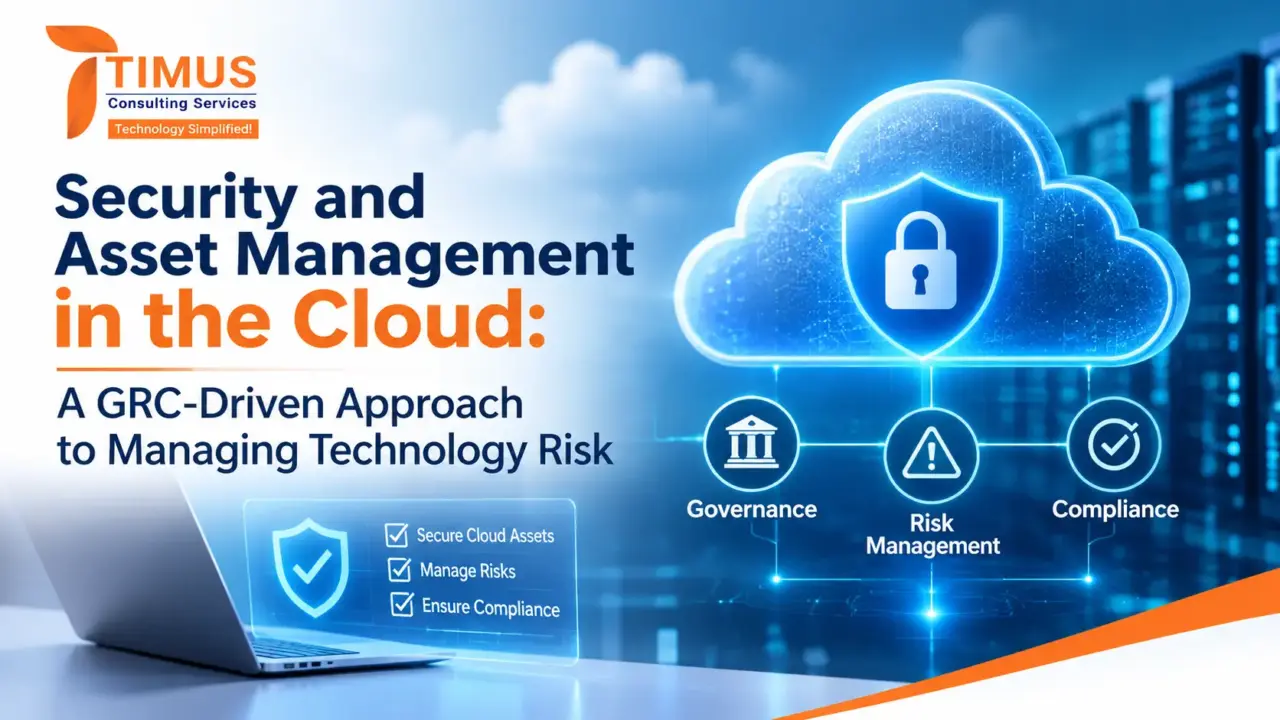
From a Governance, Risk, and Compliance (GRC) perspective, cloud security and asset management must work together. An unidentified cloud asset can create an unmanaged security exposure, while an ineffective security control can introduce operational, regulatory, and financial risks.
A structured GRC framework helps organizations establish accountability, assess technology risks, monitor control effectiveness, manage remediation activities, and maintain compliance across their cloud environments.
This blog explores how organizations can integrate cloud security and asset management into their enterprise GRC framework.
1. Understanding Cloud Security and Asset Management
Cloud security refers to the policies, technologies, processes, and controls used to protect cloud infrastructure, applications, identities, and information from unauthorized access, cyber threats, and data breaches.
Cloud asset management involves identifying, classifying, tracking, monitoring, and managing cloud resources throughout their lifecycle.
Cloud assets may include:
- Virtual machines and cloud servers.
- Databases and storage accounts.
- Applications and software services.
- Network infrastructure and firewalls.
- Containers and Kubernetes workloads.
- User identities, privileged accounts, and service accounts.
- APIs, backup resources, and cloud-hosted data.
From a GRC perspective, asset management provides the foundation for effective technology risk management.
Organizations cannot effectively assess risks or evaluate control coverage without knowing which assets exist and how important they are to business operations.
The NIST Cybersecurity Framework emphasizes identifying and managing organizational resources according to their business importance and risk exposure.
Therefore, an effective cloud asset management program should establish:
- Complete visibility of cloud assets.
- Clearly defined asset ownership.
- Business criticality and data classification.
- Documented security requirements.
- Periodic risk and control assessments.
- Continuous monitoring of asset security.
- Defined accountability for remediation.
2. Cloud Asset Discovery and Centralized Inventory
One of the biggest challenges in cloud environments is maintaining an accurate and up-to-date inventory of deployed resources.
Cloud infrastructure is dynamic. New resources can be provisioned within minutes, applications can scale automatically, and temporary workloads may be created and removed without traditional asset registration processes.
Without centralized visibility, organizations may face unmanaged cloud resources, commonly referred to as shadow IT.
Key components of cloud asset inventory
A centralized cloud asset inventory should capture:
| Asset information | Purpose |
|---|---|
| Asset ID and Name | Uniquely identify the cloud resource |
| Cloud Provider | AWS, Azure, Google Cloud, etc. |
| Environment | Production, Development, Testing |
| Business Owner | Establish accountability |
| Technical Owner | Identify the responsible IT team |
| Business Criticality | Determine business importance |
| Data Classification | Identify sensitive information |
| Location / Region | Track hosting and data residency |
| Security Status | Identify vulnerabilities and configuration gaps |
| Lifecycle Status | Active, Under Maintenance, Decommissioned |
Cloud-native services such as AWS Config, Azure Resource Graph, and Google Cloud Asset Inventory can support resource discovery and inventory management within their respective environments.
The discovered information can be consolidated into a centralized asset repository or CMDB to provide a broader organizational view.
GRC perspective
From a GRC standpoint, asset inventory should not simply be a technical register.
It should establish a relationship between:
- Cloud assets and business processes.
- Assets and associated technology risks.
- Assets and applicable security controls.
- Asset owners and risk owners.
- Security findings and remediation activities.
For example, a cloud-hosted database supporting a critical financial application should be associated with the relevant business process, data classification, technology risk, and applicable security controls.
This relationship allows organizations to understand the business impact of a security issue rather than treating every technical finding as an isolated event.
3. Asset Classification, Ownership, and Lifecycle Management
Identifying cloud assets is only the first step. Organizations must also understand the importance of each asset and establish clear accountability.
Asset classification
Cloud assets should be classified based on:
- Business criticality.
- Information sensitivity.
- Regulatory requirements.
- Operational dependencies.
- Security exposure.
For example, a production database containing customer financial information should receive a higher criticality classification than a temporary development environment.
This classification helps organizations prioritize security controls, risk assessments, and monitoring activities.
Asset ownership
Every cloud asset should have an assigned business or technical owner.
The asset owner should be responsible for ensuring that the asset:
- Meets organizational security requirements.
- Has appropriate access restrictions.
- Is included in periodic reviews.
- Has documented risk and control information.
- Is maintained throughout its lifecycle.
Unassigned assets should be treated as potential governance gaps and investigated.
Asset lifecycle management
Cloud assets should be governed throughout their lifecycle:
- Provisioning: Ensure assets are created through approved processes.
- Registration: Capture asset details in the centralized inventory.
- Classification: Assign criticality and data sensitivity.
- Monitoring: Continuously assess security and compliance.
- Modification: Review changes to configurations and ownership.
- Decommissioning: Remove unused resources and revoke associated access.
GRC perspective
Lifecycle management should be linked to formal governance processes.
For example, when a cloud application is decommissioned, the organization should verify that:
- Associated risks are reviewed.
- Security controls are no longer required or are appropriately retired.
- User and service-account access is revoked.
- Sensitive information is retained or disposed of according to policy.
- The asset inventory is updated.
- Related compliance evidence is maintained where required.
This ensures that asset lifecycle changes do not create residual security or compliance risks.
4. Identifying and Assessing Cloud-Related Risks
Cloud security risks should be formally identified, assessed, documented, and monitored through the organization’s enterprise risk management framework.
Some common cloud-related risks include:
| Risk area | Potential risk | Business impact |
|---|---|---|
| Asset Visibility | Unidentified or unmanaged cloud resources | Increased attack surface |
| Access Management | Excessive user privileges | Unauthorized access |
| Data Protection | Inadequate encryption or data exposure | Data breach and regulatory penalties |
| Configuration Management | Misconfigured cloud resources | Security vulnerabilities |
| Vulnerability Management | Delayed security patching | Exploitation of known vulnerabilities |
| Third-Party Risk | Inadequate cloud provider oversight | Service disruption and compliance exposure |
| Business Continuity | Insufficient backup and recovery arrangements | Business interruption |
Risk assessment approach
A structured cloud risk assessment should consider:
1. Risk Identification
Identify threats and vulnerabilities associated with cloud assets, applications, infrastructure, and service providers.
2. Risk Analysis
Evaluate the likelihood of a risk occurring and its potential business impact.
3. Risk Evaluation
Determine the inherent risk and assess whether existing controls adequately mitigate the exposure.
4. Risk Treatment
Define appropriate mitigation activities, assign ownership, and establish remediation timelines.
5. Risk Monitoring
Periodically reassess risks based on changes in the cloud environment, emerging threats, and control effectiveness.
GRC perspective
Cloud-related risks should be maintained within a centralized risk register and linked to the relevant business processes, technology assets, controls, and risk owners.
This allows management to understand how technical security weaknesses can affect business objectives.
For example, an exposed production database may represent more than a configuration issue. Depending on the data involved, it could create operational, privacy, regulatory, and reputational risks.
5. Implementing Effective Cloud Security Controls
Once risks are identified, organizations must establish appropriate security controls to reduce their exposure.
These controls should be mapped to internal security policies, regulatory requirements, and recognized industry frameworks.
A. Identity and Access Management (IAM)
Identity and access management ensures that only authorized individuals and systems can access cloud resources.
Key controls include:
- Role-Based Access Control (RBAC).
- Multi-Factor Authentication (MFA).
- Least-privilege access.
- Periodic user access reviews.
- Privileged access management.
- Service-account and credential management.
- Timely removal of inactive accounts.
GRC application: Access management controls should be documented, assigned to control owners, assessed periodically, and supported by evidence such as access review records and privileged account reports.
B. Data Protection and Privacy
Cloud environments often contain sensitive business and customer information.
Organizations should implement:
- Encryption at rest and in transit.
- Data classification and handling policies.
- Data Loss Prevention (DLP).
- Backup and recovery controls.
- Data retention and disposal requirements.
- Appropriate data residency arrangements.
GRC application: Data protection controls should be mapped to applicable privacy obligations, information security policies, and regulatory requirements. Control assessments should verify whether these requirements are operating effectively.
C. Configuration and Vulnerability Management
Misconfigured cloud resources and unpatched vulnerabilities can expose organizations to cyber threats.
Important controls include:
- Secure configuration baselines.
- Regular vulnerability assessments.
- Automated configuration monitoring.
- Timely patch management.
- Network segmentation.
- Continuous logging and monitoring.
GRC application: Configuration and vulnerability findings should be assessed based on asset criticality, risk severity, and potential business impact. Significant findings should be formally recorded as issues and assigned for remediation.
D. Logging and Monitoring
Organizations should maintain appropriate visibility into cloud activities and security events.
Key controls include:
- Centralized log collection.
- Monitoring privileged activities.
- Detecting unusual access patterns.
- Monitoring configuration changes.
- Maintaining audit trails.
- Establishing incident response procedures.
GRC application: Monitoring controls should be periodically evaluated to confirm that critical cloud assets are covered and that identified security events are investigated and resolved.
6. Integrating Cloud Security with Enterprise GRC
A major challenge for organizations is the separation between technical security monitoring and enterprise risk management.
Cloud security teams may use different tools to identify vulnerabilities, monitor configurations, and investigate security incidents, while GRC teams manage risks, controls, assessments, policies, and issues through separate platforms.
This creates information silos and makes it difficult to obtain a consolidated view of technology risk.
Integrating cloud security processes with GRC helps bridge this gap.
Key areas of GRC integration
Risk Management
Cloud security risks should be linked to enterprise risk registers, business processes, and accountable risk owners.
Control Management
Technical security controls should be mapped to organizational policies, regulatory requirements, and recognized frameworks.
Control Assessments
Control owners should periodically assess whether security controls are appropriately designed and operating effectively.
Issue Management
Identified security gaps should be recorded, assigned, prioritized, and tracked until remediation is completed.
Policy Management
Cloud security policies should define minimum requirements for asset provisioning, access management, data protection, configuration, and monitoring.
Compliance Management
Organizations should maintain evidence demonstrating that applicable cloud security requirements are implemented and monitored.
Management Reporting
Dashboards should provide visibility into cloud-related risks, control effectiveness, outstanding issues, remediation progress, and compliance status.
7. The Role of GRC Platforms: IBM OpenPages Perspective
Enterprise GRC platforms can help organizations establish a centralized framework for managing technology risks and security-related governance activities.
For example, IBM OpenPages can be used to manage risk, control, issue, policy, and assessment processes within an enterprise GRC framework.
When incorporated into a cloud governance architecture, it can support the management and oversight of cloud-related risks.
Example use cases
| GRC area | Cloud security application |
|---|---|
| Risk Management | Maintain cloud technology risks and associated risk assessments |
| Control Management | Document controls for IAM, encryption, vulnerability management, and monitoring |
| Risk Assessments | Assess cloud-related risks and evaluate control effectiveness |
| Issue Management | Track security findings and remediation activities |
| Policy Management | Maintain cloud security policies and associated requirements |
| Compliance Management | Track applicable regulatory and internal compliance obligations |
| Reporting | Generate dashboards and reports on technology risk and control performance |
Illustrative integration scenario
Consider an organization operating multiple cloud environments.
Its cloud security monitoring solution identifies a production storage resource that has an inappropriate public access configuration.
A structured GRC process could work as follows:
- Detection: The cloud security monitoring solution identifies the configuration violation.
- Asset Identification: The affected resource is matched with the centralized cloud asset inventory.
- Risk Evaluation: The organization evaluates the asset’s business criticality, data sensitivity, and potential impact.
- GRC Issue Creation: A security issue is created in the GRC platform, with supporting details and evidence.
- Ownership Assignment: The issue is assigned to the responsible technical or business owner.
- Remediation: The owner corrects the configuration within the defined timeline.
- Validation: Security teams verify that the issue has been resolved.
- GRC Closure: The issue is updated with remediation evidence and formally closed.
- Reporting: GRC dashboards reflect the issue status, risk exposure, and remediation performance.
An integration between cloud security tools and IBM OpenPages can be implemented through supported APIs, middleware, or other approved integration mechanisms, depending on the deployed product versions and architecture. This example describes a conceptual workflow, not an assumption of an out-of-the-box native connector.
The key benefit is that technical security findings become part of a structured enterprise risk and control management process.
8. Continuous Control Monitoring and Automation
Traditional control assessments are often performed periodically. However, cloud environments change continuously, making periodic assessments alone insufficient to provide ongoing assurance.
Continuous Control Monitoring (CCM) helps organizations evaluate whether security controls remain effective over time.
Examples include:
- Monitoring whether MFA is enabled for privileged accounts.
- Identifying cloud assets without assigned owners.
- Detecting unauthorized configuration changes.
- Monitoring encryption compliance.
- Tracking unresolved critical vulnerabilities.
- Identifying resources that do not meet approved security baselines.
- Monitoring completion of periodic access reviews.
Automation can further strengthen these activities.
For example, when a cloud security tool identifies a non-compliant resource, an automated process can generate an alert, associate the finding with the relevant asset, and initiate a remediation workflow.
Where appropriate, policy-as-code can also prevent non-compliant configurations from being deployed in the first place.
The combination of automated monitoring and GRC workflows enables organizations to move towards proactive risk management rather than relying entirely on periodic reviews.
9. Measuring Cloud Security and GRC Effectiveness
Organizations should define meaningful Key Performance Indicators (KPIs) and Key Risk Indicators (KRIs) to monitor the effectiveness of their cloud security and asset management programs.
Some recommended metrics include:
| KPI / KRI | Measurement objective |
|---|---|
| Cloud Asset Inventory Coverage | Percentage of discovered cloud assets recorded in the inventory |
| Asset Ownership Coverage | Percentage of assets with assigned owners |
| Unmanaged Cloud Assets | Number of unidentified or unregistered resources |
| Critical Vulnerabilities | Number of unresolved critical vulnerabilities |
| Configuration Compliance | Percentage of assets meeting approved security baselines |
| Privileged Access Compliance | Percentage of privileged accounts meeting access requirements |
| Access Review Completion | Percentage of scheduled access reviews completed |
| Control Effectiveness | Percentage of assessed controls operating effectively |
| Open Security Issues | Number of unresolved cloud security issues |
| Remediation SLA Compliance | Percentage of issues resolved within agreed timelines |
| Mean Time to Remediate | Average time required to resolve identified security issues |
| Compliance Coverage | Percentage of applicable cloud security requirements assessed |
These metrics can be incorporated into GRC dashboards to provide management with a consolidated view of cloud security and technology risk.
It is important to distinguish between activity metrics and effectiveness metrics. For example, the number of completed assessments measures activity, whereas the percentage of controls operating effectively provides insight into control performance.
10. Common Challenges in Implementing Cloud GRC
Organizations may encounter several challenges when implementing cloud security and asset management within their GRC framework.
Fragmented Asset Inventory
Multiple cloud providers and disconnected inventory tools can make it difficult to maintain a complete view of organizational assets.
Unclear Ownership
Assets without clearly assigned owners can result in delayed remediation and weak accountability.
Disconnected Security and GRC Processes
Security findings may remain within technical monitoring tools without being formally assessed or tracked through GRC processes.
Inconsistent Control Mapping
Different teams may interpret security requirements differently, resulting in inconsistent control implementation and assessment.
Limited Continuous Monitoring
Organizations relying exclusively on periodic assessments may fail to identify security gaps between assessment cycles.
Inadequate Reporting
Technical security reports may not provide sufficient business context for risk managers and senior management to understand the potential impact.
Addressing these challenges requires collaboration between cloud operations, cybersecurity, IT risk, compliance, internal audit, and business stakeholders.
11. Recommended Implementation Approach
Organizations should adopt a phased approach to integrating cloud asset management and security into their GRC framework.
Phase 1: Establish Visibility
- Identify all cloud platforms and accounts.
- Establish a centralized asset inventory.
- Define asset classification requirements.
- Assign business and technical owners.
Phase 2: Establish Governance
- Define cloud security policies.
- Establish risk assessment procedures.
- Map security controls to relevant frameworks.
- Define accountability and reporting requirements.
Phase 3: Strengthen Security Controls
- Implement IAM and privileged access controls.
- Establish encryption and data protection requirements.
- Implement vulnerability and configuration management.
- Establish centralized logging and monitoring.
Phase 4: Integrate with GRC
- Record cloud-related risks.
- Establish control assessment processes.
- Connect security findings with issue management.
- Define remediation ownership and timelines.
- Maintain audit evidence.
Phase 5: Implement Continuous Monitoring
- Automate asset discovery.
- Monitor control compliance.
- Establish automated alerts and workflows.
- Develop risk and compliance dashboards.
- Periodically review and improve the framework.
This approach helps organizations gradually build a mature cloud governance and technology risk management capability.
Conclusion
Cloud security and asset management should be viewed as essential components of an organization’s enterprise GRC strategy rather than independent IT activities.
Maintaining visibility into cloud assets, establishing ownership, implementing appropriate security controls, and continuously monitoring compliance are critical to managing technology risk effectively.
By integrating cloud security monitoring with enterprise risk management, organizations can establish stronger relationships between assets, risks, controls, issues, and compliance requirements.
GRC platforms such as IBM OpenPages can support this governance approach by providing structured processes for risk assessments, control management, issue tracking, policy oversight, and management reporting.
Ultimately, the objective is to establish a cloud environment where every critical asset is identified, every significant risk is assessed, every control has clear ownership, and every security issue is tracked through resolution.
A mature cloud GRC framework does more than protect cloud infrastructure. It provides the governance, accountability, and continuous assurance required to support secure and sustainable digital transformation.