

Introduction
Cloud computing has become a fundamental part of modern business technology strategies. As organizations continue to embrace digital transformation, traditional IT infrastructure is gradually giving way to flexible, scalable, and cloud-based solutions.
Historically, organizations relied on on-premises infrastructure to host applications, store business data, and manage IT operations. Maintaining these environments required significant investments in hardware, software, networking, data centres, and technical resources.
Cloud computing has changed this approach by enabling organizations to access computing resources, storage, databases, networking, and software services over the internet without having to maintain all the underlying infrastructure themselves.
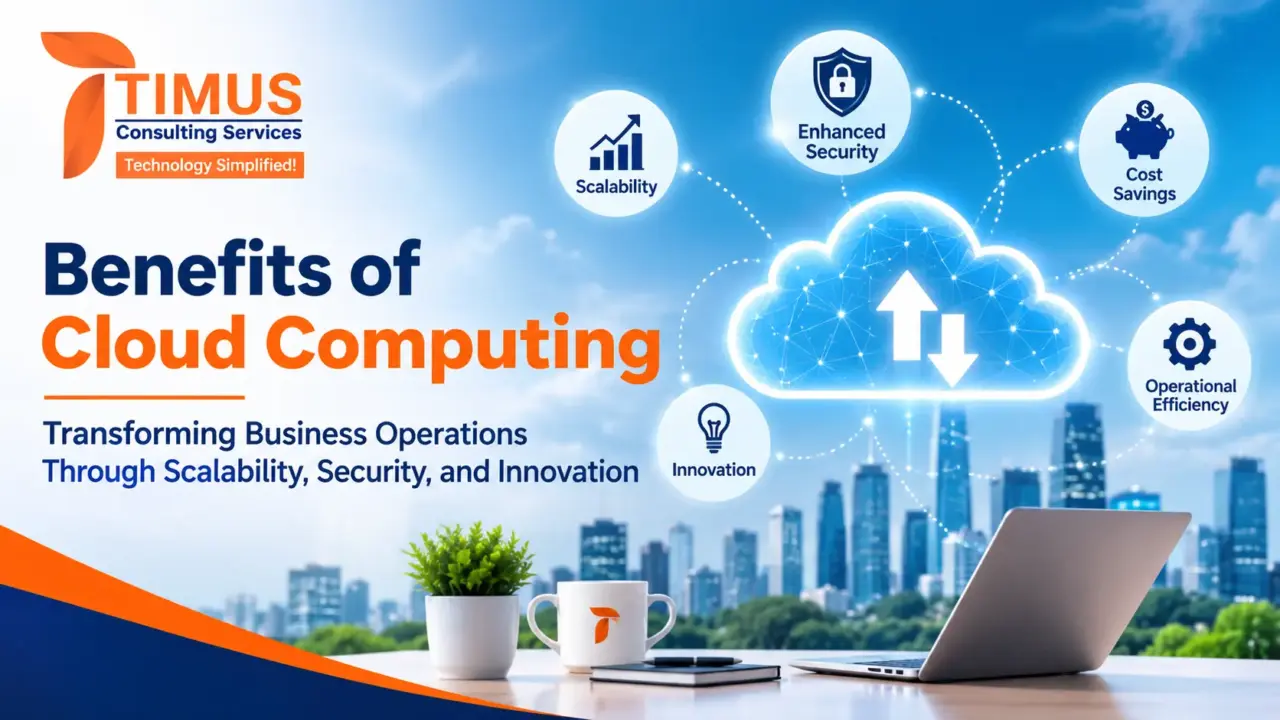
Beyond reducing infrastructure costs, cloud computing offers several strategic advantages, including improved scalability, business agility, operational efficiency, data accessibility, and disaster recovery capabilities.
However, the benefits of cloud adoption extend beyond technology modernization. When implemented with appropriate governance and security measures, cloud computing can also strengthen organizational resilience, improve risk management, and support regulatory compliance.
Let’s explore the key benefits of cloud computing and understand how it is transforming modern business operations.
1. Cost Optimization and Reduced Infrastructure Investment
One of the primary benefits of cloud computing is the ability to reduce infrastructure-related expenditure.
Traditional IT environments require organizations to invest in physical servers, storage devices, networking equipment, software licences, and data centre facilities. These investments often involve significant upfront costs and ongoing maintenance expenses.
Cloud computing introduces a more flexible consumption model, allowing organizations to pay for the computing resources they consume.
Key advantages include:
- Reduced capital expenditure on physical infrastructure.
- Lower hardware procurement and maintenance costs.
- Reduced dependency on dedicated data centre facilities.
- Flexible allocation of computing resources.
- Better visibility into infrastructure consumption.
For example, an organization experiencing business growth can increase its cloud infrastructure capacity without purchasing additional physical servers.
Business value: Organizations can optimize IT expenditure, reduce infrastructure management overhead, and redirect resources towards strategic business initiatives.
2. Scalability and Flexibility
Business requirements are constantly evolving. Organizations may experience fluctuations in application usage, customer demand, transaction volumes, and data storage requirements.
Traditional infrastructure often requires additional hardware procurement and configuration to accommodate these changes.
Cloud computing provides the flexibility to scale computing resources according to business demand.
Organizations can:
- Increase computing capacity during periods of high demand.
- Expand storage based on business requirements.
- Scale down resources when demand decreases.
- Support business expansion across geographical locations.
- Accommodate changing application workloads.
For example, an e-commerce organization can increase its computing capacity during festive sales periods and reduce it when transaction volumes return to normal.
Business value: Cloud scalability enables organizations to respond quickly to changing business requirements without maintaining unnecessary infrastructure capacity.
3. Improved Accessibility and Remote Collaboration
Cloud computing enables employees to access business applications, documents, and information from different geographical locations through authorized internet connections.
This is particularly valuable for organizations operating across multiple offices or supporting hybrid and remote working environments.
Important advantages include:
- Access to applications from different locations.
- Real-time collaboration across departments.
- Centralized document storage and sharing.
- Improved communication between distributed teams.
- Reduced dependency on physical office infrastructure.
For example, employees working from different locations can collaborate on shared cloud-hosted documents and applications without exchanging multiple versions through email.
Business value: Cloud computing improves workforce flexibility, collaboration, and productivity while supporting modern working environments.
4. Enhanced Data Backup and Disaster Recovery
Business continuity is an essential consideration for every organization. Unexpected events such as hardware failures, cyberattacks, natural disasters, and infrastructure outages can disrupt business operations and result in data loss.
Cloud computing provides capabilities that organizations can use to establish effective backup and disaster recovery strategies.
Key capabilities include:
- Automated data backups.
- Data replication across geographical locations.
- Recovery of applications and business information.
- Flexible disaster recovery environments.
- Improved recovery planning and infrastructure availability.
For example, if an organization’s primary IT infrastructure becomes unavailable, appropriately configured cloud disaster recovery services can help restore critical applications and data in an alternate environment.
Organizations should define Recovery Time Objectives (RTOs) and Recovery Point Objectives (RPOs) to establish acceptable recovery timelines and data loss thresholds.
Business value: Cloud-based backup and disaster recovery capabilities help organizations improve operational resilience and minimize the potential impact of unexpected disruptions.
5. Improved Security Capabilities
Security is one of the most important considerations when adopting cloud technology.
Leading cloud service providers offer various security capabilities designed to protect infrastructure, applications, and organizational data.
These capabilities may include:
- Identity and Access Management (IAM).
- Multi-Factor Authentication (MFA).
- Data encryption.
- Network security controls.
- Security monitoring and logging.
- Threat detection and vulnerability management.
- Privileged access management.
For example, organizations can implement role-based access controls to ensure that employees can access only the applications and information required for their responsibilities.
However, cloud security follows a shared responsibility model. Cloud providers manage the security of their underlying infrastructure, while customers remain responsible for areas such as data protection, access configuration, application security, and identity management, depending on the selected service model.
Business value: Cloud platforms provide access to advanced security capabilities that organizations can incorporate into their broader cybersecurity and IT governance frameworks.
6. Faster Deployment and Business Agility
In traditional IT environments, deploying new infrastructure or applications involves procurement, installation, configuration, and testing activities. These processes can delay business initiatives.
Cloud computing enables organizations to provision computing resources and deploy applications much faster.
Key benefits include:
- Rapid infrastructure provisioning.
- Faster application deployment.
- Reduced infrastructure setup time.
- Support for development and testing environments.
- Improved integration with DevOps practices.
- Faster response to changing business requirements.
For example, development teams can provision cloud-based testing environments without waiting for physical infrastructure to become available.
Business value: Organizations can accelerate innovation, reduce deployment timelines, and bring new products and services to market faster.
7. Simplified IT Operations and Maintenance
Maintaining traditional IT infrastructure requires dedicated resources to manage hardware, software updates, security patches, and infrastructure performance.
Cloud computing reduces some of these operational responsibilities by allowing service providers to manage underlying infrastructure components, depending on the service model.
Benefits include:
- Reduced hardware maintenance activities.
- Simplified infrastructure management.
- Access to updated platform capabilities.
- Opportunities to automate repetitive IT tasks.
- Improved infrastructure monitoring.
- Better utilization of IT resources.
For example, organizations using Software as a Service (SaaS) applications generally do not need to manage the underlying application hosting infrastructure.
Business value: IT teams can reduce routine infrastructure management activities and focus more on strategic technology initiatives.
8. Better Data Management and Advanced Analytics
Modern organizations generate large volumes of data through business applications, customer interactions, financial transactions, and operational activities.
Cloud platforms provide scalable storage, data processing, and analytics capabilities that help organizations derive meaningful insights from their information.
Important advantages include:
- Centralized data storage.
- Scalable data processing.
- Integration with business intelligence platforms.
- Advanced reporting and analytics.
- Support for artificial intelligence and machine learning.
- Improved access to business information.
For example, organizations can use cloud-based analytics platforms to consolidate operational data, monitor business performance, identify trends, and support management decisions.
Business value: Cloud computing enables organizations to make better use of enterprise data and improve decision-making through advanced analytics.
9. Access to Emerging Technologies and Innovation
Cloud platforms provide organizations with access to advanced technologies that may otherwise require significant infrastructure investments.
These technologies include:
- Artificial Intelligence (AI).
- Machine Learning (ML).
- Big Data Analytics.
- Internet of Things (IoT).
- Generative AI.
- Advanced application integration services.
For example, organizations can use cloud-based AI services to analyze large datasets, automate repetitive business processes, and generate insights that support operational decision-making.
Cloud platforms also enable development teams to experiment with new technologies without making substantial upfront investments in infrastructure.
Business value: Organizations can adopt emerging technologies more efficiently and accelerate their digital transformation initiatives.
10. Environmental Sustainability and Resource Optimization
Cloud computing can contribute to organizational sustainability initiatives when infrastructure resources are consolidated and efficiently utilized.
Large cloud providers operate data centres designed to optimize energy consumption, hardware utilization, and computing efficiency.
Potential benefits include:
- Reduced dependency on individual physical servers.
- Improved utilization of computing resources.
- Consolidation of infrastructure.
- Access to energy-efficient data centre facilities.
- Opportunities to monitor cloud-related carbon emissions.
However, the environmental impact depends on the cloud provider, data centre location, energy sources, and workload efficiency.
Business value: Cloud adoption can support organizational sustainability objectives when combined with effective resource utilization and cloud cost management practices.
11. Cloud Computing from an IT Governance, Risk and Compliance (GRC) Perspective
While cloud computing provides several operational and technological benefits, organizations must also understand and manage the risks associated with cloud adoption.
Moving applications and business information to cloud environments introduces additional governance, security, regulatory, and third-party risk considerations.
From a GRC perspective, organizations should establish appropriate controls to ensure that cloud services operate in accordance with internal policies, regulatory requirements, and business expectations.
Some important considerations include:
Cloud Governance
Organizations should establish cloud governance policies covering service selection, infrastructure ownership, accountability, acceptable usage, and operational responsibilities.
Data Protection and Privacy
Sensitive business and customer information must be protected through appropriate encryption, data classification, retention policies, and access restrictions.
Third-Party Risk Management
Cloud service providers should undergo appropriate risk assessments covering information security, service availability, contractual obligations, data protection, and disaster recovery arrangements.
Access Management
Organizations should implement appropriate identity management, privileged access controls, authentication mechanisms, and periodic access reviews.
Regulatory Compliance
Organizations must evaluate applicable regulatory requirements relating to information security, data privacy, data residency, and operational resilience.
Continuous Risk Monitoring
Cloud-related risks, control deficiencies, security incidents, and remediation activities should be monitored through structured risk management processes.
For example, platforms such as IBM OpenPages can support organizations in managing technology risks, third-party risks, controls, issues, and assessments within an integrated GRC environment.
When combined with Cognos Analytics, organizations can develop reporting solutions that provide visibility into cloud risk exposure, control effectiveness, compliance status, and remediation progress.
Business value: Integrating cloud governance with enterprise GRC processes helps organizations strengthen oversight, improve accountability, and manage cloud-related risks more effectively.
12. Understanding Different Cloud Computing Models
Organizations can adopt different cloud deployment and service models depending on their business requirements, security expectations, and operational capabilities.
Cloud Deployment Models
| Model | Description |
|---|---|
| Public Cloud | Cloud infrastructure and services provided over the internet by a cloud service provider. |
| Private Cloud | Cloud infrastructure dedicated to a single organization. |
| Hybrid Cloud | A combination of public and private cloud environments. |
| Multi-Cloud | Use of cloud services from multiple cloud providers. |
Cloud Service Models
| Model | Description | Example |
|---|---|---|
| Infrastructure as a Service (IaaS) | Provides virtualized computing, storage, and networking resources. | Amazon EC2 |
| Platform as a Service (PaaS) | Provides a platform for developing, testing, and deploying applications. | Google App Engine |
| Software as a Service (SaaS) | Provides ready-to-use software applications over the internet. | Microsoft 365 |
Each model offers different levels of flexibility, control, and management responsibility. Organizations should select the model that best aligns with their infrastructure requirements, application architecture, regulatory obligations, and risk appetite.
13. Challenges Organizations Should Consider Before Moving to the Cloud
Although cloud computing offers significant advantages, organizations must also consider potential challenges before adopting cloud services.
| Challenge | Consideration |
|---|---|
| Data Privacy | Ensure sensitive information is appropriately protected. |
| Vendor Dependency | Evaluate provider dependency and exit strategies. |
| Cloud Security | Implement appropriate security configurations and monitoring. |
| Regulatory Compliance | Address applicable regulatory and data residency requirements. |
| Cost Management | Monitor resource consumption and avoid unnecessary spending. |
| Service Availability | Establish availability and disaster recovery requirements. |
| Access Management | Implement appropriate identity and access controls. |
| Data Migration | Plan migration activities to minimize disruption and data loss. |
A successful cloud strategy requires more than selecting a cloud provider. Organizations must establish appropriate governance, security, risk management, and operational monitoring processes.
Conclusion
Cloud computing has become an important enabler of modern business transformation. Its benefits extend beyond reducing infrastructure costs to improving scalability, operational efficiency, accessibility, business continuity, security capabilities, and data analytics.
For organizations operating in highly regulated industries, cloud adoption also provides an opportunity to modernize IT operations while strengthening governance, risk management, and compliance oversight.
However, realizing these benefits requires a structured cloud adoption strategy supported by appropriate security controls, regulatory compliance processes, vendor risk assessments, and continuous monitoring.
Ultimately, cloud computing is not simply a technology upgrade. It is a strategic business investment that enables organizations to become more agile, resilient, scalable, and data-driven.
The real value of cloud computing lies not just in moving infrastructure to the cloud, but in transforming how organizations operate, manage risks, leverage technology, and deliver business value.
Frequently Asked Questions (FAQs)
Q1. What is cloud computing?
Cloud computing is the delivery of computing services, including servers, storage, databases, networking, and software, over the internet. It allows businesses to access IT resources without maintaining extensive physical infrastructure.
Q2. What are the main benefits of cloud computing for businesses?
The main benefits include cost savings, scalability, flexibility, improved collaboration, data accessibility, enhanced security capabilities, and faster business innovation.
Q3. How does cloud computing improve business scalability?
Cloud computing allows organizations to increase or decrease computing resources based on business requirements. This helps businesses manage changing workloads without investing in additional physical hardware.
Q4. Is cloud computing secure for business operations?
Yes. Cloud platforms offer security capabilities such as encryption, identity management, access controls, monitoring, and backup. However, businesses must configure and manage their security responsibilities properly.
Q5. How does cloud computing reduce operational costs?
It reduces upfront hardware investments, infrastructure maintenance expenses, and the need for extensive on-premises resources. Many cloud services also offer pay-as-you-go pricing.