
Introduction
Organizations have long relied on Robotic Process Automation (RPA) to automate repetitive, rule-based activities such as data entry, report generation, invoice processing, system updates, and record reconciliation. RPA has helped businesses improve efficiency, reduce manual errors, and lower operational costs.
However, traditional RPA works best when processes are predictable and follow clearly defined rules. It struggles when a task requires interpretation, reasoning, decision-making, or adaptation to unexpected situations.
This is where Agentic AI changes the automation landscape.
Agentic AI introduces intelligent agents capable of understanding goals, planning actions, making context-aware decisions, using enterprise tools, and adapting their approach based on results. When Agentic AI is combined with RPA, organizations can move beyond task automation toward intelligent, end-to-end process orchestration.
What Is Robotic Process Automation?
Robotic Process Automation uses software bots to perform repetitive digital tasks by following predefined instructions. These bots can interact with applications in much the same way as human users—for example, by opening screens, entering information, copying data, downloading reports, and sending notifications.
Common RPA use cases include:
- Transferring information between applications
- Processing invoices and purchase orders
- Creating and updating customer or employee records
- Generating scheduled reports
- Reconciling transactions
- Performing routine compliance checks
- Sending reminders and notifications
RPA delivers significant value when processes are stable, structured, and rules-driven. However, when information is unstructured or a decision falls outside the configured rules, the bot may fail or require human intervention.
What Is Agentic AI?
Agentic AI refers to artificial intelligence systems that can act with a degree of autonomy to accomplish a defined objective. Instead of responding to a single prompt, an AI agent can interpret a goal, divide it into smaller tasks, select appropriate tools, execute actions, evaluate the results, and modify its approach when necessary.
For example, an Agentic AI system investigating a compliance issue could:
- Review the issue description and supporting evidence.
- Identify the relevant policy or regulatory requirement.
- Retrieve related risks, controls, and previous issues.
- Assess the severity and potential business impact.
- Recommend corrective actions and responsible owners.
- Use an RPA bot or an application interface to update the GRC system.
- Notify stakeholders and monitor the action plan.
The agent provides the reasoning and orchestration, while RPA performs the structured system-level activities.
RPA Executes; Agentic AI Decides
The relationship between Agentic AI and Robotic Process Automation AI can be explained simply:
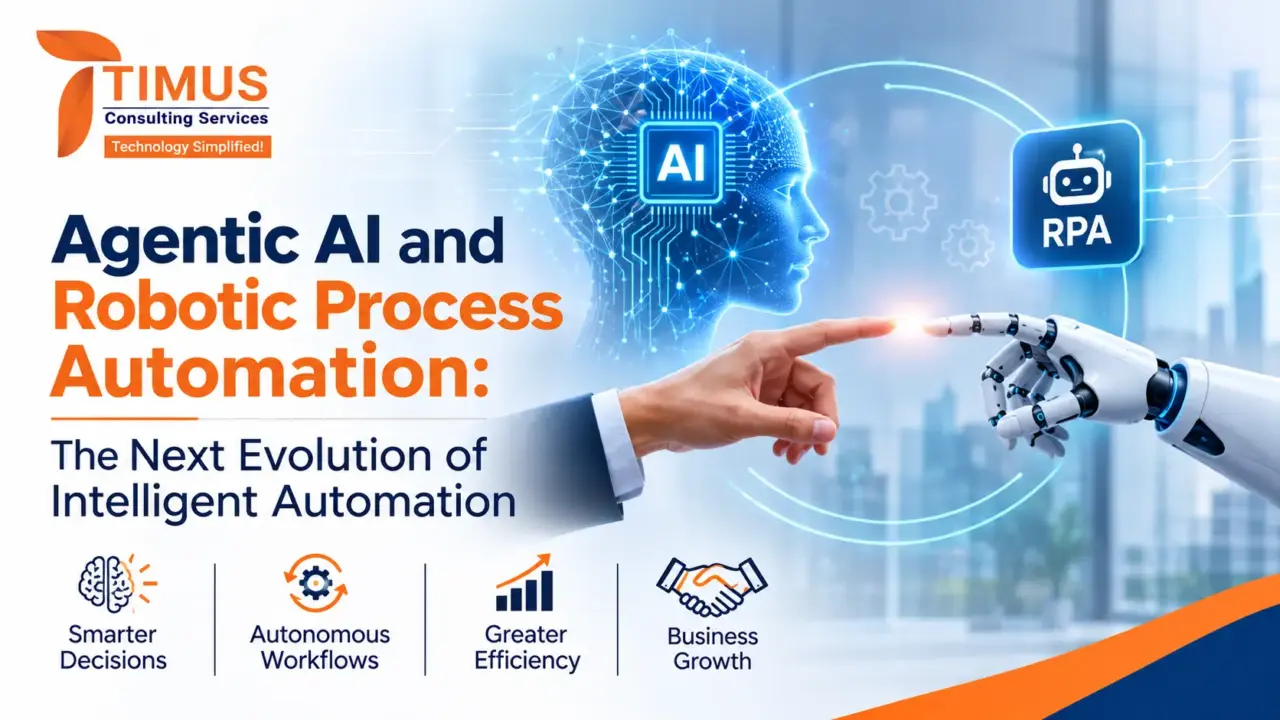
RPA acts as the hands, while Agentic AI acts as the brain.
RPA is effective at executing predefined actions consistently. Agentic AI is effective at interpreting information, selecting the next action, and adjusting the process based on context.
Consider an invoice-processing scenario. A traditional RPA bot can extract values from predefined fields, validate them against purchase-order data, and update the financial system. If the invoice contains an unusual format or an unexplained price difference, the bot may stop.
An AI agent can analyze the exception, review the supplier’s history, examine contractual terms, determine the likely cause, and decide whether the invoice should be approved, rejected, or escalated. It can then instruct the RPA bot to complete the required system updates.
Key Benefits of Combining Agentic AI and Robotic Process Automation
1. End-to-End Process Automation
RPA normally automates individual tasks within a process. Agentic AI can coordinate multiple tasks, systems, bots, and human approvals to manage the complete business process.
2. Intelligent Decision-Making
AI agents can analyze structured and unstructured information, understand context, compare alternatives, and recommend or execute an appropriate action.
3. Better Exception Handling
Instead of stopping when an unexpected condition occurs, an agent can investigate the exception, gather additional information, and determine the next step.
4. Natural-Language Interaction
Employees can communicate with AI agents through everyday language. A user might ask, “Review all overdue high-risk issues and notify the responsible owners.” The agent can interpret the request and coordinate the necessary automation.
5. Continuous Adaptation
Agentic systems can evaluate outcomes, learn from feedback, and improve their decisions over time. This makes automation more adaptable than a collection of static rules.
6. Improved Employee Productivity
By automating repetitive work as well as parts of analysis and coordination, organizations allow employees to focus on strategic decisions, stakeholder engagement, and complex problem-solving.
Business Use Cases
The combination of Agentic AI and Robotic Process Automation can be applied across multiple functions:
- Finance: Investigating invoice exceptions, reconciling accounts, and coordinating approvals
- Human Resources: Screening documents, supporting onboarding, and answering employee queries
- Customer Service: Understanding customer intent, resolving common requests, and updating CRM records
- IT Operations: Diagnosing incidents, executing remediation scripts, and escalating unresolved problems
- Supply Chain: Monitoring disruptions, evaluating alternatives, and updating orders
- Governance, Risk, and Compliance: Assessing issues, identifying applicable controls, recommending remediation, collecting evidence, and monitoring overdue actions
- Third-Party Risk: Reviewing vendor information, identifying risk indicators, initiating assessments, and escalating high-risk findings
Governance and Control Considerations
Giving AI agents the ability to initiate actions introduces new risks. Organizations must ensure that autonomous automation remains transparent, secure, and accountable.
Important controls include:
- Clearly defined agent objectives and authority boundaries
- Role-based access and least-privilege permissions
- Human approval for high-impact decisions
- Complete audit trails of decisions and actions
- Validation of AI-generated recommendations
- Monitoring for inaccurate, biased, or unexpected outputs
- Protection of sensitive and confidential data
- Emergency stop and rollback mechanisms
- Regular testing of bots, models, prompts, and integrations
Not every action should be fully autonomous. A risk-based model can be used in which low-risk activities are automated, medium-risk decisions require review, and high-risk decisions remain under human control.
A Practical Implementation Approach
Organizations can introduce Agentic AI and RPA gradually:
- Identify repetitive processes with high manual effort and clear business value.
- Separate deterministic tasks from activities requiring judgment.
- Use RPA for structured and repeatable system interactions.
- Introduce AI agents for interpretation, reasoning, planning, and exception handling.
- Define approval points and escalation rules.
- Test the solution in a controlled environment.
- Monitor accuracy, automation success, exceptions, and business outcomes.
- Expand autonomy only after the process demonstrates reliability.
This phased approach helps organizations achieve measurable benefits while maintaining appropriate governance.
Conclusion
Robotic Process Automation transformed business operations by automating repetitive tasks. Agentic AI represents the next stage of that transformation by adding reasoning, planning, adaptability, and autonomous coordination.
The real opportunity does not come from replacing RPA with Agentic AI. It comes from combining them. RPA provides reliable execution, while Agentic AI provides intelligence and direction.
Together, they can create a new generation of intelligent automation—one that not only performs tasks but also understands objectives, manages exceptions, coordinates workflows, and continuously works toward better business outcomes.
Frequently Asked Questions (FAQs)
1. What is Agentic AI in automation?
Agentic AI refers to AI systems that can independently understand objectives, make decisions, plan actions, and execute multi-step tasks with minimal human intervention.
2. What is Robotic Process Automation (RPA)?
RPA uses software bots to automate repetitive, rule-based tasks such as data entry, invoice processing, report generation, and transferring information between applications.
3. What is the difference between Agentic AI and RPA?
RPA follows predefined rules and workflows, while Agentic AI can understand context, make decisions, adapt to changing situations, and manage more complex tasks.
4. Can Agentic AI and RPA work together?
Yes. Agentic AI can handle decision-making and workflow coordination, while RPA bots execute structured, repetitive tasks. Together, they create more intelligent automation systems.
5. What are the business benefits of combining Agentic AI and RPA?
Key benefits include improved productivity, reduced manual effort, faster processing, better decision-making, reduced operational costs, and enhanced scalability.