
Introduction
Artificial Intelligence (AI) and Large Language Models (LLMs) have transformed the way we interact with technology. From answering questions and generating content to automating complex tasks, LLMs are becoming increasingly powerful.
However, they have one important limitation: they don’t automatically know everything about your private or organization-specific data.
For example, imagine asking an AI assistant:
- What is our company’s leave policy?
- Summarize the latest project documentation.
- What were the key findings in last month’s audit report?
- Based on our internal knowledge base, what is the recommended solution?
A general-purpose LLM might not know the answers because this information is not part of its training data.
This is where Retrieval-Augmented Generation (RAG) comes into the picture.
What is RAG?
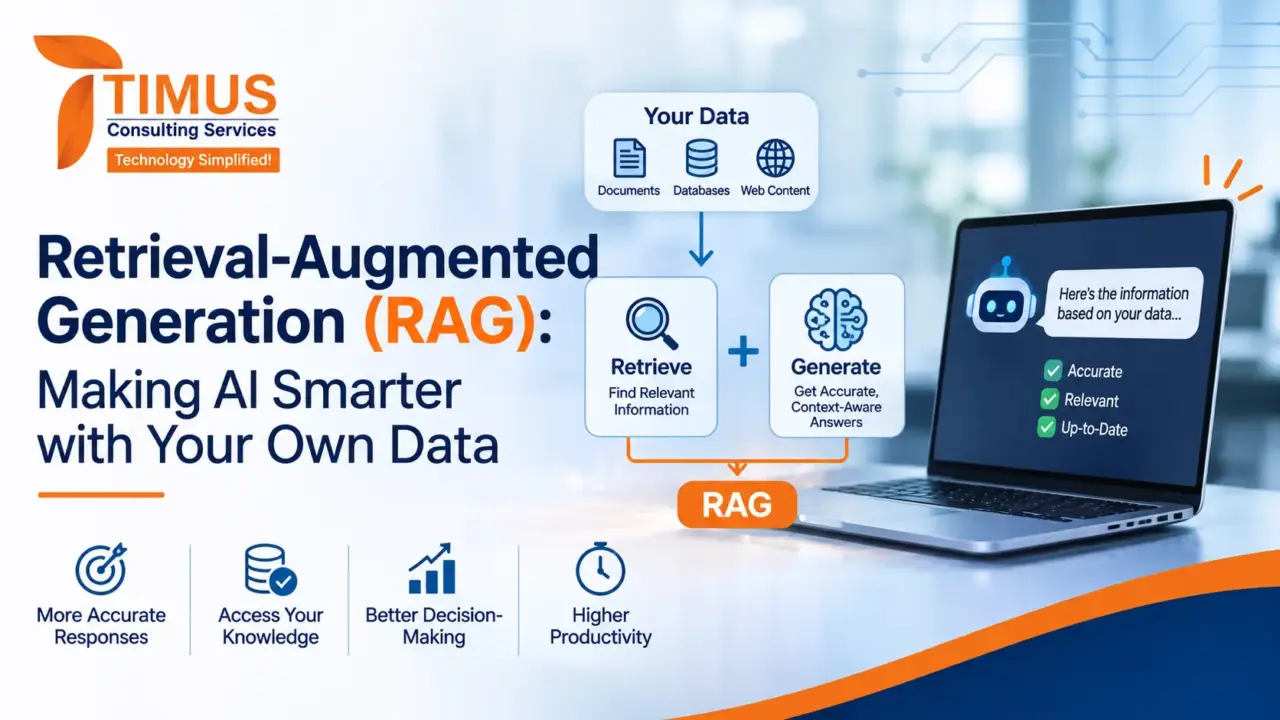
Retrieval-Augmented Generation (RAG) is an AI architecture that combines information retrieval with the text-generation capabilities of Large Language Models.
In simple terms, RAG allows an AI model to search for relevant information from an external knowledge source before generating a response.
Instead of relying only on what the model learned during training, RAG provides additional context from relevant documents, databases, or knowledge repositories.
Think of RAG as an AI assistant that can refer to your organization’s documents before answering your questions.
How Does RAG Work?
RAG generally follows five major steps:
1. Data Collection
The first step is collecting relevant information from different sources, such as:
- PDF documents
- Word files
- Excel spreadsheets
- Websites
- Internal databases
- Company knowledge bases
This information becomes the knowledge source for the AI application.
2. Data Chunking and Embedding
Large documents are divided into smaller sections called chunks.
Why is this necessary?
Because processing an entire document for every question can be inefficient. Smaller chunks make it easier to retrieve specific information.
Next, each chunk is converted into a numerical representation called an embedding.
Embeddings capture the semantic meaning of text, allowing the system to identify information based on meaning rather than just exact keyword matches.
3. Vector Database Storage
The generated embeddings are stored in a vector database.
A vector database helps identify and retrieve information that is semantically similar to a user’s question.
Examples include:
- Chroma
- Pinecone
- Weaviate
- FAISS
4. Information Retrieval
When a user asks a question, the system converts the query into an embedding and searches the vector database for the most relevant information.
It retrieves the document chunks that are most closely related to the question.
5. Response Generation
Finally, the retrieved information is passed to the LLM along with the user’s original question.
The LLM uses this additional context to generate a relevant and context-aware response.
This makes the response more grounded in the available information.
Understanding the RAG Architecture
The overall RAG workflow can be represented as:
User Query → Embedding Model → Vector Database → Relevant Context → LLM → Final Response
The key idea is simple:
Retrieve relevant information first, then generate the answer.
Real-World Applications of RAG
RAG is not just a theoretical AI concept. It has several practical applications across industries.
1. Enterprise Knowledge Assistant
Employees can ask questions about company policies, HR guidelines, project documentation, and internal processes without manually searching through multiple documents.
2. Customer Support Automation
Businesses can build AI-powered support assistants that retrieve information from product manuals, FAQs, and troubleshooting guides to provide accurate responses.
3. Healthcare Information Management
RAG can help retrieve relevant information from medical guidelines, research papers, and clinical documentation. Such systems require appropriate privacy controls and professional oversight.
4. Legal Document Analysis
Legal teams can use RAG to search contracts, agreements, case documents, and regulatory guidelines to identify relevant clauses and information.
5. Software Development Assistance
Developers can build AI assistants that understand internal code documentation, API references, technical manuals, and development standards.
RAG vs. Fine-Tuning: What’s the Difference?
One common question is whether RAG and fine-tuning serve the same purpose.
They do not.
| RAG | Fine-Tuning |
|---|---|
| Retrieves external information | Trains a model further |
| Uses updated knowledge sources | Updates model behavior and learned patterns |
| Does not require retraining the LLM | Requires additional model training |
| Useful for document-based Q&A | Useful for specialized behavior and output styles |
| Can provide source references | Does not inherently provide source references |
In many AI applications, RAG and fine-tuning can also be used together.
Benefits of RAG
Some major advantages of implementing RAG include:
- More relevant answers: Responses are generated using information retrieved from specific knowledge sources.
- Access to private data: Organizations can connect AI applications to internal knowledge repositories.
- Reduced hallucinations: Providing relevant context can reduce unsupported answers, although it cannot eliminate hallucinations entirely.
- Updated information: Knowledge sources can be updated without retraining the underlying LLM.
- Better transparency: Retrieved documents can be used to provide references supporting generated responses.
- Cost efficiency: RAG can be more practical than repeatedly fine-tuning a model whenever organizational information changes.
Challenges and Limitations of RAG
Although RAG offers several advantages, implementing it successfully requires careful planning.
Some common challenges include:
- Poor-quality documents can lead to irrelevant or inaccurate responses.
- Incorrect chunking strategies can result in missing important context.
- Retrieval quality directly affects the quality of generated answers.
- Large knowledge repositories can increase processing time and infrastructure costs.
- Sensitive information must be protected through proper access controls.
- Retrieved content can contain misleading instructions, making prompt-injection protection important.
Therefore, a successful RAG implementation requires more than simply connecting a vector database to an LLM.
Getting Started with RAG
For developers who want to explore RAG practically, a simple technology stack could include:
- Python: For application development.
- LangChain: For building retrieval and LLM workflows.
- Embedding Models: For converting text into numerical vectors.
- ChromaDB: For storing and searching embeddings.
- LLM: For generating responses using retrieved context.
- Streamlit: For building a simple user interface.
A great beginner project is to build a Chat with Your PDF application.
Upload a PDF, process its content, store its embeddings, and build a chatbot that answers questions based on the uploaded document.
This small project demonstrates the complete RAG pipeline.
Conclusion
Retrieval-Augmented Generation represents an important step toward building more useful and context-aware AI applications.
By combining information retrieval with the intelligence of Large Language Models, RAG enables organizations to build AI assistants that can work with their own knowledge and information.
As businesses continue adopting Generative AI, RAG will play an important role in connecting powerful AI models with real-world
Frequently Asked Questions (FAQs)
Q1. What is Retrieval-Augmented Generation (RAG)?
Retrieval-Augmented Generation (RAG) is an AI technique that combines large language models with external knowledge sources to generate more accurate, relevant, and context-specific responses.
Q2. How does RAG improve AI responses?
RAG retrieves relevant information from trusted data sources before generating an answer, helping reduce inaccurate responses and providing more context-aware results.
Q3. What are the key benefits of RAG for businesses?
Key benefits include improved response accuracy, access to company-specific knowledge, reduced hallucinations, better decision-making, and enhanced productivity.
Q4. How is RAG different from traditional generative AI?
Traditional generative AI primarily relies on information learned during training, whereas RAG retrieves relevant external information to provide updated and business-specific answers.
Q5. Where can businesses use RAG technology?
Businesses can use RAG for customer support chatbots, enterprise knowledge management, document search, compliance management, employee assistance, and intelligent business applications.