
Introduction:
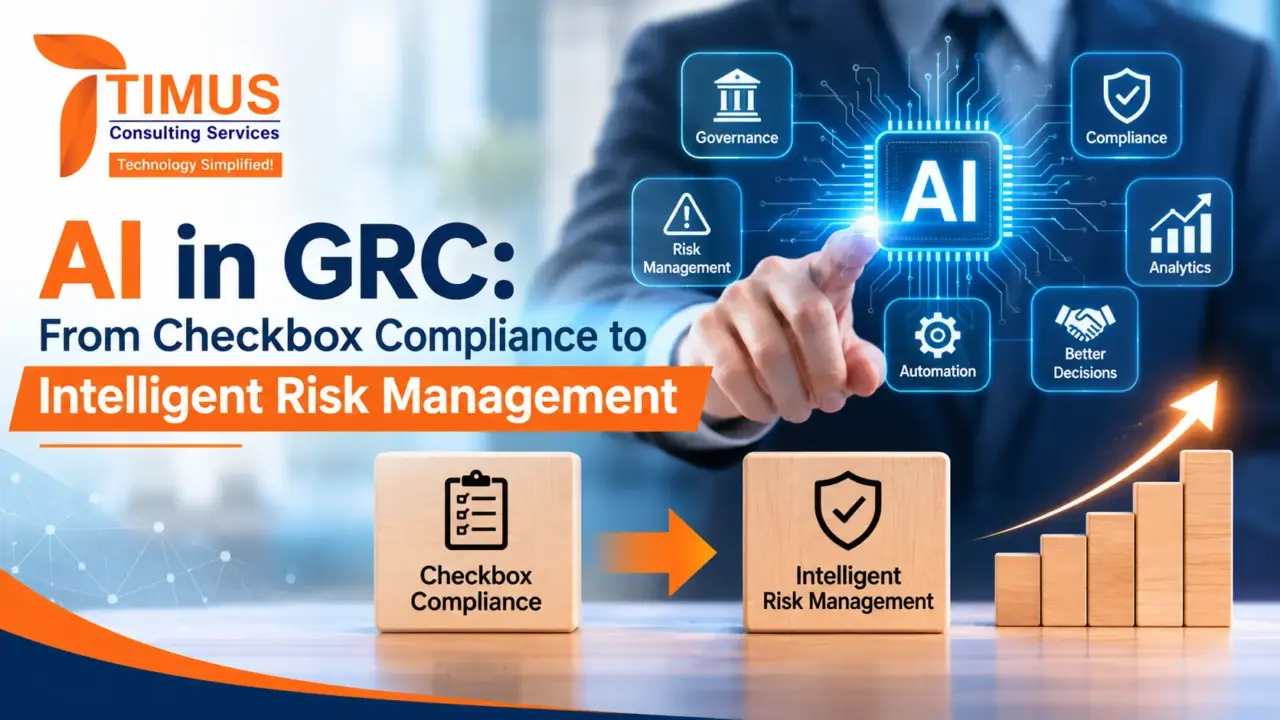
Governance, Risk, and Compliance (GRC) has always been a discipline of discipline: policies, controls, assessments, audits, and endless evidence collection. For years, the work has been manual, periodic, and backward-looking. Artificial intelligence is changing that. Teams that once spent weeks assembling quarterly reports can now surface emerging risks in near real time, and the conversation is shifting from “are we compliant?” to “are we resilient?”
This post looks at where AI is making a real difference in GRC, where the pitfalls are, and how to adopt it responsibly.
Why GRC Is Ready for AI
GRC programs sit on top of enormous volumes of unstructured information: regulations, contracts, policies, audit findings, incident reports, vendor questionnaires, and control evidence. Three pressures make AI a natural fit:
- Regulatory volume and velocity. New and changing regulations arrive faster than teams can interpret them.
- Resource constraints. Risk and compliance teams are rarely growing at the pace of their obligations.
- Data overload. Valuable risk signals are buried in documents, logs, and emails that humans cannot review at scale.
AI, particularly machine learning and large language models (LLMs), is good at exactly these problems: reading, classifying, summarizing, and spotting patterns in large datasets.
Where AI Adds Value Today
1. Regulatory Change Management
LLMs can read new regulations, summarize what changed, and map requirements to your existing policies and controls. Instead of a compliance analyst reading a 200-page rule, the system highlights the affected controls and drafts a gap analysis for human review.
2. Risk Assessment and Scoring
Machine learning models can analyze historical loss events, control test results, and key risk indicators to suggest inherent and residual risk ratings. This does not replace judgment, but it gives risk owners a data-backed starting point and reduces inconsistency between assessors.
3. Continuous Controls Monitoring
Traditional control testing samples a small slice of transactions at a point in time. AI-driven monitoring can analyze full populations continuously, flagging anomalies such as unusual access patterns, duplicate payments, or segregation-of-duties conflicts as they happen.
4. Third-Party and Vendor Risk
AI can automatically review vendor questionnaires, SOC reports, and contracts, and monitor external signals like news, financial health, and security ratings. This turns vendor risk from an annual survey into a living view.
5. Audit and Evidence Automation
Generative AI can draft audit workpapers, summarize evidence, and answer auditor questions against a library of documented controls. Teams report meaningful time savings on the repetitive parts of audit preparation.
6. Policy and Control Authoring
Drafting and harmonizing policies across frameworks (ISO 27001, SOC 2, NIST, GDPR, and others) is tedious. AI can suggest unified control sets and flag duplicated or conflicting requirements, so one control can satisfy many frameworks.
7. Incident and Issue Management
Natural language processing can categorize incidents, identify root-cause themes, and recommend remediation actions based on similar past issues.
The Other Side: Governing AI Itself
AI in GRC has a second meaning that is just as important: GRC for AI. As organizations deploy AI, they inherit new risks, including bias, hallucination, data leakage, model drift, and opaque decision-making. Regulations such as the EU AI Act and frameworks like the NIST AI Risk Management Framework and ISO/IEC 42001 are turning AI governance into a formal compliance obligation.
A mature GRC program now needs to:
- Maintain an inventory of AI systems and use cases
- Classify AI risk by impact and regulatory category
- Assign ownership and accountability for each model
- Define controls for testing, monitoring, and human oversight
- Track incidents and issues involving AI behavior
The GRC platform becomes the system of record not only for traditional risk, but for AI risk too.
Challenges and Risks to Watch
AI is powerful, but adopting it in a risk function means holding it to a higher standard.
- Explainability. Regulators and auditors want to know why a risk was rated high. Black-box outputs are hard to defend.
- Hallucinations. An LLM that invents a regulatory citation is a compliance risk, not just an annoyance. Outputs must be grounded in source documents and verified.
- Data privacy and confidentiality. Control evidence and risk data are sensitive. Be clear about where data goes and how it is used.
- Bias and consistency. Models trained on historical data can reinforce past blind spots.
- Over-reliance. Automation can create false confidence. Human judgment must stay in the loop for material decisions.
- Data quality. AI amplifies whatever it is given. Messy risk registers produce messy insights.
A Practical Roadmap for Adoption
- Start with a clear use case. Pick a high-volume, low-regret task such as policy mapping, questionnaire review, or issue categorization rather than trying to transform everything at once.
- Fix the foundation. Clean up your risk taxonomy, control library, and data. Structured, consistent GRC data makes every AI feature work better.
- Keep humans in the loop. Treat AI output as a recommendation that a qualified person reviews and approves, with a clear audit trail.
- Ground outputs in your own content. Use retrieval from your approved policies, controls, and regulations to reduce hallucination and keep answers traceable.
- Govern the AI. Register the AI use case in your own GRC platform, assess its risk, define controls, and monitor it like any other material risk.
- Measure outcomes. Track time saved, issues detected earlier, and assessment consistency, so you can show value and refine.
- Build skills. Invest in training so risk and compliance professionals understand what AI can and cannot do.
What This Means for GRC Teams
AI will not replace risk and compliance professionals. It will change what they spend time on. Less time collecting evidence, reformatting reports, and chasing questionnaires; more time on judgment, advising the business, and anticipating what could go wrong next.
The organizations that benefit most will be the ones that pair AI capability with strong governance: clean data, clear accountability, transparent models, and humans who stay in charge of the decisions that matter.
Conclusion
AI is moving GRC from a periodic, reactive function toward a continuous, predictive one. The opportunity is significant, but so is the responsibility. Start small, ground your AI in trusted data, keep people accountable, and treat AI as both a tool for GRC and a subject of GRC. Done well, it turns compliance from a cost center into a genuine source of resilience and insight.
Frequently Asked Questions (FAQs)
Q1. What is AI in GRC?
AI in Governance, Risk, and Compliance (GRC) uses artificial intelligence, machine learning, and automation to improve risk identification, compliance monitoring, reporting, and decision-making.
Q2. How does AI improve traditional GRC processes?
AI reduces manual work, automates compliance checks, identifies potential risks, analyses large datasets, and provides real-time insights, making GRC processes faster and more efficient.
Q3. What are the key benefits of AI-powered GRC?
Key benefits include:
-
Automated compliance monitoring.
-
Early risk detection and prediction.
-
Reduced manual effort.
-
Improved reporting accuracy.
-
Better decision-making.
-
Continuous risk monitoring.
Q4. Can AI help organizations identify risks before they occur?
Yes. AI-powered predictive analytics can analyse historical data, identify unusual patterns, and highlight potential risks before they develop into major problems.
Q5. How does AI support regulatory compliance?
AI helps organizations monitor regulatory changes, automate compliance assessments, identify policy gaps, and maintain accurate compliance documentation.
Q6. Is AI in GRC suitable for banks and financial institutions?
Yes. Banks and financial institutions can use AI in GRC to monitor financial risks, detect suspicious activities, strengthen internal controls, and improve regulatory compliance.
Q7. Does AI replace human decision-making in GRC?
No. AI supports human decision-making by providing insights, identifying risks, and automating repetitive tasks. Human oversight remains essential for strategic decisions and accountability.