

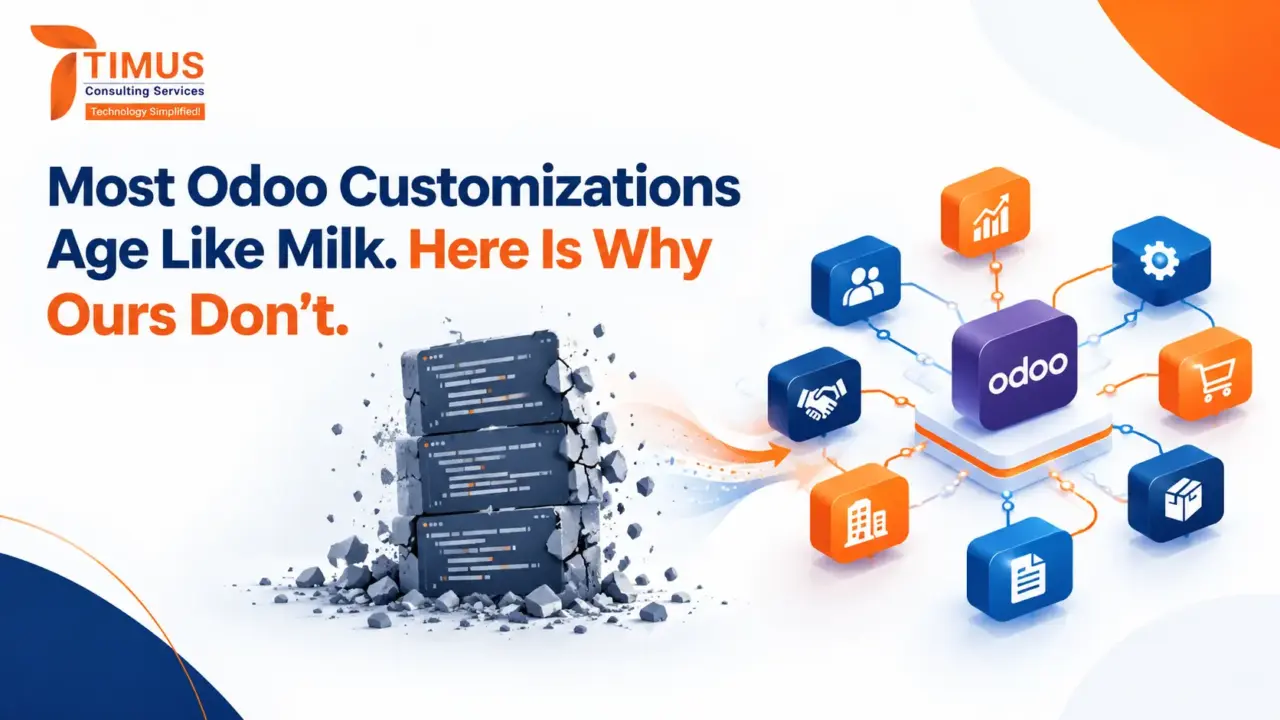
Ask any CTO or Finance Head who has lived through a difficult Odoo upgrade what went wrong, and you will almost always hear the same story. The initial implementation went fine. The business needed a few custom approval workflows, a specialized inventory calculation, and an integration with a local logistics provider. Their implementation partner said, “No problem, Odoo is open-source, we can customize anything.” They wrote the code, went live, and moved on.
The “Yes-Man” Trap in Odoo Development
- Because Odoo’s Python and PostgreSQL architecture is so flexible, an inexperienced developer can force it to do almost anything. If you ask for a ten-step custom button on an invoice screen, a junior developer will happily spend forty hours hardcoding it directly into the system’s core views.
They delivered what you asked for, so it feels like a win. In reality, they just planted a landmine in your ERP.
There is a massive difference between writing code that works today and engineering an ERP that scales for five years. When you don’t have highly skilled Odoo resources leading the build, three things inevitably happen: - You rebuild features Odoo already has. We routinely audit systems where a previous vendor wrote thousands of lines of custom code to handle multi-step manufacturing routes or complex tax rules that Odoo supports natively out of the box—simply because the developer didn’t know the functional platform deeply enough.
- Your database grinds to a halt at scale. Code that works fine on a test server with 500 records will crash a live system with 500,000 invoice lines. Unoptimized database queries and poorly written automated actions are the number one reason growing businesses complain that “Odoo is slow.”
- Security and access controls break silently. When custom modules are built in a rush, record rules and user permissions are often bypassed to “just make the screen work.” Suddenly, a warehouse clerk can see financial margins, or a sales rep can alter an approved purchase order without triggering a log.
What Having the “Right Resources” Actually Looks Like
- The “Configuration First, Code Second” Rule: Our functional architects challenge every customization request before it ever reaches a developer. If a workflow can be achieved using 90% native Odoo configuration and 10% clean extension, we will never let you pay for 100% custom code.
- Upgrade-Safe Inheritance: When we do write custom modules, our engineers never touch Odoo’s core files. We build modular, loosely coupled extensions using strict inheritance patterns. When Odoo 20 or 21 drops, your custom logic upgrades cleanly instead of breaking the whole system.
- Enterprise-Grade Integrations: No ERP lives on an island. Whether we are connecting Odoo to third-party payment gateways, e-commerce storefronts, legacy banking portals, or AI-driven analytics pipelines, our engineers build fault-tolerant APIs with proper retry logic, payload logging, and failure alerts—so a dropped connection never means a lost order.
- Performance Engineering for High Volume: Our backend specialists write ORM queries and PostgreSQL indexes designed for heavy transaction loads. Whether you are processing ten orders a day or ten thousand, the system responds in milliseconds.
Four Questions to Test Your Odoo Partner’s Technical Depth
Before you hire a team to build or rescue your Odoo environment, put their lead architect in a room and ask them these four questions:
1. “Tell me about a time you talked a client out of a customization.” If they brag about building everything the client asks for, run. A skilled consultant protects you from unnecessary technical debt.
2. “How do you ensure custom modules won’t block our next version upgrade?” Look for specific answers about clean module separation, automated testing, and avoiding monkey-patching core methods.
3. “How do you handle failed API calls between Odoo and our other software?” If there is no mention of dead-letter queues, webhook logs, or automated retry mechanisms, your staff will end up reconciling failed syncs manually in Excel.
4. “Who reviews the code before it hits our production server?” High-performing teams enforce peer code reviews, staging environment sign-offs, and role-based access testing before any change goes live.
You don’t choose Odoo just to get your business off spreadsheets for a year. You choose it to build an operational backbone that can scale across new products, new warehouses, and new countries. Make sure the hands building that backbone know how to engineer it for the long haul.
Timus Consulting Services is a GRC-first consultancy delivering Odoo ERP, AI/ML, Cloud, and business consulting across India, the UAE, the UK, Ireland, Canada, and the US. Whether you are planning a fresh Odoo rollout, need dedicated senior developers to scale your current setup, or want a technical health check on an existing implementation, reach out to our team at timusconsulting.com or business@timusconsulting.com.
FAQs
1. Why do so many Odoo implementations become difficult to upgrade?
Most upgrade failures happen when developers modify core Odoo files directly or install poorly written third-party apps instead of following Odoo’s modular inheritance standards. Cleanly architected custom modules are far faster and cheaper to migrate across versions.
2. Should we customize Odoo or adapt our processes to standard Odoo?
A healthy benchmark is the 80/20 rule: use standard Odoo workflows for the 80% of your business that follows standard accounting, inventory, and sales practices, and reserve custom development for the 20% that gives your business a true competitive advantage.
3. Why is our current Odoo system running slowly as our data grows?
Performance bottlenecks in Odoo are rarely caused by the platform itself. They are usually triggered by unoptimized custom code, inefficient database queries (N+1 query problems), unindexed fields, or improperly tuned PostgreSQL and server workers.
4. Can Timus take over and fix an existing Odoo implementation built by another vendor?
Yes. We regularly conduct technical and functional audits of existing Odoo environments, refactor broken or slow custom modules, clean up database discrepancies, and stabilize systems without disrupting daily operations.
5. How does Timus integrate Odoo with external software and legacy systems?
Our engineering team builds secure, fault-tolerant REST and webhook integrations that connect Odoo with e-commerce platforms, 3PL logistics providers, payment gateways, BI tools, and custom enterprise software—complete with automated error logging and retry mechanisms.