
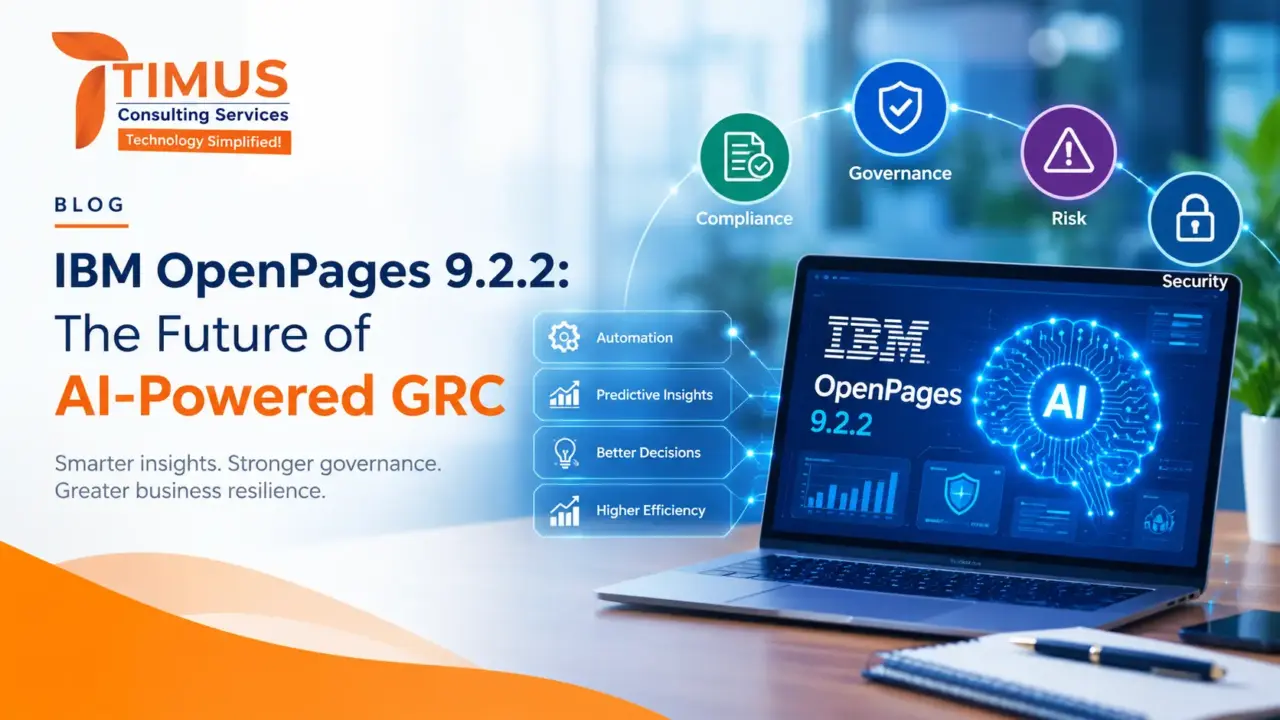
Explore IBM OpenPages 9.2.2 and its latest AI-powered GRC capabilities, including intelligent recommendations, document analysis, workflow automation, and simplified enterprise governance.
Introduction
In today’s rapidly evolving business environment, organizations face increasing pressure to manage risks, maintain regulatory compliance, strengthen internal controls, and make informed decisions. Traditional Governance, Risk, and Compliance (GRC) approaches often depend on manual assessments, disconnected systems, spreadsheets, and time-consuming reviews.
As organizations grow, these approaches can make it difficult to maintain consistent oversight across departments, identify emerging risks, and respond quickly to changing business requirements.
IBM OpenPages is designed to address these challenges by providing an integrated platform for managing enterprise risk, compliance, internal audit, and related governance activities. With the release of IBM OpenPages 9.2.2, IBM continues to expand the role of artificial intelligence (AI) in GRC, helping organizations move beyond identifying risks toward taking informed, structured action.
What’s New in IBM OpenPages 9.2.2?
IBM OpenPages 9.2.2 builds on the AI capabilities introduced in version 9.2 and expanded in version 9.2.1. The latest release focuses on connecting AI-generated insights with business processes, improving user experiences, and simplifying system administration.
1. AI-Powered Insights and Recommendations
One of the most significant developments in OpenPages is the integration of AI into everyday GRC activities.
Organizations frequently manage interconnected risks, controls, issues, policies, and action items. Identifying relationships between these records can require considerable manual effort, particularly in large enterprise environments.
OpenPages 9.2.2 introduces AI-powered relationship recommendations within the View Insights experience. These recommendations can help users identify relevant GRC records and establish meaningful connections between them.
For example, when reviewing a risk, an analyst may use AI-powered recommendations to identify potentially related controls, existing issues, or other risk records. This can help improve visibility into relationships that might otherwise be overlooked.
The release also expands preconfigured AI model templates for common GRC activities, including risk assessments, audit planning, control analysis, issue similarity analysis, and personally identifiable information (PII) detection.
Business value: Reduced manual investigation, improved consistency, and better-informed risk assessments.
2. AI-Driven Workflow Automation
Identifying a risk or issue is only one part of effective risk management. Organizations must also assign responsibilities, create action plans, connect related records, and monitor progress until the matter is resolved.
OpenPages 9.2.2 expands the ability to incorporate AI-powered actions into configured workflows. These actions can include creating and linking related GRC records as part of an established process.
Consider a practical example: an organization identifies a potential control deficiency during an assessment. Depending on the configured workflow and available AI capabilities, the system can help identify related records and support the creation of an associated issue or action item.
This can reduce repetitive data entry and help teams move from identifying a problem to managing its resolution.
AI-driven actions should still operate within appropriate permissions, workflow conditions, review requirements, and organizational governance policies.
Business value: Less repetitive work, more consistent record relationships, and a more efficient path from risk identification to remediation.
3. Expanded AI-Powered Document Analysis
GRC teams regularly review policies, audit reports, vendor assessments, regulatory documents, and supporting evidence. Extracting relevant information from these documents can consume significant time.
OpenPages 9.2.2 expands AI-powered document analysis to additional model providers, including Anthropic Claude Sonnet, watsonx.ai, and Mistral, alongside existing support for Google Gemini and OpenAI.
Users can generate insights from documents attached to GRC records, including supported PDF and Word files.
This capability can support activities such as identifying relevant information in evidence documents, summarizing supporting material, and assisting reviewers during risk and compliance assessments.
For example, during a third-party risk assessment, an analyst may need to examine a vendor’s security documentation. AI-assisted analysis can help surface relevant information for review rather than requiring the analyst to begin with a completely manual document examination.
AI-generated findings should be validated against the original evidence before they are used to support formal risk decisions.
Business value: Faster evidence review, reduced manual reading effort, and improved access to relevant information.
4. Greater Flexibility for Enterprise AI Integration
Organizations have different requirements for AI models, authentication, infrastructure, and data protection. A single integration approach may not meet every enterprise’s needs.
OpenPages 9.2.2 expands flexibility through support for generic OAuth 2.0 authentication, client-managed API gateways, and additional AI model integrations.
The release also extends support for the OpenPages Model Context Protocol (MCP) Server to on-premises deployments.
MCP provides a standardized way for compatible AI agents and applications to interact with supported tools and contextual information. In the OpenPages environment, this creates opportunities to connect AI-assisted interactions with governed GRC data and processes.
For example, a risk professional could use a compatible AI agent to help understand workflow stages, identify task ownership, or determine the requirements for advancing a workflow.
Such integrations must be configured with appropriate access controls and governance safeguards. AI access does not eliminate the need for authorization, auditability, or human accountability.
Business value: Greater flexibility in adopting enterprise AI while aligning integrations with existing infrastructure and security requirements.
5. Improved GRC Canvas and Questionnaire Experiences
Effective GRC depends on how easily users can understand relationships and complete assessments.
OpenPages continues to enhance GRC Canvas, which provides a visual way to explore connections among risks, controls, policies, issues, and other business objects.
Version 9.2.2 allows users to create related objects directly within a canvas and launch canvases with fewer steps. These improvements can reduce context switching and help teams work with connected GRC information more efficiently.
Questionnaires also receive enhancements. Respondents can view existing object field values within questions, while the new Object Selector answer type enables related GRC records to be associated directly with questionnaire responses.
These features can help organizations collect more contextual information and establish stronger links between assessment responses and the records they support.
Business value: Better-connected GRC information, more convenient assessment experiences, and improved visibility into relationships across the enterprise.
6. Simplified Administration and Configuration Management
Maintaining an enterprise GRC platform involves more than configuring objects and workflows. Administrators must also manage changes across development, testing, and production environments.
OpenPages 9.2.2 enhances Configuration Packaging, enabling administrators to include additional assets such as GRC Canvas templates and JSP reports. It also introduces improvements to package change tracking, configuration validation, and deployment performance.
Additionally, GRC Scripting enables JavaScript-based customizations within OpenPages for supported administrative and business requirements.
These capabilities can help teams automate repetitive tasks, validate data, respond to workflow actions, and manage configuration changes more systematically.
For organizations with multiple environments, controlled configuration promotion and validation can be especially valuable when introducing new workflows, reports, or business rules.
Business value: More manageable configuration lifecycles, reduced administrative effort, and improved control over platform changes.
What Does IBM OpenPages 9.2.2 Mean for Businesses?
The value of a GRC platform is not measured only by the number of features it offers. Its real impact depends on whether it helps an organization manage risks more effectively and make better decisions.
IBM OpenPages 9.2.2 provides opportunities for organizations to improve several areas of GRC operations:
- Operational risk management: Connect related risks, issues, controls, and action items more effectively.
- Internal audit: Support audit planning, document analysis, and the identification of relevant information.
- Compliance management: Improve assessment processes and establish clearer connections between evidence and compliance records.
- Third-party risk management: Support the analysis of vendor documentation and related risk information.
- AI governance: Explore governed interactions between AI agents and enterprise GRC processes.
- Platform administration: Improve configuration management and reduce repetitive administrative work.
The actual benefits depend on the organization’s configuration, licensing, supported integrations, data quality, and implementation approach.
The Future of GRC: From Risk Visibility to Intelligent Action
The evolution of IBM OpenPages reflects a broader shift in enterprise GRC. Organizations increasingly need platforms that do more than store risk information or generate reports. They need connected systems that help people interpret information, identify relationships, support decisions, and execute governed processes.
AI can contribute to this transformation by reducing repetitive analysis and making relevant information easier to access. Workflow integration can help translate insights into action, while configuration and security controls provide the structure required for enterprise adoption.
However, successful AI-powered GRC depends on more than technology alone. Reliable data, well-designed workflows, clear accountability, effective change management, and human oversight remain essential.
IBM OpenPages 9.2.2 represents another step toward this more connected and intelligent approach to governance, risk, and compliance.
Conclusion
IBM OpenPages 9.2.2 expands the platform’s AI capabilities, strengthens workflow integration, improves document analysis, and simplifies configuration management. For organizations looking to modernize their GRC operations, these enhancements create opportunities to reduce manual effort, improve visibility, and make risk-related processes more efficient.
The key is to adopt these capabilities with a clear business objective and a well-defined implementation strategy.
Organizations that align platform modernization with their risk management objectives can build a stronger foundation for consistent, scalable, and accountable enterprise governance.