

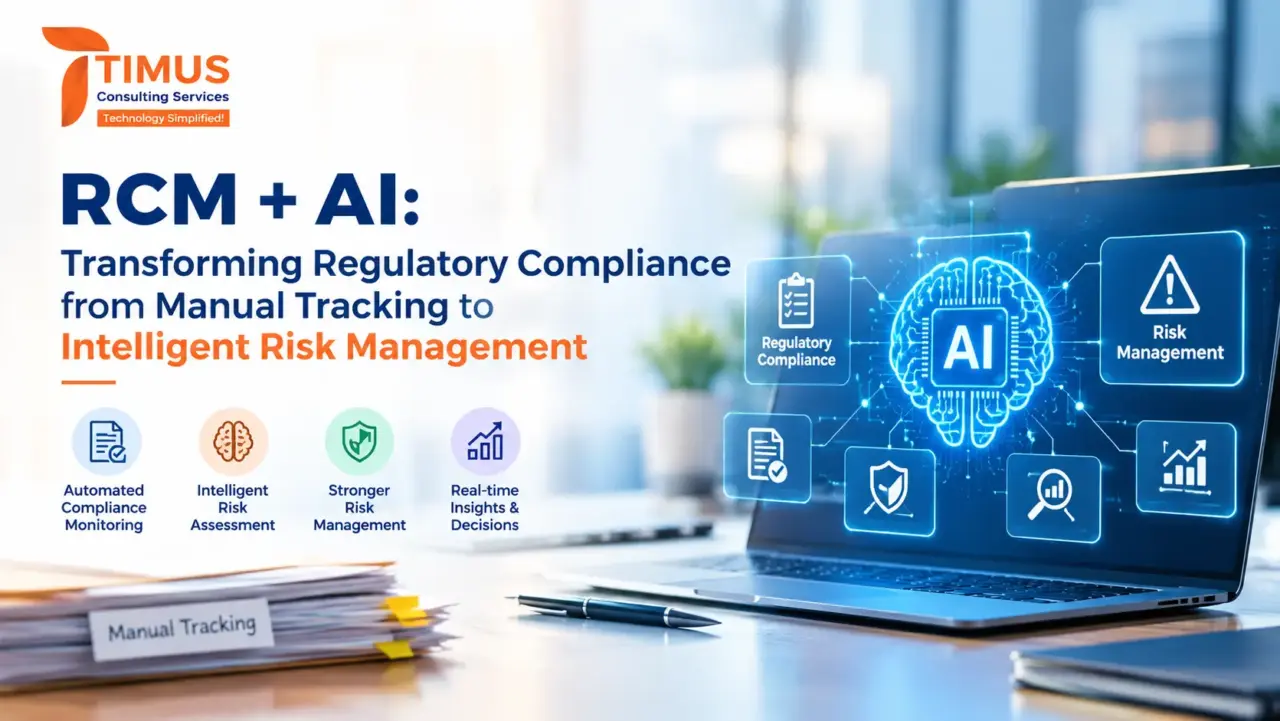
Introduction: The Growing Complexity of Regulatory Compliance
In today’s rapidly changing regulatory environment, organizations—especially banks and financial institutions—must continuously monitor new regulations, circulars, guidelines, and compliance obligations.
Traditionally, many compliance activities have relied on manual reviews, spreadsheets, email communications, and periodic assessments. While these methods may work for a limited volume of requirements, they become increasingly difficult to manage as regulatory expectations grow.
A single regulatory update can affect multiple business units, policies, processes, controls, and even financial risk models. Identifying these dependencies, assigning responsibility, and tracking implementation can require significant coordination.
This is where Regulatory Compliance Management (RCM) combined with Artificial Intelligence (AI) can create meaningful value.
Rather than replacing compliance professionals, AI can help them process information faster, identify potential impacts, reduce repetitive work, and make better-informed decisions.
1. Understanding RCM and AI
Regulatory Compliance Management is the structured process of identifying applicable regulations, translating them into requirements, assigning responsibilities, assessing compliance, collecting evidence, and managing gaps until they are resolved.
AI adds an intelligence layer to this process.
It can help interpret large volumes of regulatory text, summarize changes, classify requirements, suggest relationships with existing compliance records, and highlight areas that may require further investigation.
For example, IBM OpenPages Regulatory Compliance Management supports the organization of regulations and requirements, mapping to internal risk and control frameworks, compliance assessments, and responses to regulatory events. AI-assisted capabilities can complement these processes, depending on the platform’s features, configuration, and integrations.
The opportunity is to connect regulatory information with business action—not simply store more documents.
2. Where Can AI Add Value in RCM?
A. Regulatory Change Identification and Summarization
Organizations may receive regulatory updates from multiple authorities and external regulatory intelligence providers. Understanding which changes are relevant can be time-consuming.
AI can help by:
- Summarizing lengthy circulars and regulatory publications.
- Extracting key dates, topics, stated obligations, and deadlines.
- Comparing new text with earlier versions to highlight potential changes.
- Categorizing updates by regulatory area, such as cybersecurity, KYC, digital payments, or outsourcing.
Example: A new banking circular introduces additional security expectations for digital payment systems. AI creates a summary of the new provisions and highlights the sections that appear to introduce, amend, or clarify existing requirements.
The Compliance Analyst then validates the summary against the original publication.
B. Intelligent Impact Assessment
Identifying a regulatory change is only the beginning. The organization must determine what the change means for its operations.
AI can compare the new regulatory text with an existing repository of requirements, obligations, controls, policies, and business processes. It can recommend potential relationships and highlight records that may need review.
For example, a new requirement concerning access control could potentially affect:
- Information Security.
- IT Operations.
- Digital Banking.
- Existing access review obligations.
- Relevant policies and internal controls.
AI could produce a proposed impact list with explanations and references to the supporting text.
This is important: AI should recommend potential impacts, not make final legal applicability decisions without appropriate review. A qualified compliance professional must validate the recommendations.
C. Requirement Mapping and Gap Detection
One of the most valuable applications of AI is helping identify missing or incomplete links between regulatory requirements and the organization’s compliance framework.
Suppose a regulation requires periodic access reviews for critical systems.
An AI-assisted process could compare this requirement with existing records and flag questions such as:
- Is a corresponding internal obligation recorded?
- Is an accountable owner assigned?
- Is a control mapped to the requirement?
- Is the assessment frequency defined?
- Is there evidence that the control operates as intended?
The result is a set of potential gaps for the Compliance team to investigate.
AI can also assist with drafting requirement descriptions and suggesting classifications. However, every proposed mapping should be checked for accuracy and duplication before it becomes an approved record.
D. Smarter Workflows and Action Tracking
After an impact assessment, organizations need to move from analysis to implementation.
AI can help summarize assessment findings, draft task descriptions, recommend responsible teams based on approved ownership data, and highlight actions that may need attention.
Workflow automation can then route items for review, assign due dates, send notifications, and enforce required approvals.
For instance, if a regulatory change affects Digital Banking and Information Security, the process could create separate impact review tasks for both business units.
Each task would have an owner, a deadline, a status, and a clear completion requirement.
The workflow—not the AI-generated recommendation—should enforce mandatory approvals and closure conditions.
3. Connecting RCM with Model Risk Governance (MRG)
The value becomes even more interesting when Regulatory Compliance Management is connected with Model Risk Governance.
Financial institutions use models for activities such as credit scoring, fraud detection, customer risk assessment, and financial forecasting. Regulatory changes may influence how certain models must be developed, validated, documented, monitored, or governed.
Consider this hypothetical scenario.
A new regulatory requirement changes expectations for the validation of a particular category of credit risk models.
An AI-assisted RCM process identifies the requirement and suggests that it may affect the bank’s model governance framework. The Compliance team validates the interpretation and identifies the relevant business area.
The MRG team then reviews the model inventory to determine which models may be affected.
An integrated process could look like this:
Regulatory Change → Requirement Mapping → Potentially Impacted Models → MRG Assessment → Validation or Remediation → Evidence and Approval
AI could assist in comparing regulatory text with model documentation, identifying potentially affected models, summarizing validation findings, and highlighting missing documentation.
The MRG team remains responsible for confirming model impact, determining validation requirements, assessing findings, and approving the outcome under the bank’s governance policies.
The goal is a traceable relationship between regulatory expectations and model governance activities, rather than two disconnected compliance processes.
4. A Practical Architecture for RCM + AI
A sensible implementation can begin with an AI-assisted workflow rather than an autonomous compliance system.
Step 1 — Regulatory information enters the process.
An authorized source provides a new circular, regulatory notice, or updated requirement.
Step 2 — AI extracts and summarizes information.
The AI component proposes key topics, relevant dates, changed provisions, and a structured summary. Source references are retained wherever possible.
Step 3 — Existing records are compared.
The system searches approved compliance records and suggests potentially affected requirements, controls, obligations, business units, or models.
Step 4 — Compliance professionals review the recommendations.
Analysts confirm applicability, correct inaccurate suggestions, identify omitted impacts, and document their decisions.
Step 5 — Governed workflows initiate actions.
Approved assessments are routed to responsible owners. Tasks, deadlines, reviews, and escalations follow defined business rules.
Step 6 — Evidence and completion are verified.
Owners submit supporting evidence, reviewers validate completion, and the system retains an audit trail.
Step 7 — Dashboards provide visibility.
Management can monitor regulatory changes awaiting assessment, affected business units, overdue tasks, unresolved compliance gaps, and implementation progress.
IBM OpenPages offers a configurable GRC platform and supports regulatory workflows and external regulatory-data integrations. The exact AI architecture and automation available for a particular implementation must be confirmed against its product version, licences, configuration, and integration requirements.
5. The Risks of Using AI in Regulatory Compliance
AI introduces opportunities, but it also introduces risks that must be managed deliberately.
Incorrect interpretations: AI may misinterpret complex legal language or omit an important exception.
Missed requirements: A generated summary may overlook a clause, deadline, condition, or affected business unit.
Unsupported recommendations: AI may suggest a relationship or conclusion that cannot be justified by the source material.
Data confidentiality: Regulatory documents and internal compliance records may contain confidential information that must be handled according to organizational policies.
Unclear accountability: If a recommendation is incorrect, the organization must still be able to establish who reviewed it, who approved the decision, and what evidence supported the outcome.
Organizations should use controlled source material, access restrictions, human review, documented decision-making, testing, monitoring, and complete audit trails.
The NIST AI Risk Management Framework and its Generative AI Profile provide useful guidance for evaluating and managing AI-related risks throughout the system lifecycle.
The principle is straightforward: AI may accelerate analysis, but accountability for regulatory decisions must remain clearly assigned.
6. How Organizations Can Start
A successful RCM + AI initiative does not need to automate every compliance activity at once.
A practical phased approach could be:
Phase 1 — Assist: Use AI to summarize regulatory publications and extract structured information for analyst review.
Phase 2 — Recommend: Introduce suggested requirement mappings, potential business impacts, and possible gaps, with source references and human validation.
Phase 3 — Integrate: Connect approved assessments with workflows, business-unit ownership, obligation tracking, and relevant MRG records.
Phase 4 — Optimize: Evaluate quality, monitor performance, improve mappings, and use reliable data to prioritize reviews and management attention.
At each stage, organizations should define measurable success criteria—for example, analyst review time, recommendation accuracy, missed-impact rates, workflow completion, and the number of suggestions rejected or corrected by reviewers.
These measures help establish whether AI is improving the compliance process rather than merely making it appear more sophisticated.
Conclusion: From Regulatory Information to Regulatory Intelligence
The future of Regulatory Compliance Management is not simply about collecting regulations faster. It is about understanding their potential business impact, connecting them to accountable owners, and ensuring that required actions are completed and evidenced.
AI can help compliance teams process information, recognize patterns, and investigate potential gaps more efficiently. When connected to structured records, established workflows, and a well-defined governance framework, it can help organizations move toward a more proactive approach to compliance.
The combination of RCM and MRG extends this opportunity further by linking regulatory expectations to model governance, validation, and remediation activities where relevant.
However, successful implementation depends on more than AI technology. It requires reliable data, clear ownership, strong controls, explainable recommendations, and meaningful human oversight.
The real value of RCM + AI lies not in replacing compliance expertise, but in enabling compliance professionals to focus that expertise where it matters most.
FAQs:
1. What is Regulatory Compliance Management (RCM)?
Regulatory Compliance Management (RCM) is the process of ensuring that an organization follows applicable laws, regulations, industry standards, and internal policies while reducing compliance risks.
2. How does AI improve Regulatory Compliance Management?
AI improves RCM by automating compliance monitoring, analyzing large volumes of regulatory data, identifying potential risks, detecting anomalies, and helping organizations respond to regulatory changes more efficiently.
3. What are the key benefits of combining RCM + AI?
Combining RCM + AI can improve operational efficiency, support early risk detection, reduce manual workloads, strengthen compliance reporting, and provide data-driven insights for better decision-making.
4. Can AI automate regulatory compliance monitoring?
Yes. AI can help monitor regulatory updates, analyze compliance documentation, identify potential gaps, and flag unusual activities. Human oversight remains essential for validating findings and making important compliance decisions.
5. How does AI help with risk assessment and management?
AI can analyze historical data, identify emerging risk patterns, prioritize potential compliance issues, and support predictive risk assessments, enabling organizations to take preventive action.