
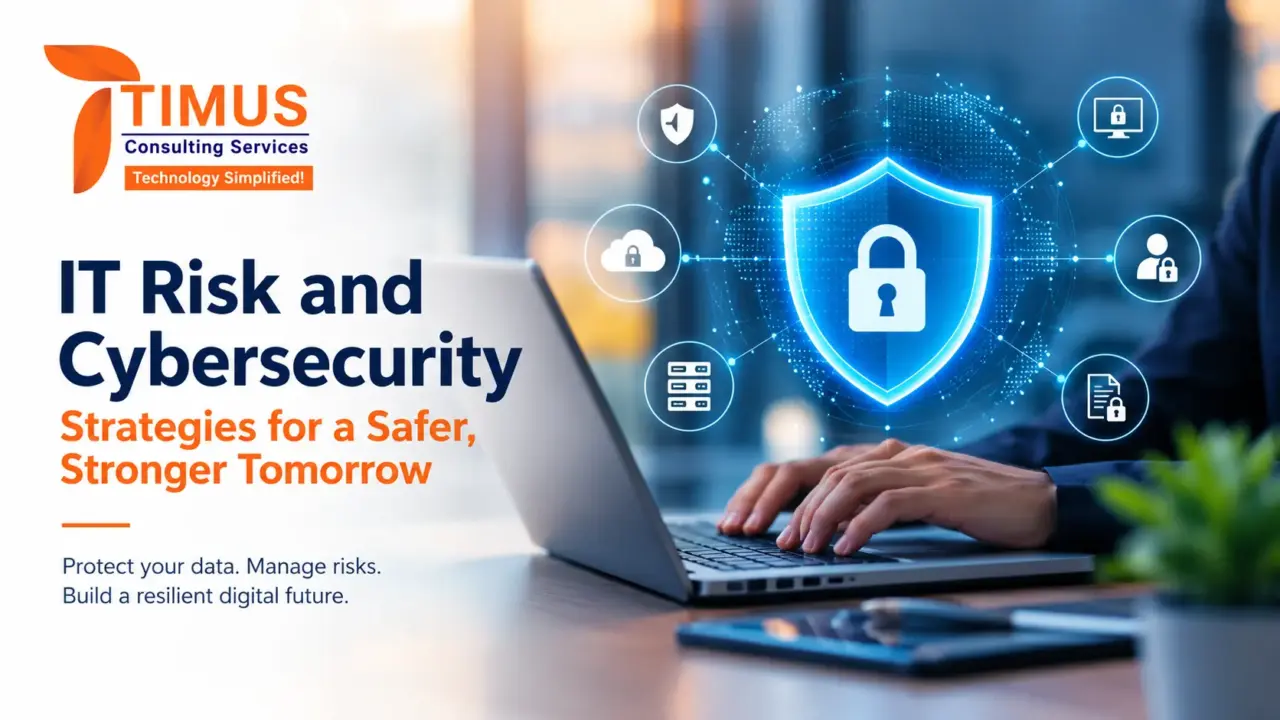

In today’s digital-first economy, organizations rely on cloud platforms, business applications, connected infrastructure, and sensitive data to operate. That dependence creates opportunity — but also exposes businesses to cyberattacks, outages, data loss, and regulatory challenges.
Core idea: Cybersecurity protects technology and information. IT risk management ensures security decisions support business priorities, operational resilience, and accountability.
What Is IT Risk Management?
IT risk management is the ongoing process of identifying, assessing, prioritizing, treating, and monitoring threats that could affect an organization’s systems, information, operations, or objectives.
Its purpose is not to eliminate every risk. Instead, it helps leadership understand the likelihood and potential impact of adverse events, choose proportionate controls, and make informed decisions about residual risk.
Six important categories of IT risk
Cybersecurity risk
Ransomware, credential theft, malicious access, and data breaches.
Operational risk
System failure, downtime, process breakdowns, and human error.
Compliance risk
Failure to meet applicable legal, contractual, or regulatory requirements.
Third-party risk
Vendor weaknesses, dependencies, and supply-chain exposure.
Cloud security risk
Misconfigurations, exposed storage, and excessive cloud permissions.
Data privacy risk
Unauthorized access, use, disclosure, or loss of personal data.
Why Cybersecurity Matters
Cybersecurity uses technology, people, policies, and processes to safeguard applications, devices, networks, and data against digital threats. A practical security program protects three foundational outcomes: the CIA triad.
ConfidentialityOnly authorized people can access sensitive information.
IntegrityInformation remains accurate and protected from unauthorized change.
AvailabilityCritical information and services remain accessible when needed.
Five Cybersecurity Threats Every Business Should Address
Risk exposure changes as systems, users, technologies, and adversary tactics evolve. Successful security teams continually reassess their attack surface and focus on weaknesses most likely to affect critical services.
The following threats deserve consistent attention from both technical teams and business leadership.

01. Ransomware and destructive attacks
Maintain protected, tested backups; segment networks; secure endpoints; and rehearse incident response procedures.
02. Phishing and identity compromise
Use phishing-resistant multifactor authentication where feasible, employee training, and appropriate email protection.
03. Cloud misconfigurations
Continuously review exposed services, storage permissions, identity roles, and cloud configuration baselines.
04. Unpatched vulnerabilities
Maintain a current asset inventory, prioritize exploitable issues, deploy patches, and validate remediation.
05. Insider and supplier exposure
Apply least privilege, assess third-party dependencies, and monitor sensitive access with appropriate safeguards.
Connecting Cybersecurity with Governance, Risk & Compliance
Good cybersecurity does more than deploy security tools. Governance, Risk and Compliance (GRC) provides accountability for risk decisions, ensures controls address business requirements, and establishes a repeatable way to measure effectiveness.
NIST Cybersecurity Framework 2.0: Six Core Functions
Identify
Protect
Detect
Respond
Recover
These functions help translate high-level risk objectives into actionable security outcomes.
Additional useful references include ISO/IEC 27001 for information security management systems, CIS Controls for prioritized safeguards, and applicable sector-specific regulations. Framework selection should reflect the organization’s actual obligations and risk profile.
A Practical Six-Step Security Strategy
STEP 01
Identify critical assets
Inventory systems, applications, data stores, and service dependencies.
STEP 02
Assess risk
Evaluate threats, vulnerabilities, existing controls, likelihood, and impact.
STEP 03
Strengthen controls
Apply MFA, least privilege, encryption, endpoint safeguards, and secure configurations.
STEP 04
Monitor continuously
Use SIEM, logging, alert triage, vulnerability monitoring, and detection workflows.
STEP 05
Prepare to respond
Test incident response, backup recovery, communication, and business continuity plans.
STEP 06
Validate and improve
Audit key controls, perform authorized testing, remediate findings, and retest fixes.
Real-World Example: From Technical Finding to Business Decision
Imagine a company discovers that its public-facing administrative portal does not require multifactor authentication. A vulnerability assessment identifies the issue, but risk management explains why it matters.
Security finding: Internet-accessible administrative login without MFA.
Business concern: Account takeover could disrupt customer services or expose sensitive information.
Risk treatment: Restrict administrative access, enforce strong MFA, log privileged activity, and validate remediation.
The essential lesson is that finding a weakness is only the beginning. Someone must own the risk, make a treatment decision, implement corrective action, and verify that exposure has been reduced.
The Future: Continuous and AI-Assisted Risk Management
Security programs are evolving toward continuous assessment, automated evidence collection, faster alert analysis, and clearer connections between technical findings and business impact. AI can help with risk correlation, security operations triage, and control evaluation, provided results are validated and sensitive information is appropriately protected.
Automation should reinforce — not replace — defined accountability, sound governance, and human judgment in high-impact decisions.
FINAL TAKEAWAY
Cyber resilience is a business priority.
Strong cybersecurity protects systems and data. Effective IT risk management makes those protections measurable, accountable, and aligned with business needs. Together, they enable organizations to operate and innovate with greater confidence.
Further reading: NIST Cybersecurity Framework | CISA Cybersecurity Performance Goals