
Introduction
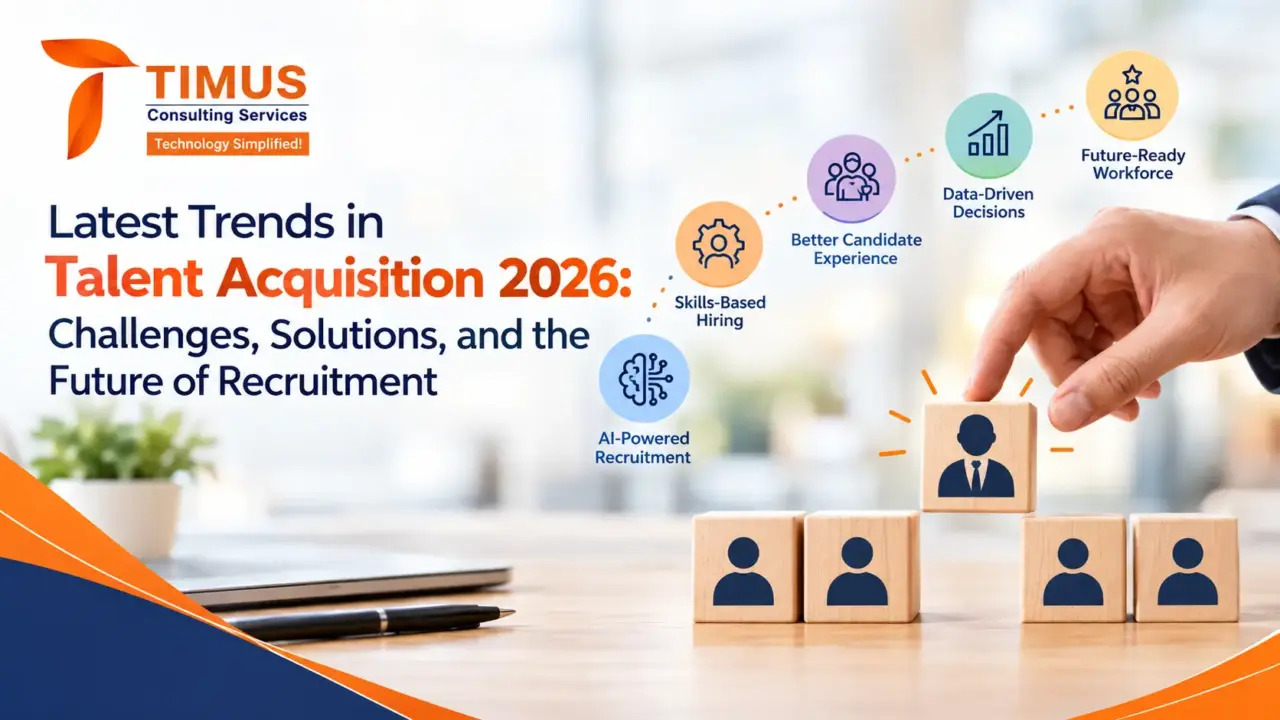
Talent acquisition is evolving rapidly. In 2026, recruitment is no longer just about filling vacancies; it is about building a skilled, adaptable, and future-ready workforce that supports business growth.
The rise of Artificial Intelligence (AI), changing candidate expectations, skills shortages, and increasing competition for specialized talent are transforming how organizations attract, assess, and retain employees. Talent acquisition teams are expected to balance hiring speed, cost efficiency, candidate experience, and quality of hire while ensuring fairness and transparency.
According to SHRM’s 2026 Talent Trends research, nearly 70% of HR professionals continue to face challenges recruiting for full-time positions. This highlights the need for organizations to rethink traditional recruitment strategies and adopt more effective, data-driven approaches.
So, what are the latest talent acquisition trends, and how can organizations overcome today’s hiring challenges? Let’s explore.
1.1 AI-Powered Recruitment and Automation
AI is becoming an integral part of modern recruitment. Organizations are using AI-powered tools to screen resumes, identify suitable candidates, automate interview scheduling, personalize candidate communication, and analyze recruitment data.
Automation helps recruiters reduce repetitive administrative tasks and focus more on relationship-building and strategic hiring decisions.
Challenges:
- Overdependence on AI-generated recommendations.
- Potential bias in automated screening systems.
- Difficulty verifying candidates’ actual skills and experience.
- Data privacy and responsible AI adoption concerns.
Solutions:
- Use AI to support recruiters rather than replace human judgment.
- Audit recruitment algorithms for bias and inconsistent outcomes.
- Keep human oversight in shortlisting and final selection.
- Establish clear policies for data privacy, transparency, and responsible AI use.
- Measure AI effectiveness through quality of hire, time-to-hire, and candidate satisfaction.
The goal is not simply to automate recruitment, but to make better hiring decisions with the support of technology.
1.2 Skills-Based Hiring Over Traditional Qualifications
Employers are increasingly focusing on what candidates can actually do rather than relying exclusively on degrees, job titles, or years of experience.
Skills-based hiring is particularly valuable for technology, digital transformation, analytics, AI, and other specialized roles where capabilities can change quickly.
Challenges:
- Identifying candidates with non-traditional career paths.
- Difficulty evaluating practical skills consistently.
- Overreliance on resumes and self-reported expertise.
- Lack of standardized assessment methods.
Solutions:
- Introduce role-specific technical tests and practical assignments.
- Use structured interviews and competency-based questions.
- Evaluate portfolios, certifications, and demonstrable work.
- Consider transferable skills and candidates from adjacent industries.
- Define essential and trainable skills before publishing job descriptions.
A skills-first approach expands the talent pool and helps organizations identify capable candidates who might otherwise be overlooked.
1.3 Data-Driven Talent Acquisition
Recruitment analytics is moving beyond basic hiring reports. Organizations increasingly need actionable insights to understand hiring performance, identify bottlenecks, forecast workforce requirements, and allocate recruitment budgets effectively.
Challenges:
- Fragmented data across applicant tracking systems and other HR tools.
- Limited visibility into recruitment funnel performance.
- Difficulty connecting hiring activity with business outcomes.
- Inconsistent reporting across recruitment teams.
Solutions:
- Build a centralized recruitment dashboard.
- Track time-to-hire, cost-per-hire, offer acceptance rate, and source effectiveness.
- Monitor interview-to-offer and application-to-interview conversion rates.
- Evaluate quality of hire and early employee retention.
- Review data regularly with hiring managers to improve decision-making.
Recruitment data becomes valuable when it helps teams understand not just how many candidates they hired, but whether they hired the right people.
1.4 Candidate Experience as a Competitive Advantage
Candidate experience plays a major role in an organization’s ability to attract talent and strengthen its employer reputation.
Candidates increasingly expect transparent job descriptions, quick responses, convenient interview scheduling, clear feedback, and regular updates throughout the hiring process.
Challenges:
- Delayed communication and lengthy interview cycles.
- Poor coordination between recruiters and hiring managers.
- Repetitive application processes.
- Candidates withdrawing because of slow decisions.
Solutions:
- Simplify application forms and remove unnecessary steps.
- Set clear timelines and communicate them to candidates.
- Automate interview scheduling and status updates.
- Provide timely feedback, including when candidates are unsuccessful.
- Collect candidate feedback and use it to improve the recruitment journey.
A smooth and respectful hiring process can improve offer acceptance, referrals, and employer reputation.
1.5 Employer Branding and Recruitment Marketing
Employer branding is becoming increasingly important as candidates compare organizations based on culture, career development, flexibility, leadership, and workplace values.
A strong employer brand communicates why candidates should choose an organization over competing employers.
Challenges:
- Limited visibility among relevant talent communities.
- Generic job advertisements that fail to differentiate the company.
- A gap between advertised culture and actual employee experience.
- Difficulty attracting passive candidates.
Solutions:
- Develop an authentic employee value proposition (EVP).
- Share employee stories, career journeys, and workplace experiences.
- Strengthen career pages and professional social media presence.
- Encourage employee advocacy and referral programs.
- Ensure recruitment messaging reflects the real workplace experience.
Effective employer branding attracts candidates who understand the organization’s culture and expectations before applying.
1.6 Internal Mobility and Talent Development
Organizations are increasingly looking internally to fill vacancies and address skills shortages. Internal mobility includes promotions, lateral moves, reskilling, cross-functional opportunities, and succession planning.
Developing existing employees can reduce dependence on external hiring while improving employee engagement and retention.
Challenges:
- Limited visibility into employees’ existing skills.
- Managers reluctant to release high-performing employees.
- Employees unaware of internal career opportunities.
- Skill gaps between current roles and future business needs.
Solutions:
- Create an internal skills inventory.
- Publish internal vacancies and career pathways.
- Offer reskilling and upskilling programs.
- Encourage collaboration between talent acquisition, learning and development, and business leaders.
- Track internal hiring and internal movement rates.
The best candidate for an open position may already be part of the organization.
1.7 AI-Ready Workforce and Future Skills
As AI reshapes job responsibilities, organizations need candidates who combine technical expertise with adaptability, analytical thinking, communication, problem-solving, and continuous learning.
Recruitment strategies must anticipate future capability requirements instead of focusing only on current vacancies.
Challenges:
- Shortages of specialized AI, cybersecurity, and digital talent.
- Rapid changes in job requirements.
- Competition for candidates with emerging skills.
- Uncertainty about which capabilities will remain relevant.
Solutions:
- Conduct regular workforce and skills-gap analyses.
- Develop partnerships with universities and training providers.
- Establish internships, apprenticeships, and graduate hiring programs.
- Assess candidates’ learning agility alongside current technical skills.
- Build reskilling pathways for existing employees.
Future-ready recruitment depends on identifying both the skills organizations need today and the capabilities they will need tomorrow.
1.8 A More Strategic Role for Talent Acquisition
Talent acquisition professionals are increasingly expected to act as strategic business partners rather than simply managing vacancies.
They must understand business priorities, advise on talent availability, challenge unrealistic job requirements, and recommend the right mix of hiring, internal development, and workforce planning.
Challenges:
- Recruitment teams involved too late in workforce planning.
- Unrealistic expectations from hiring managers.
- Pressure to reduce hiring costs while maintaining quality.
- Success measured mainly through the number of positions filled.
Solutions:
- Involve recruiters in workforce planning discussions.
- Establish clear hiring priorities with business leaders.
- Use market intelligence to set realistic compensation and hiring timelines.
- Review recruitment performance against business needs.
- Balance speed, cost, candidate experience, and quality of hire.
Strategic talent acquisition connects the right talent with the organization’s long-term objectives.
FAQs for the Blog
Q1. What are the top talent acquisition trends in 2026?
Key trends include AI-powered recruitment, skills-based hiring, data-driven decision-making, personalised candidate experiences, employer branding, and proactive workforce planning.
Q2. How is AI transforming talent acquisition in 2026?
AI helps recruiters automate resume screening, candidate sourcing, interview scheduling, and routine communication, allowing them to focus more on candidate relationships and strategic hiring decisions.
Q3. What are the biggest challenges in talent acquisition?
Common challenges include skills shortages, high competition for qualified candidates, recruitment costs, lengthy hiring cycles, and candidate drop-offs.
Q4. What is skills-based hiring?
Skills-based hiring evaluates candidates based on their practical abilities, competencies, and relevant experience rather than relying solely on degrees, job titles, or years of experience.
Q5. How can companies improve their recruitment process in 2026?
Companies can improve recruitment by adopting suitable automation tools, defining clear job requirements, using structured interviews, strengthening employer branding, and tracking metrics such as time-to-hire and quality of hire.