

Introduction
Non-governmental organizations occupy a strange middle ground in the world of risk. They are asked to operate with the accountability of a public company, the compliance obligations of a regulated financial institution, and the operational agility of a startup — all while running on a fraction of the budget of any of those. Donors want proof their money is well spent. Governments and regulators want proof funds aren’t being diverted. Beneficiaries, often in fragile or crisis-affected settings, need programs to actually work. And boards, increasingly, want documented evidence that risk is being managed rather than simply hoped away.
For years, the tools IBM Openpages for NGOs used to manage all of this looked a lot like the tools used to manage everything else in the sector: spreadsheets, email chains, shared drives, and a lot of institutional memory sitting in the heads of a few overworked staff. That approach breaks down quickly once an organization grows past a handful of country offices or a few dozen donor-funded projects. This is where a purpose-built Governance, Risk, and Compliance (GRC) platform like IBM OpenPages becomes not just useful, but genuinely transformative — and where a specialized implementation partner like Timus Consulting Services can make the difference between a platform that sits half-used and one that becomes the backbone of an organization’s risk culture.
This post looks at the specific risk challenges NGOs face, how IBM Openpages for NGOs is built to address them, and why the right implementation partner matters as much as the software itself.
The Distinct Risk Landscape of the NGO Sector
Risk management in an IBM Openpages for NGOs doesn’t look like risk management in a bank, and it shouldn’t be forced into the same mold. A few challenges show up again and again across the sector.
Fragmented, multi-country operations. Many NGOs run programs across dozens of countries, each with its own regulatory environment, local partners, currency, and political context. Risk data tends to live wherever the local team happens to keep it — a spreadsheet in one office, a paper file in another. Getting a single, accurate picture of organizational risk from that patchwork is close to impossible without a shared system of record.
Donor and grant compliance complexity. Institutional donors — USAID, the EU, the Global Fund, foundations — each attach their own reporting requirements, financial controls, and audit rights to their funding. A single large NGO might be simultaneously accountable to twenty or more donors, each with different rules about procurement, sub-granting, and safeguarding. Missing a compliance requirement doesn’t just create paperwork headaches; it can mean the loss of funding or the reputational damage that comes with a failed audit.
Third-party and partner risk. NGOs rarely deliver programs alone. They work through local implementing partners, subcontractors, and community-based organizations, many of which have limited internal controls of their own. Diligence on these partners — verifying financial capacity, safeguarding practices, and past performance — is essential, but it’s a task that’s easy to under-resource when budgets are already stretched thin.
Safeguarding and reputational exposure. The sector has learned, sometimes painfully, that safeguarding failures — whether financial misconduct or abuse of beneficiaries by staff or partners — can end careers, end organizations, and undo years of donor trust almost overnight. Yet many NGOs still rely on ad hoc incident reporting rather than a structured, auditable process for logging, investigating, and tracking safeguarding concerns.
Operating in fragile and high-risk environments. Conflict zones, natural disasters, and politically unstable regions are often exactly where NGOs need to work. That means physical security risk, staff duty-of-care obligations, and business continuity planning sit alongside the more familiar categories of financial and compliance risk — and they all need to be tracked with the same rigor.
Thin risk management resourcing. Perhaps the most fundamental challenge is simply capacity. Few NGOs have a dedicated enterprise risk team the way a bank does. Risk management is often a part-time responsibility bolted onto someone’s existing job, which means it tends to be reactive — addressed after an incident, an audit finding, or a donor complaint, rather than before one.
How IBM Openpages for NGOs Addresses These Challenges
IBM OpenPages was built as an enterprise GRC platform, and much of what makes it valuable to a global bank translates directly to the problems above — often better than sector-specific tools that were never designed with this level of rigor in mind.
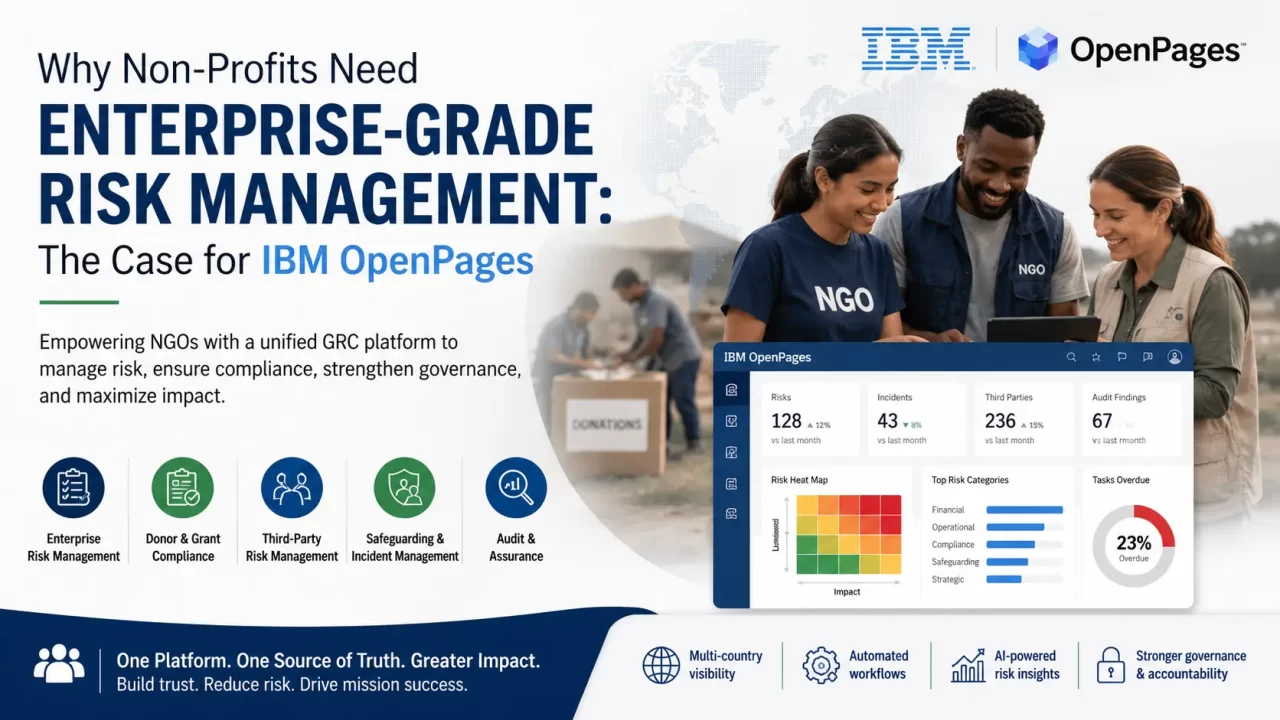
A single source of truth across a fragmented organization. OpenPages centralizes risk, compliance, audit, and control data in one platform accessible across country offices and program teams. Instead of headquarters chasing down spreadsheets before every board meeting, risk information flows into a shared repository that can be filtered by country, program, donor, or risk category, giving leadership the enterprise-wide view that fragmented operations otherwise make impossible.
Structured donor and grant compliance tracking. OpenPages’ policy and compliance management capabilities allow an organization to map each donor’s specific requirements to controls and evidence, track them over time, and flag gaps before an external audit finds them. Rather than reconstructing compliance history from memory when a donor audit is announced, the documentation trail already exists.
Purpose-built third-party risk management. This is one of OpenPages’ strongest modules, and it maps almost perfectly onto the NGO partner-risk problem. Organizations can maintain a centralized repository of implementing partners and vendors, run configurable risk assessment questionnaires for due diligence, and calculate risk scores that help prioritize which partners need closer monitoring. For an IBM Openpages for NGOs managing dozens or hundreds of local partners, this turns partner risk from a once-a-year checkbox exercise into an ongoing, data-driven process.
A structured home for incident and safeguarding management. OpenPages’ issue and incident management functionality gives organizations a consistent, auditable way to log concerns, assign investigations, track remediation, and maintain the kind of documented chain of accountability that donors and boards increasingly expect on safeguarding matters — replacing the informal, inconsistent reporting that has proven so costly in the sector’s more difficult moments.
Internal audit that keeps pace with a lean team. OpenPages’ Internal Audit Management module lets a small internal audit or compliance function plan audits based on actual risk levels, automate task assignment and follow-up, and maintain a complete record of findings and remediation — meaning a two- or three-person audit team can cover far more ground than manual, spreadsheet-driven audit planning would allow.
AI-assisted risk insight without a large risk team. With Watson-powered analytics built into the platform, OpenPages can help surface risk patterns and flag emerging issues even when an organization doesn’t have the luxury of a large dedicated risk analytics function — effectively giving a resource-constrained NGO some of the same predictive risk capability that a much larger institution would have to build from scratch.
Modular adoption that respects the budget. Because OpenPages is modular, an NGO doesn’t need to implement the full platform on day one. Many organizations start with third-party risk management or incident tracking — the areas of greatest exposure — and expand into operational risk, IT governance, or audit management as capacity and budget allow.