

Introduction
Artificial Intelligence is rapidly becoming part of everyday business operations. Organizations are using AI to automate processes, analyze information, improve customer experiences, detect threats, and support critical business decisions.
But as AI becomes more deeply integrated into organizations, a new question is emerging: Who is responsible for ensuring that AI is used safely, ethically, transparently, and in accordance with regulations?
This is where AI Governance becomes essential.
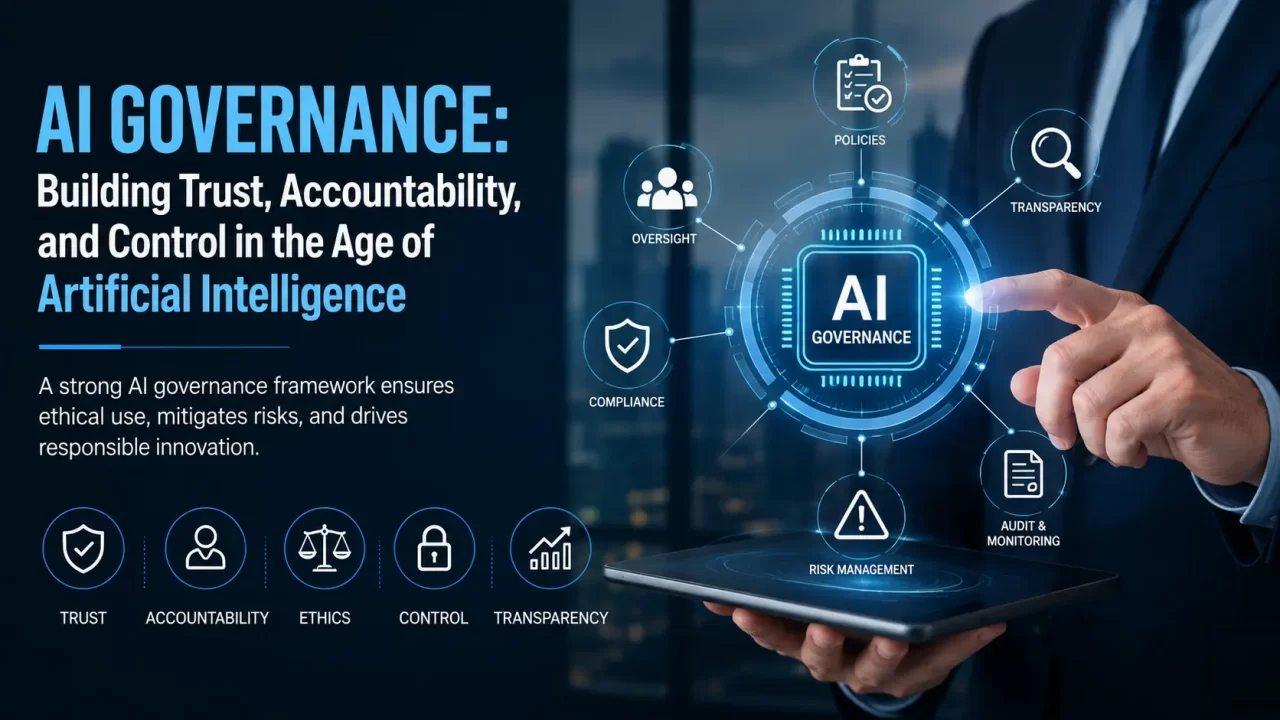
AI Governance provides the policies, processes, controls, and accountability mechanisms required to manage AI throughout its lifecycle. It helps organizations understand how AI systems are developed and deployed, what risks they create, who is responsible for their outcomes, and how those risks should be monitored.
Effective AI governance is not about preventing organizations from using AI. Instead, it creates the framework needed to innovate with AI while maintaining trust, security, compliance, and accountability.
What Is AI Governance?
AI Governance is the framework an organization uses to manage the development, deployment, monitoring, and use of artificial intelligence systems responsibly.
It brings together technology, business leadership, legal teams, cybersecurity, risk management, compliance, and data governance to establish clear rules around AI.
A strong AI governance framework typically addresses:
* AI policies and standards
* Risk assessment and management
* Data privacy and security
* Model transparency and explainability
* Human oversight and accountability
* AI ethics and responsible use
* Regulatory compliance
* Model monitoring and performance
* Third-party AI risk
* Documentation and auditability
The goal is to ensure that AI systems remain **safe, reliable, transparent, compliant, and aligned with business objectives.**
Why Organizations Need AI Governance
AI can create significant business value, but uncontrolled AI adoption can also introduce new risks.
Employees may use public AI tools with confidential company information. An automated decision-making system may produce biased outcomes. A generative AI model may generate inaccurate information. A third-party AI provider may introduce security or privacy concerns.
At the same time, governments and regulators around the world are introducing new requirements around responsible AI.
Without a defined governance framework, organizations may struggle to answer basic questions such as:
* Which AI systems are being used across the organization?
* What data is being provided to those systems?
* Who approved the use of a particular AI solution?
* What risks were identified before deployment?
* How are AI models monitored after implementation?
* What happens when an AI system produces an incorrect or harmful result?
* Can the organization demonstrate compliance during an audit?
AI Governance provides the structure needed to answer these questions.
Key Pillars of AI Governance
1. AI Risk Management
Every AI system can introduce different levels of risk depending on its purpose, data, users, and potential impact.
Organizations should identify and classify AI risks before deployment.
Risk assessments may consider:
* Privacy risks
* Cybersecurity threats
* Model inaccuracies
* Bias and discrimination
* Regulatory exposure
* Operational risks
* Reputational damage
* Intellectual property concerns
A risk-based approach allows organizations to apply stronger controls to high-impact AI systems while maintaining flexibility for lower-risk applications.
2. Data Governance
AI is only as reliable as the data it uses.
Poor-quality, incomplete, outdated, or biased data can negatively affect AI outputs. Organizations therefore need clear controls around how AI-related data is collected, stored, processed, shared, and protected.
Effective data governance should address:
* Data quality
* Data ownership
* Data classification
* Privacy requirements
* Access controls
* Data retention
* Sensitive information protection
* Data lineage
Strong data governance creates a reliable foundation for responsible AI.
3. Transparency and Explainability
Organizations need to understand how AI systems arrive at important decisions.
This becomes particularly important when AI influences areas such as hiring, lending, insurance, healthcare, security, or customer eligibility.
AI governance should establish requirements for documenting:
* What the AI system does
* What data it uses
* How it is trained
* What its limitations are
* How its performance is measured
* When human intervention is required
The objective is not necessarily to make every AI model completely understandable to every user, but to ensure that appropriate stakeholders have enough information to evaluate and challenge AI-driven outcomes.
4. Human Oversight
AI should not automatically replace human responsibility for high-impact decisions.
Organizations should define where human review is mandatory and establish clear escalation procedures when an AI system produces unexpected or questionable results.
For example, an AI system may identify a potentially fraudulent transaction, but a trained investigator can review the case before a final action is taken.
Human oversight helps organizations balance automation with accountability.
5. Security and Privacy
AI systems can create new attack surfaces and data protection challenges.
Organizations need to protect AI models, training data, prompts, outputs, APIs, and supporting infrastructure from unauthorized access and manipulation.
Security controls may include:
* Identity and access management
* Encryption
* Secure APIs
* Monitoring and logging
* Threat detection
* Model security testing
* Data-loss prevention
* Incident response procedures
Privacy controls are equally important when AI systems process personal or confidential information.
6. Compliance and Regulatory Alignment
AI regulations and standards are evolving rapidly.
Organizations operating across multiple regions may need to consider different legal and regulatory requirements depending on where their AI systems are developed, deployed, and used.
An AI governance program should therefore connect AI activities with the organization’s existing:
* Compliance framework
* Risk management program
* Privacy program
* Cybersecurity controls
* Internal audit processes
* Corporate governance structure
This creates a more consistent approach to managing AI-related obligations.
Real-World AI Governance Use Cases
1. Financial Services
Financial institutions increasingly use AI for fraud detection, credit assessment, customer support, and risk analysis.
AI governance helps ensure that these systems are appropriately monitored and that automated decisions do not create unacceptable levels of bias, privacy risk, or regulatory exposure.
For example, a bank may require additional human review when an AI model produces a high-impact financial decision.
2. Healthcare
Healthcare organizations can use AI to support diagnostics, administrative workflows, patient engagement, and clinical decision-making.
Because healthcare data is highly sensitive and AI errors can have serious consequences, governance becomes critical.
Organizations can establish controls covering data privacy, model validation, human oversight, security, documentation, and ongoing performance monitoring.
3. Human Resources
AI-powered recruitment tools can help organizations screen applications, identify candidates, and automate parts of the hiring process.
However, poorly designed systems may reproduce historical biases within training data.
AI governance can require organizations to test models for fairness, document their decision-making processes, monitor outcomes, and maintain appropriate human involvement.
4. Customer Service
Organizations increasingly use generative AI chatbots and virtual assistants to interact with customers.
Governance can establish rules around what information AI systems can access, what responses require human escalation, how customer data is protected, and how inaccurate or inappropriate outputs are handled.
5. Cybersecurity
AI is becoming an important component of modern security operations.
Security teams can use AI to analyze large volumes of logs, detect unusual behavior, prioritize alerts, and support incident investigations.
AI governance ensures that these systems are monitored, secure, properly documented, and subject to human oversight when necessary.
Benefits of a Strong AI Governance Framework
Greater Trust
Customers, employees, regulators, and business partners are more likely to trust AI systems when organizations can demonstrate responsible management and accountability.
Reduced AI Risk
Governance helps organizations identify potential problems before AI systems are deployed at scale.
Better Regulatory Readiness
Well-documented AI processes make it easier to demonstrate compliance as regulations and standards continue to evolve.
Improved Decision-Making
Clear accountability and monitoring help organizations understand when AI outputs can be trusted and when additional human judgment is required.
Stronger Data Protection
AI governance establishes clearer rules for handling sensitive information and reduces the likelihood of inappropriate data usage.
Safer AI Innovation
Governance does not have to slow innovation. With predefined policies, approval processes, and risk controls, organizations can adopt AI more confidently and consistently.
Common AI Governance Challenges
Implementing AI governance can be difficult, particularly for organizations that are adopting AI rapidly.
Common challenges include:
* Lack of visibility into AI systems being used across the organization
* Unclear ownership of AI-related risks
* Rapidly changing AI technologies
* Evolving regulatory requirements
* Limited AI expertise within governance teams
* Inconsistent documentation
* Difficulty monitoring third-party AI solutions
* Concerns around bias and fairness
* Data privacy and intellectual property risks
* Shadow AI usage by employees
One of the biggest challenges is that AI adoption can happen faster than governance programs can adapt.
Organizations therefore need governance frameworks that are flexible, scalable, and continuously updated.
How to Build an Effective AI Governance Program
Organizations can take a structured approach to developing AI governance.
Step 1: Create an AI Inventory
Identify the AI systems currently being developed, purchased, or used across the organization.
Step 2: Classify AI Risk
Evaluate each system according to its purpose, data, users, business impact, and potential harm.
Step 3: Establish AI Policies
Define clear rules covering acceptable AI usage, data protection, security, human oversight, transparency, and accountability.
Step 4: Assign Ownership
Clearly define who is responsible for approving, monitoring, maintaining, and retiring each AI system.
Step 5: Implement Controls
Introduce technical and organizational controls based on the risk level of each AI application.
Step 6: Monitor Continuously
AI governance should not end when a model goes into production. Organizations should continuously monitor performance, security, data quality, and compliance.
Step 7: Review and Improve
AI technologies, regulations, and business requirements will continue to change. Governance frameworks should therefore be reviewed and updated regularly.
AI Governance and GRC
AI Governance should not operate as a completely separate function.
Organizations can integrate AI governance into their existing Governance, Risk, and Compliance (GRC) programs.
For example, AI governance can connect with existing processes for:
* Enterprise risk management
* Policy management
* Compliance assessments
* Internal audits
* Vendor risk management
* Cybersecurity
* Data governance
* Privacy management
* Incident management
This approach allows organizations to use existing governance structures while adding AI-specific controls where required.
The Future of AI Governance
AI governance will become increasingly important as organizations move from experimenting with AI to deploying it across critical business functions.
Future governance programs are likely to become more automated and continuous.
Organizations may increasingly use AI itself to support governance activities such as:
* Monitoring AI systems for unusual behavior
* Identifying potential compliance gaps
* Tracking AI assets across the enterprise
* Automatically analyzing AI-related documentation
* Detecting changes in model performance
* Supporting risk assessments
* Generating governance reports
* Monitoring regulatory developments
However, automation will not eliminate the need for human accountability.
The future of AI governance will likely depend on a combination of **technology, clearly defined responsibility, strong controls, and human judgment.**
Conclusion
AI Governance is becoming a fundamental part of responsible digital transformation.
As organizations adopt artificial intelligence across operations, customer services, cybersecurity, finance, healthcare, and other critical functions, managing AI-related risks becomes just as important as realizing its benefits.
A mature AI governance framework provides organizations with the structure to manage these risks while supporting innovation. It brings together risk management, data governance, cybersecurity, compliance, ethics, transparency, and human oversight into a coordinated approach.
Organizations that establish AI governance early will be better positioned to scale AI responsibly, respond to regulatory changes, protect stakeholders, and build long-term trust.
The future of AI is not simply about building more intelligent systems—it is about building systems that organizations can trust, control, and govern responsibly.