

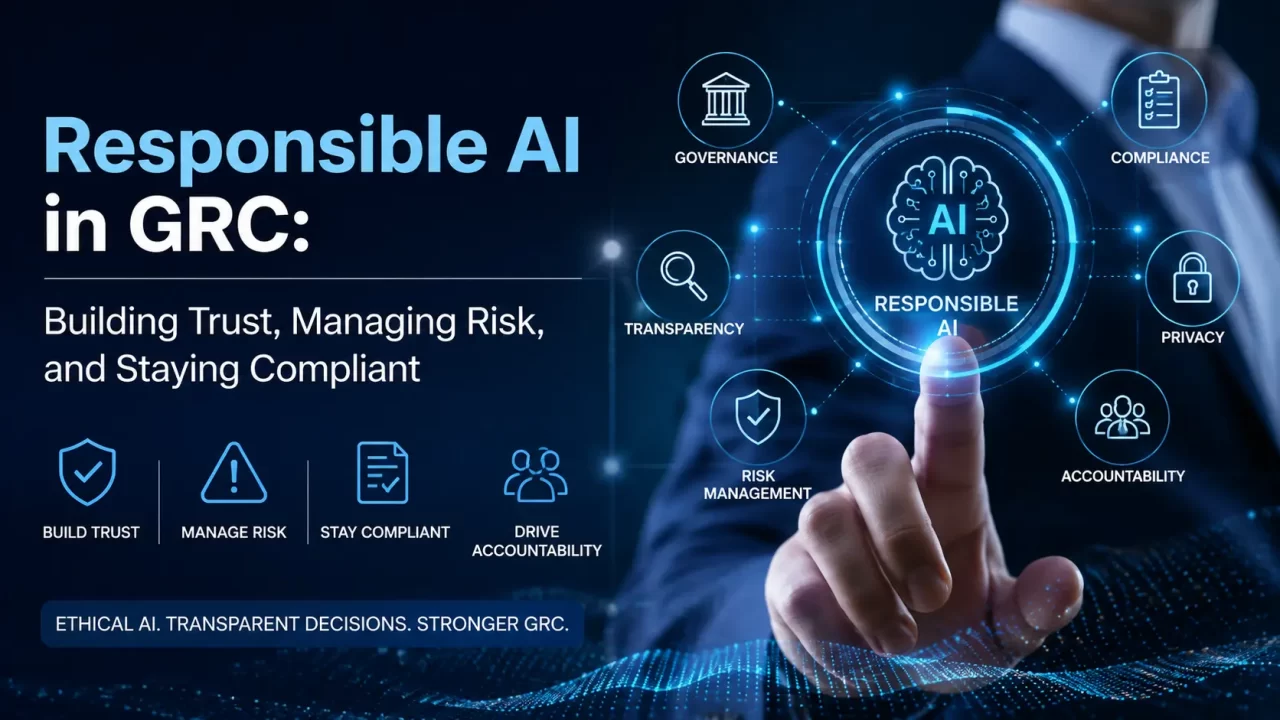
Introduction
Artificial intelligence is rapidly becoming part of everyday business operations—from customer service and fraud detection to recruitment, healthcare, cybersecurity, financial decision-making, and enterprise automation.
But as organizations adopt AI at scale, a critical question is emerging:
How can organizations ensure that AI is being used responsibly, securely, transparently, and in compliance with applicable regulations?
This is where Responsible AI in GRC becomes important.
Governance, Risk, and Compliance (GRC) provides organizations with a structured approach for managing policies, risks, controls, regulatory requirements, audits, and accountability. Responsible AI extends these principles to the unique risks created by artificial intelligence.
Instead of treating AI governance as a separate initiative, organizations can integrate Responsible AI into their existing GRC programs to create a unified approach to AI governance, AI risk management, and AI compliance.
Standards such as ISO/IEC 42001 provide organizations with a formal management-system approach for establishing, implementing, maintaining, and continually improving AI governance.
What Is Responsible AI in GRC?
Responsible AI in GRC refers to the integration of responsible artificial intelligence principles into an organization’s governance, risk management, and compliance processes.
The objective is not simply to determine whether an AI system works. Organizations also need to understand:
- What the AI system is being used for
- What data it processes
- What risks it creates
- Who is accountable for its decisions
- Whether its outputs can be explained
- Whether users can challenge or override its decisions
- Whether the system complies with applicable laws and policies
- How the system is monitored after deployment
In practical terms, Responsible AI transforms AI governance from a technology-only concern into an enterprise risk and compliance discipline.
Why Responsible AI Matters for GRC
Traditional GRC programs were designed around risks such as cybersecurity, privacy, financial controls, operational resilience, and regulatory compliance.
AI introduces additional dimensions of risk.
An AI system may produce inaccurate or biased outputs, expose sensitive information, behave unpredictably, make decisions that are difficult to explain, or create new cybersecurity vulnerabilities.
Generative AI and agentic AI add further complexity. OWASP’s 2025 guidance identifies risks including prompt injection, sensitive information disclosure, supply-chain vulnerabilities, data and model poisoning, and excessive agency.
As a result, organizations need GRC processes that can answer questions such as:
Can we identify every AI system being used across the organization?
Can we determine the risk associated with each system?
Can we demonstrate that appropriate controls are in place?
Can we provide evidence to auditors and regulators?
Can we continuously monitor AI systems after deployment?
These questions form the foundation of AI governance.
The Three Pillars of Responsible AI in GRC
Responsible AI can be mapped directly to the three pillars of GRC.
1. AI Governance
AI governance defines who is responsible for AI and how AI should be used.
An effective AI governance framework should establish:
- AI policies and standards
- Roles and responsibilities
- AI ownership
- Approval processes
- AI risk classifications
- Human oversight requirements
- Acceptable-use policies
- Third-party AI requirements
- Incident management procedures
- AI lifecycle controls
Governance should begin before an AI system is deployed and continue throughout its lifecycle.
A centralized AI inventory or AI registry is therefore an important foundation.
For every AI system, organizations should ideally maintain information such as:
| AI Asset | Example Information |
|---|---|
| AI system | Customer support chatbot |
| Business owner | Customer Experience |
| Technical owner | AI/IT team |
| Purpose | Customer query resolution |
| Model/provider | Internal or third-party model |
| Data used | Customer interaction data |
| Risk level | Low/Medium/High |
| Regulatory requirements | Privacy, AI regulations |
| Controls | Access, monitoring, human review |
| Status | Development/Production/Retired |
This turns AI governance from an informal activity into a measurable enterprise process.
2. AI Risk Management
AI risk management focuses on identifying, assessing, treating, and continuously monitoring AI-related risks.
Common AI risks include:
- Bias and discrimination
- Inaccurate or unreliable outputs
- Privacy violations
- Sensitive information disclosure
- Cybersecurity attacks
- Model manipulation
- Data poisoning
- Hallucinations
- Lack of explainability
- Excessive automation
- Unauthorized AI usage
- Third-party model risks
- Regulatory non-compliance
- Intellectual property risks
- Reputational damage
Each AI application should therefore undergo a risk assessment appropriate to its intended use and potential impact.
A simple AI risk model can include:
Identify → Assess → Control → Monitor → Report → Improve
This creates a continuous AI risk-management lifecycle rather than a one-time assessment.
3. AI Compliance
AI compliance connects organizational AI practices with applicable laws, regulations, contractual requirements, industry standards, and internal policies.
The regulatory environment is evolving rapidly.
For example, the EU AI Act follows a risk-based approach, with requirements varying according to the risk associated with an AI system. The European Commission states that transparency rules under the Act apply from August 2026, while certain high-risk AI obligations have later applicability dates.
Organizations operating across jurisdictions therefore need mechanisms to map:
Regulation → Requirement → Control → Evidence → Owner → Assessment
This is where GRC platforms can provide significant value.
Responsible AI and the AI Governance Framework
A mature Responsible AI program should connect business policies, technical controls, and compliance requirements.
A typical AI governance framework can contain the following layers:
Policy Layer
Defines organizational principles for responsible AI.
Examples include:
- AI acceptable-use policy
- Generative AI policy
- Data usage policy
- Human oversight policy
- AI ethics policy
- Third-party AI policy
Risk Layer
Identifies and evaluates AI risks.
Examples:
- AI impact assessments
- Risk classification
- Bias assessments
- Privacy assessments
- Security assessments
- Model risk assessments
Control Layer
Defines safeguards that reduce identified risks.
Examples:
- Access controls
- Data protection
- Human approval
- Model validation
- Output monitoring
- Audit logging
- Explainability mechanisms
- Incident response
Evidence Layer
Demonstrates that controls are actually operating.
Evidence may include:
- Assessment reports
- Approval records
- Model validation results
- Audit logs
- Monitoring reports
- Training records
- Incident records
- Vendor assessments
Monitoring Layer
Continuously evaluates AI systems after deployment.
This is particularly important because AI systems can change as models, prompts, data, integrations, and users change.
Responsible AI Controls Organizations Should Consider
Responsible AI controls should cover the entire AI lifecycle.
Before Deployment
Organizations can implement:
- AI use-case registration
- Risk classification
- Data assessment
- Privacy assessment
- Security assessment
- Bias testing
- Model validation
- Regulatory assessment
- Human oversight requirements
- Business-owner approval
During Deployment
Organizations should consider:
- Access management
- Usage monitoring
- Output validation
- Human-in-the-loop controls
- Logging
- Data protection
- Prompt and configuration management
- Security monitoring
- Performance monitoring
After Deployment
Controls should include:
- Periodic risk assessments
- Model performance monitoring
- Bias monitoring
- Incident management
- Regulatory change monitoring
- Control testing
- Audit reviews
- Model or system re-approval when material changes occur
This lifecycle approach helps organizations avoid one of the biggest weaknesses in AI governance: treating approval as the end of governance rather than the beginning of continuous oversight.
How GRC Platforms Can Support Responsible AI
A modern GRC platform can become the operational layer for Responsible AI.
Instead of managing AI governance through disconnected spreadsheets, emails, documents, and manual reviews, organizations can centralize AI risk and compliance activities.
Key capabilities may include:
AI Asset Inventory
Maintain a centralized inventory of AI models, applications, vendors, use cases, and owners.
AI Risk Assessments
Use standardized questionnaires and risk scoring to evaluate AI systems.
Regulatory Mapping
Map AI regulations and standards to organizational controls.
Control Management
Assign controls to responsible teams and track their implementation.
Policy Management
Create, approve, distribute, and monitor AI-related policies.
Evidence Management
Centralize evidence required for audits and compliance reviews.
Vendor Risk Management
Evaluate third-party AI providers, foundation models, APIs, and AI-enabled SaaS applications.
Continuous Monitoring
Monitor changes in AI systems, risks, controls, regulations, and incidents.
Audit Management
Provide auditors with traceable evidence showing how AI systems are governed.
ISO/IEC 42001 and Responsible AI
ISO/IEC 42001 is particularly relevant to organizations building formal AI governance programs.
The standard specifies requirements for establishing, implementing, maintaining, and continually improving an Artificial Intelligence Management System (AIMS). ISO describes it as a management-system standard designed for organizations developing, providing, or using AI-based products and services.
Its management-system approach is valuable because Responsible AI cannot be achieved through a single technical control.
Organizations need a repeatable system covering:
Policies + People + Processes + Risk Management + Controls + Monitoring + Continual Improvement
ISO/IEC 42001 can therefore serve as an important reference point when designing an enterprise AI governance program.
Responsible AI and AI Security
Responsible AI is also closely connected to cybersecurity.
An AI system can be ethically designed but still be insecure.
For example, an enterprise AI assistant may have appropriate privacy policies but remain vulnerable to prompt injection or sensitive information disclosure.
OWASP’s GenAI Security Project identifies security and safety risks specifically associated with LLM, generative AI, and emerging agentic AI systems.
This means AI GRC programs should bring together:
AI Governance + Cybersecurity + Privacy + Compliance + Risk Management
Rather than treating these disciplines as isolated programs.
Responsible AI in Agentic AI
The rise of agentic AI makes Responsible AI in GRC even more important.
Traditional AI may generate a recommendation or response.
An AI agent may instead:
- Interpret a goal
- Make decisions
- Call external tools
- Access enterprise data
- Execute workflows
- Take actions on behalf of users
This creates a new governance question:
What happens when an AI system has the authority to act rather than simply provide information?
Organizations should therefore consider controls around:
- Agent identity
- Tool permissions
- Data access
- Action authorization
- Human approval
- Transaction limits
- Audit trails
- Agent behavior monitoring
- Emergency shutdown
- Separation of duties
OWASP released dedicated guidance for agentic AI security in 2025, reflecting the growing importance of governing autonomous AI systems.
A Practical Responsible AI GRC Implementation Roadmap
Organizations do not need to build a complex AI governance program overnight.
A practical implementation can follow five stages.
Stage 1: Discover
Identify all AI systems currently being developed, purchased, or used.
Create an enterprise AI inventory.
Stage 2: Classify
Classify AI systems according to factors such as:
- Business impact
- Data sensitivity
- Regulatory exposure
- Level of automation
- Number of affected users
- Potential harm
- Decision-making authority
Stage 3: Assess
Perform appropriate:
- AI risk assessments
- Privacy assessments
- Security assessments
- Impact assessments
- Vendor assessments
Stage 4: Control
Implement controls based on the risk level of each system.
High-impact AI should generally receive stronger governance and oversight than low-risk applications.
Stage 5: Monitor
Continuously monitor:
- AI performance
- Risks
- Controls
- Incidents
- Regulatory requirements
- Model changes
- Vendor changes
- Data changes
This creates a continuous AI governance lifecycle.
Common Challenges in Responsible AI Governance
Organizations often encounter several challenges when implementing Responsible AI.
Lack of AI Visibility
Employees may use AI tools without centralized approval or tracking.
Fragmented Ownership
IT, legal, compliance, security, data science, and business teams may have different responsibilities without a common governance model.
Rapidly Changing Regulations
AI regulations and guidance continue to evolve across jurisdictions.
Difficulty Measuring AI Risk
Traditional risk frameworks may not capture model-specific risks such as hallucination, drift, bias, prompt injection, or excessive agency.
Third-Party AI Dependency
Organizations increasingly rely on external models, APIs, SaaS applications, and AI infrastructure.
Continuous Change
AI systems can change rapidly, making periodic assessments alone insufficient.
These challenges reinforce the need for a centralized and continuously maintained AI GRC program.
Best Practices for Responsible AI in GRC
Organizations can strengthen their Responsible AI programs by following several principles:
1. Create a Central AI Inventory
You cannot govern what you cannot see.
2. Establish Clear Accountability
Every material AI system should have clearly identified business and technical owners.
3. Use Risk-Based Governance
Not every AI application requires the same level of scrutiny.
4. Integrate AI Into Existing GRC
Avoid creating a completely disconnected AI compliance program.
5. Automate Evidence Collection
Where possible, automatically collect control evidence, logs, assessments, and monitoring results.
6. Maintain Human Oversight
High-impact decisions should have appropriate human review and escalation mechanisms.
7. Monitor AI Continuously
Responsible AI is a lifecycle activity, not a one-time certification exercise.
8. Prepare for Audits
Maintain traceable records showing:
What was assessed → Who approved it → What controls were implemented → What evidence exists → What changed
9. Govern Third-Party AI
Evaluate AI vendors and external models as part of third-party risk management.
10. Connect Security and Responsible AI
AI governance should include cybersecurity, privacy, and data protection rather than treating them as separate concerns.
The Future of Responsible AI in GRC
AI governance is moving from an emerging practice toward a core enterprise capability.
Organizations will increasingly need to manage AI systems in the same structured way they manage cybersecurity, privacy, financial, and operational risks.
The future of AI GRC is likely to involve greater automation across the governance lifecycle:
Discover → Classify → Assess → Approve → Control → Monitor → Audit → Improve
GRC platforms can become the central system of record connecting AI assets, risks, controls, policies, regulations, assessments, evidence, and accountability.
At the same time, organizations should recognize that Responsible AI is not simply about regulatory compliance.
Compliance establishes a baseline.
Responsible AI aims to build systems that are safe, secure, transparent, accountable, reliable, privacy-aware, and aligned with human interests.
Conclusion
The rapid adoption of artificial intelligence is creating enormous opportunities—but it is also introducing a new class of enterprise risks.
Responsible AI in GRC provides a structured way to manage those risks.
By integrating AI governance, risk management, compliance, cybersecurity, privacy, controls, and continuous monitoring, organizations can move from reactive AI compliance to proactive AI governance.
Standards such as ISO/IEC 42001 provide a management-system foundation, while regulatory frameworks such as the EU AI Act and security guidance such as OWASP’s GenAI resources provide additional reference points for building a comprehensive governance approach.
The organizations that succeed with AI will not necessarily be those that deploy the most AI.
They will be the organizations that can demonstrate where AI is being used, what risks it creates, who is accountable, what controls are in place, and how those controls are continuously monitored.
That is the role of Responsible AI in GRC.