
Growth is one of the most exciting stages in a company’s journey. New customers, larger teams, expanding operations, new markets, technology investments, and strategic partnerships create significant opportunities.
But growth also introduces new risks and greater complexity.
Processes that worked effectively when a company was small may become difficult to manage as the organization expands. More employees mean more access points. More customers mean greater operational responsibility. More suppliers create additional third-party dependencies. More data creates greater security and compliance requirements.
This is where Risk and Control Management (RCM) becomes increasingly important.
At Timus Consulting Services, we help organizations strengthen their governance, risk, compliance, and control environments so they can scale with confidence while maintaining appropriate oversight.
What Is Risk and Control Management?
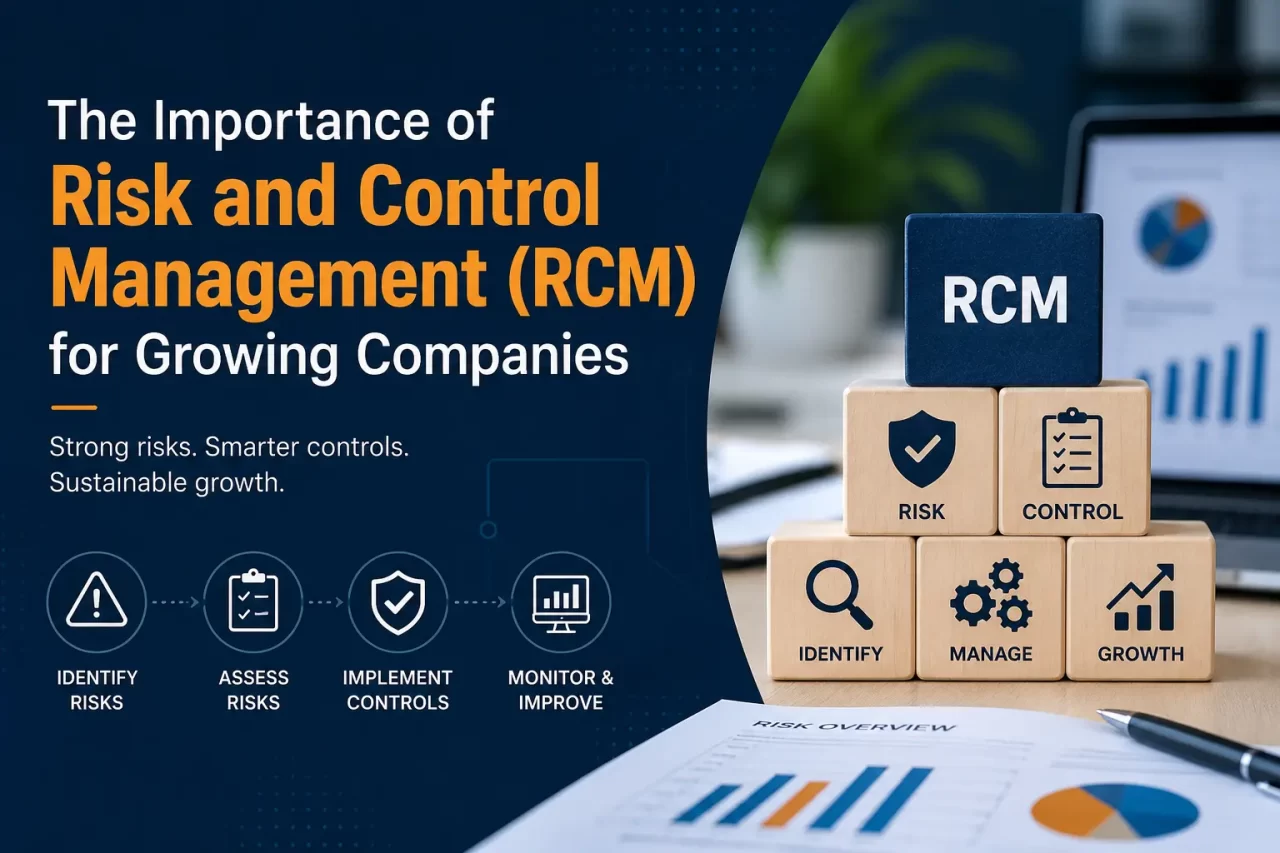
Risk and Control Management (RCM) is a structured approach to identifying, assessing, monitoring, and managing organizational risks through appropriate controls.
In simple terms:
Risk Management asks:
What could go wrong?
Control Management asks:
What are we doing to prevent, detect, or respond to it?
A mature RCM framework brings these two activities together, enabling organizations to understand whether their controls are effectively addressing their most important risks.
Why Does RCM Matter as Companies Grow?
For a growing organization, complexity can increase faster than expected.
Consider a company that expands from 100 employees to 1,000 employees.
It may now have:
- Multiple business units
- More locations
- More applications
- Larger customer databases
- Multiple suppliers
- Greater financial exposure
- More regulatory obligations
- Increased cybersecurity risks
- More complex approval processes
- Additional management layers
Without a structured risk and control framework, organizations may struggle to maintain visibility over these growing risks.
RCM provides a framework for creating accountability, consistency, transparency, and control.
- Identifying Risks Before They Become Problems
Growing companies often focus heavily on opportunities and expansion.
However, rapid growth can introduce risks that may not be immediately visible.
Examples include:
- Cybersecurity risks
- Financial risks
- Operational risks
- Compliance risks
- Data privacy risks
- Third-party risks
- Fraud risks
- Business continuity risks
- Technology risks
- Reputational risks
An effective RCM program helps organizations identify and assess these risks before they develop into significant business problems.
The objective is not to eliminate every risk.
Instead, organizations should understand their risks and determine whether they are within acceptable levels.
- Establishing Strong Internal Controls
As organizations grow, informal processes become increasingly difficult to manage.
A founder or senior manager may have been able to personally approve important transactions when the company was small.
That approach does not scale effectively when the organization has thousands of employees.
RCM helps organizations establish formal controls such as:
- Segregation of duties
- Approval workflows
- Access controls
- Financial controls
- Policy controls
- Reconciliation controls
- Monitoring controls
- Compliance controls
- Change management controls
These controls help reduce errors, fraud, unauthorized activity, and operational failures.
- Creating Accountability
One of the biggest advantages of a structured RCM program is clear ownership.
Every important risk and control should have appropriate accountability.
For example:
Risk Owner → Control Owner → Control → Testing → Issue → Remediation → Management Reporting
This creates a clear chain of responsibility.
Instead of asking:
“Who is responsible for this risk?”
Management can quickly identify the appropriate owner and understand the status of the associated controls.
- Supporting Regulatory Compliance
As companies expand into new markets and industries, their regulatory obligations can increase significantly.
Organizations may need to comply with requirements related to:
- Data protection
- Financial reporting
- Cybersecurity
- Industry regulations
- Employment requirements
- Environmental regulations
- Information security
- Third-party management
- Corporate governance
RCM helps organizations map regulatory requirements to policies, risks, controls, assessments, and evidence.
This can make compliance management more structured and repeatable.
- Improving Audit Readiness
Internal and external audits become increasingly important as organizations mature.
Without centralized risk and control information, audit preparation can become a time-consuming exercise involving spreadsheets, emails, shared drives, and manual evidence collection.
An effective RCM framework can provide auditors and management with visibility into:
- Risks
- Controls
- Control owners
- Testing results
- Evidence
- Findings
- Issues
- Remediation activities
- Historical records
This can significantly improve audit readiness and reduce administrative effort.
- Managing Third-Party Risk
Growing companies often rely on external vendors for technology, logistics, professional services, cloud platforms, payment processing, and other critical business functions.
This creates additional exposure.
A supplier may introduce risks involving:
- Data security
- Business continuity
- Regulatory compliance
- Financial stability
- Service availability
- Privacy
- Cybersecurity
RCM can be integrated with Third-Party Risk Management (TPRM) to ensure that supplier-related risks are identified, assessed, monitored, and appropriately controlled.
- Strengthening Cybersecurity Controls
As organizations become more digital, cybersecurity becomes an important component of enterprise risk management.
RCM can help organizations establish and monitor controls around:
- Identity and access management
- Privileged access
- Data protection
- Vulnerability management
- Security monitoring
- Incident response
- Backup and recovery
- Security awareness
- Change management
Instead of treating cybersecurity as purely an IT responsibility, organizations can connect cyber risks to broader enterprise risk and control frameworks.
- Making Better Management Decisions
Effective RCM is not only about compliance.
It can provide valuable information for strategic decision-making.
Management can gain visibility into:
- High-risk business areas
- Control weaknesses
- Overdue remediation activities
- Recurring issues
- Risk trends
- Business-unit performance
- Compliance gaps
- Emerging risks
With dashboards and analytics, executives can focus on the areas that require the greatest attention.
- Moving Away from Spreadsheet-Based Risk Management
Spreadsheets can be useful during the early stages of an organization’s growth.
However, as the number of risks, controls, business units, regulations, and assessments increases, spreadsheet-based RCM can become difficult to maintain.
Common challenges include:
- Duplicate information
- Manual updates
- Version-control problems
- Limited audit trails
- Inconsistent reporting
- Difficult evidence management
- Lack of real-time visibility
- Manual follow-ups
Technology-enabled RCM can provide a centralized environment where risk and control information is maintained consistently.
RCM as a Foundation for GRC
Risk and Control Management is an important building block of a broader Governance, Risk and Compliance (GRC) strategy.
A connected GRC environment can bring together:
Enterprise Risk Management
↓
Risk & Control Management
↓
Compliance Management
↓
Internal Audit
↓
Issues & Remediation
↓
Third-Party Risk
↓
Business Continuity
↓
Management Reporting
This integrated approach helps organizations move away from siloed risk processes and toward a more comprehensive view of organizational risk.
What Does a Mature RCM Framework Look Like?
A mature RCM program typically includes:
Risk Identification
Identify and categorize organizational risks.
Risk Assessment
Assess risk based on factors such as likelihood, impact, and existing controls.
Control Definition
Establish appropriate preventive and detective controls.
Control Ownership
Assign clear responsibility for each control.
Control Testing
Regularly evaluate whether controls are appropriately designed and operating effectively.
Issue Management
Record and manage control deficiencies and findings.
Remediation
Assign actions, owners, deadlines, and remediation plans.
Monitoring
Continuously monitor risk and control performance.
Reporting
Provide management with meaningful dashboards and insights.
RCM and Business Growth: A Strategic Advantage
A common misconception is that risk management slows business growth.
In reality, effective risk management can enable sustainable growth.
When organizations understand their risks and have appropriate controls in place, they can make strategic decisions with greater confidence.
For example, a strong RCM framework can support organizations when they:
- Enter new markets
- Launch new products
- Acquire another company
- Implement new technology
- Move to the cloud
- Work with new suppliers
- Expand internationally
- Handle larger volumes of customer data
The goal is not to eliminate innovation.
The goal is to enable innovation while maintaining appropriate risk awareness and control.
How Timus Consulting Services Can Help
At Timus Consulting Services, we help organizations build structured and technology-enabled approaches to Risk and Control Management.
Our capabilities can support organizations across:
- Enterprise Risk Management
- Risk and Control Management
- Compliance Management
- Internal Audit
- Control Assessment
- Issues and Remediation
- Third-Party Risk Management
- Business Continuity Management
- Policy Management
- Risk Reporting and Dashboards
- GRC Transformation
We also help organizations evaluate and implement enterprise GRC platforms to move from fragmented, spreadsheet-driven processes toward centralized and scalable risk management.
Our approach focuses on aligning people, processes, technology, and governance with the organization’s growth strategy.
Final Thoughts
Growth creates opportunities—but it also creates complexity.
The more an organization grows, the more difficult it becomes to rely on informal processes and manual oversight.
Risk and Control Management provides the structure organizations need to scale responsibly.
A strong RCM framework can help businesses:
- Identify risks earlier
- Strengthen internal controls
- Improve accountability
- Support compliance
- Enhance audit readiness
- Manage third-party risks
- Strengthen cybersecurity
- Improve management visibility
- Enable sustainable growth
The organizations that succeed in the long term will not simply be those that grow the fastest.
They will be the organizations that can grow while understanding, managing, and controlling their risks.