
In today’s fast-moving digital environment, organizations need more than disconnected tools and manual processes to run efficiently. IT teams are expected to resolve issues faster, employees want seamless digital experiences, customers expect quick service, and business leaders need greater visibility into operations.
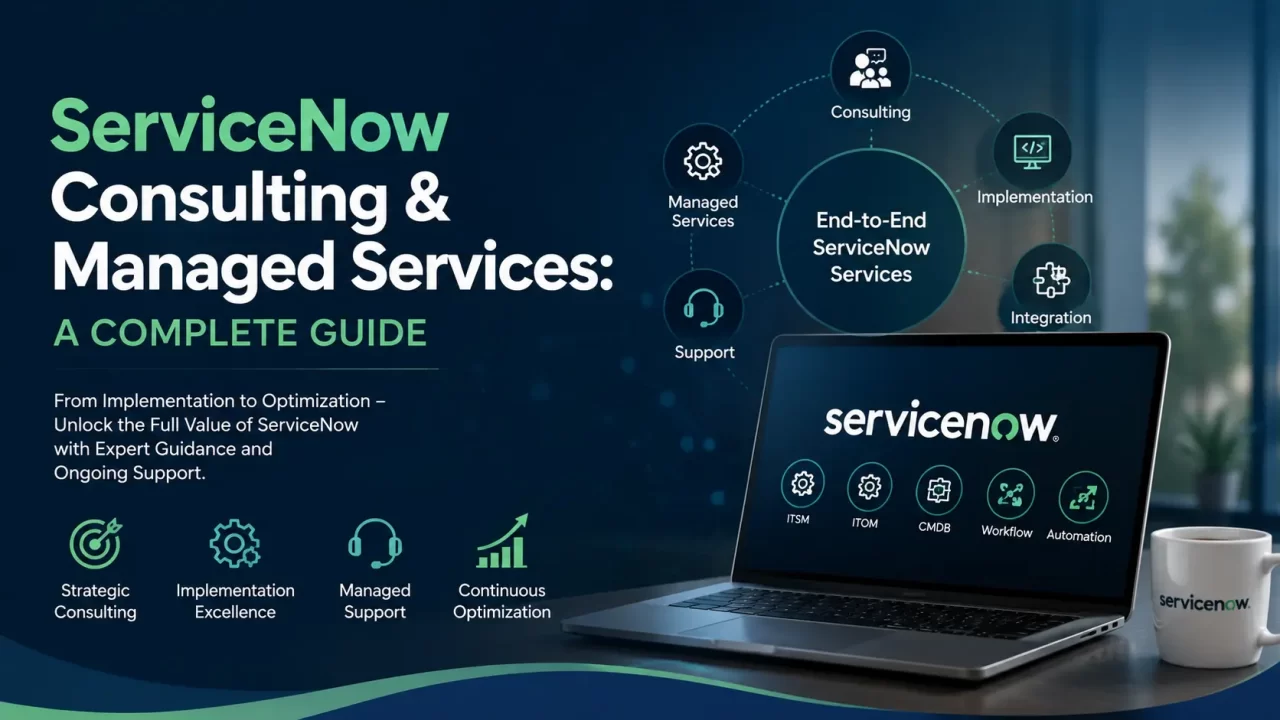
This is where ServiceNow Consulting & Managed Services can make a significant difference.
ServiceNow provides a powerful cloud-based platform that helps organizations digitize workflows, automate repetitive processes, improve service delivery, and connect different departments through a unified system. However, implementing ServiceNow successfully requires the right strategy, technical expertise, governance, integrations, and ongoing support.
Professional ServiceNow consulting and managed services help organizations maximize their ServiceNow investment while reducing implementation risks and operational complexity.
What Is ServiceNow Consulting?
ServiceNow consulting is a professional service designed to help organizations plan, implement, customize, optimize, and expand the ServiceNow platform according to their business requirements.
Every organization has different workflows, technology environments, users, compliance requirements, and business objectives. A standard implementation may therefore not be enough.
ServiceNow consultants work with business and IT stakeholders to understand existing processes and create a solution that aligns the platform with organizational goals.
ServiceNow consulting can include:
- Business and process assessment
- ServiceNow implementation
- Platform configuration and customization
- Workflow automation
- System integration
- Data migration
- Platform upgrades
- Performance optimization
- ITSM transformation
- Employee workflow transformation
- Customer service transformation
- Governance and compliance support
- ServiceNow roadmap development
The goal is not simply to deploy ServiceNow but to ensure the platform creates measurable business value.
What Are ServiceNow Managed Services?
Implementing ServiceNow is only the beginning of the journey.
As business requirements change, organizations need continuous platform monitoring, enhancements, upgrades, administration, troubleshooting, and technical support.
ServiceNow Managed Services provide ongoing expertise to maintain and optimize the platform after implementation.
Instead of relying entirely on internal teams, organizations can work with ServiceNow specialists who continuously manage the platform and help improve its performance.
Managed services may include:
- ServiceNow administration
- Incident and issue resolution
- Platform monitoring
- Application maintenance
- User and role management
- Workflow enhancements
- Integration monitoring
- ServiceNow upgrades
- Patch management
- Performance optimization
- Reporting and dashboard management
- Security and compliance support
- Release management
- Continuous improvement
- Technical support
This allows internal IT teams to focus on strategic initiatives rather than spending significant time maintaining the platform.
Why Businesses Need ServiceNow Consulting Services
ServiceNow is an extensive platform with capabilities across IT, HR, customer service, security, operations, and enterprise workflows.
Without the right implementation strategy, organizations may struggle with unnecessary customizations, inefficient workflows, poor user adoption, integration challenges, and rising maintenance costs.
Professional ServiceNow consulting helps prevent these issues.
1. Build the Right ServiceNow Strategy
A successful ServiceNow transformation starts with a clear strategy.
Consultants analyze the organization’s current technology environment, workflows, pain points, and business goals before recommending the most suitable ServiceNow capabilities.
This helps businesses answer important questions such as:
- Which ServiceNow modules should be implemented first?
- Which processes should be automated?
- What integrations are required?
- Which workflows should be redesigned?
- How should ServiceNow scale as the organization grows?
A structured roadmap helps businesses avoid unnecessary investments and focus on the capabilities that provide the greatest value.
2. Accelerate ServiceNow Implementation
ServiceNow implementations can become complicated when multiple departments, systems, databases, and integrations are involved.
Experienced consultants use structured implementation methodologies and platform best practices to accelerate deployment.
They can help organizations configure workflows, migrate data, integrate third-party systems, perform testing, and prepare users for adoption.
A well-managed implementation reduces delays and helps businesses start realizing value from ServiceNow sooner.
3. Automate Repetitive Business Processes
Manual processes are one of the biggest sources of operational inefficiency.
Tasks such as ticket assignment, approvals, employee onboarding, service requests, notifications, and escalations can consume significant employee time.
ServiceNow consultants can identify repetitive processes and convert them into automated workflows.
Automation can help organizations:
- Reduce manual effort
- Minimize human error
- Improve response times
- Standardize processes
- Increase productivity
- Improve visibility
By automating routine activities, employees can spend more time on strategic and higher-value work.
Key ServiceNow Consulting Services
ServiceNow consulting can cover multiple areas depending on an organization’s requirements.
ServiceNow Advisory and Assessment
Before implementing or expanding ServiceNow, organizations should evaluate their existing environment.
A ServiceNow assessment can identify:
- Process inefficiencies
- Platform gaps
- Unnecessary customizations
- Integration requirements
- Automation opportunities
- Performance issues
- Governance challenges
Based on this assessment, consultants can create an optimization or transformation roadmap.
ServiceNow Implementation Services
Implementation services help businesses configure and deploy ServiceNow according to their requirements.
This may include implementation of solutions such as:
IT Service Management
ServiceNow IT Service Management can help organizations manage incidents, problems, changes, requests, and other IT services through standardized digital workflows.
With proper implementation, IT teams can improve service quality while reducing manual administration.
IT Operations Management
ServiceNow IT Operations Management can provide greater visibility into infrastructure and digital services.
Organizations can use it to monitor technology environments, identify issues, understand dependencies, and improve operational resilience.
Customer Service Management
ServiceNow Customer Service Management helps organizations connect customer service with different business teams.
Customer issues can be automatically routed to the appropriate department while agents receive better visibility into cases and related information.
HR Service Delivery
ServiceNow HR Service Delivery helps simplify employee services by providing digital workflows for HR requests, onboarding, employee documentation, and other HR processes.
It can create a more consistent employee experience while reducing administrative work for HR teams.
Strategic Portfolio Management
Organizations can use Strategic Portfolio Management capabilities to connect investments, projects, resources, and strategic objectives.
This can provide decision-makers with improved visibility into priorities and organizational initiatives.
ServiceNow Integration Services
Most organizations already use multiple enterprise applications.
ServiceNow may need to communicate with systems such as:
- ERP platforms
- CRM applications
- HR systems
- Monitoring tools
- Collaboration platforms
- Identity management solutions
- Cloud services
- Security tools
ServiceNow integration services help create connected workflows across these systems.
Instead of employees manually moving information between applications, integrations allow data and processes to flow automatically.
ServiceNow Customization and Development
Organizations sometimes require capabilities beyond standard configurations.
ServiceNow developers can build custom applications, portals, workflows, integrations, and platform enhancements.
However, excessive customization can make upgrades and maintenance difficult.
An experienced consulting partner can help organizations determine when configuration is sufficient and when customization is truly necessary.
ServiceNow Migration Services
Organizations moving from legacy service management platforms to ServiceNow may need to migrate large amounts of historical data.
Migration services can support the transfer of:
- Incident records
- User information
- Configuration data
- Knowledge articles
- Service requests
- Asset information
- Historical records
A carefully planned migration helps maintain data integrity while reducing business disruption.
Why ServiceNow Managed Services Are Important
Once ServiceNow becomes an important part of business operations, maintaining platform stability becomes essential.
Managed services provide continuous access to experienced ServiceNow professionals.
Continuous Platform Support
Users may encounter configuration issues, workflow errors, integration failures, or unexpected platform behavior.
A managed services team can investigate and resolve these issues quickly.
This helps maintain platform availability and minimizes disruption.
Regular Platform Optimization
Business processes change over time.
Workflows that were effective during the original implementation may eventually require improvement.
Managed services teams can continuously evaluate platform usage and recommend enhancements.
This creates a cycle of continuous improvement rather than allowing the platform to become outdated.
ServiceNow Upgrade Support
ServiceNow regularly introduces platform updates and new capabilities.
Organizations need to evaluate changes, test applications, identify compatibility issues, and manage upgrades carefully.
Managed service providers can assist with upgrade planning, testing, remediation, and deployment.
This reduces risk and helps organizations benefit from newer platform capabilities.
Better Cost Management
Building and retaining a large internal ServiceNow team can require significant investment.
Organizations may need architects, developers, administrators, integration specialists, business analysts, and other professionals.
Managed services provide access to specialized expertise without requiring every skill to be maintained internally.
This can create a more flexible support model.
Benefits of ServiceNow Consulting & Managed Services
Combining consulting expertise with ongoing managed support can deliver several business benefits.
Improved Operational Efficiency
Automated workflows and streamlined processes reduce unnecessary manual activities.
Employees can complete tasks faster while business teams gain better visibility into operations.
Enhanced User Experience
Complex systems often result in low adoption.
ServiceNow consultants can create intuitive portals, streamlined request processes, automated notifications, and user-friendly experiences.
Improved usability encourages greater platform adoption.
Increased Productivity
When repetitive tasks are automated and information becomes easier to access, employees can work more efficiently.
IT teams can spend less time handling routine administrative activities and more time supporting transformation initiatives.
Better Visibility and Reporting
ServiceNow can consolidate operational data into dashboards and reports.
Organizations can monitor metrics such as:
- Incident volumes
- Resolution times
- Service performance
- SLA compliance
- Request trends
- Change success rates
- Workflow performance
This information can support faster and more informed decision-making.
Improved Scalability
As organizations grow, processes become more complex.
A properly designed ServiceNow architecture can scale with increasing users, services, workflows, and business requirements.
Consulting services help organizations build a strong platform foundation while managed services support continuous expansion.
Reduced Platform Risk
Poor configurations and unnecessary customizations can create long-term technical challenges.
Experienced ServiceNow professionals can apply governance and development best practices that improve maintainability and reduce platform risk.
Who Can Benefit from ServiceNow Consulting & Managed Services?
These services can be valuable for organizations at different stages of their ServiceNow journey.
Organizations New to ServiceNow
Businesses implementing ServiceNow for the first time can receive support with strategy, architecture, implementation, integration, and adoption.
Existing ServiceNow Customers
Organizations already using ServiceNow may need help resolving technical debt, improving workflows, implementing additional modules, or increasing adoption.
Businesses with Limited Internal Expertise
Companies without a dedicated ServiceNow team can use managed services to gain access to experienced professionals.
Large Enterprises
Enterprises with complex technology environments can use consulting and managed services to manage integrations, governance, large-scale workflows, and continuous platform development.
How to Choose a ServiceNow Consulting & Managed Services Partner
Choosing the right partner can significantly influence the success of your ServiceNow initiative.
Consider the following factors.
ServiceNow Expertise
Evaluate whether the provider has experience across the ServiceNow capabilities relevant to your organization.
Technical expertise should be combined with an understanding of business processes.
Industry Experience
A provider familiar with your industry may better understand common workflows, regulatory requirements, operational challenges, and business priorities.
Implementation Approach
Look for a partner that follows structured implementation methodologies and focuses on measurable business outcomes rather than simply deploying technology.
Integration Capabilities
Enterprise ServiceNow environments often require integrations with multiple applications.
Ensure the provider has strong integration and architecture expertise.
Flexible Managed Services Model
Different organizations require different levels of support.
A good provider should offer a flexible model based on your platform size, internal capabilities, support requirements, and business priorities.
Focus on Continuous Improvement
Managed services should go beyond resolving tickets.
The right provider should proactively identify opportunities to improve workflows, performance, automation, and user experience.
The Future of Enterprise Workflows with ServiceNow
Organizations are increasingly moving toward intelligent, automated, and connected digital operations.
Automation, artificial intelligence, analytics, self-service capabilities, and integrated workflows are changing how employees and customers interact with enterprise services.
ServiceNow can provide the digital foundation required to support this transformation.
However, technology alone does not guarantee success.
Organizations need the right combination of strategy, process design, implementation expertise, governance, and continuous optimization.
This is why ServiceNow consulting and managed services can play such an important role in long-term digital transformation.
Conclusion
ServiceNow Consulting & Managed Services help organizations get more value from their ServiceNow platform throughout its lifecycle.
Consulting services provide the expertise required to assess business requirements, develop a roadmap, implement solutions, integrate enterprise applications, automate workflows, and optimize the platform.
Managed services provide the ongoing administration, support, maintenance, upgrades, enhancements, and continuous improvement required to keep ServiceNow operating effectively.
By partnering with experienced ServiceNow professionals, organizations can reduce operational complexity, improve productivity, enhance user experiences, automate manual processes, and build scalable digital workflows.
Whether your organization is implementing ServiceNow for the first time or looking to optimize an existing environment, the right consulting and managed services strategy can help transform ServiceNow from a technology platform into a powerful driver of business efficiency and digital transformation.
Frequently Asked Questions
What is ServiceNow consulting?
ServiceNow consulting helps organizations plan, implement, configure, integrate, customize, and optimize the ServiceNow platform according to their business requirements.
What are ServiceNow managed services?
ServiceNow managed services provide ongoing platform administration, monitoring, maintenance, technical support, enhancements, upgrades, and optimization.
Why should businesses use ServiceNow consulting services?
Consulting services provide specialized expertise that can reduce implementation risks, improve workflow design, accelerate deployment, and help businesses maximize their ServiceNow investment.
Can ServiceNow integrate with other enterprise applications?
Yes. ServiceNow can be integrated with various enterprise applications, cloud platforms, monitoring solutions, HR systems, CRM platforms, identity solutions, and other business technologies.
What is the difference between ServiceNow consulting and managed services?
Consulting typically focuses on projects such as implementation, transformation, integration, and optimization, while managed services provide ongoing operational and technical support after implementation.
Is ServiceNow suitable for businesses beyond IT?
Yes. ServiceNow supports workflows across areas including IT, customer service, HR, security, operations, and enterprise business processes.
How can managed services reduce ServiceNow costs?
Managed services can provide flexible access to specialized ServiceNow expertise, reducing the need for organizations to maintain every technical skill internally while helping prevent costly platform issues and technical debt.