
Introduction
Organizations today operate in an increasingly complex environment shaped by evolving regulations, sophisticated cyber threats, and growing stakeholder expectations. Traditional Governance, Risk, and Compliance (GRC) practices, which often rely on manual processes, periodic assessments, and reactive decision-making, are struggling to keep pace with this rapidly changing landscape.
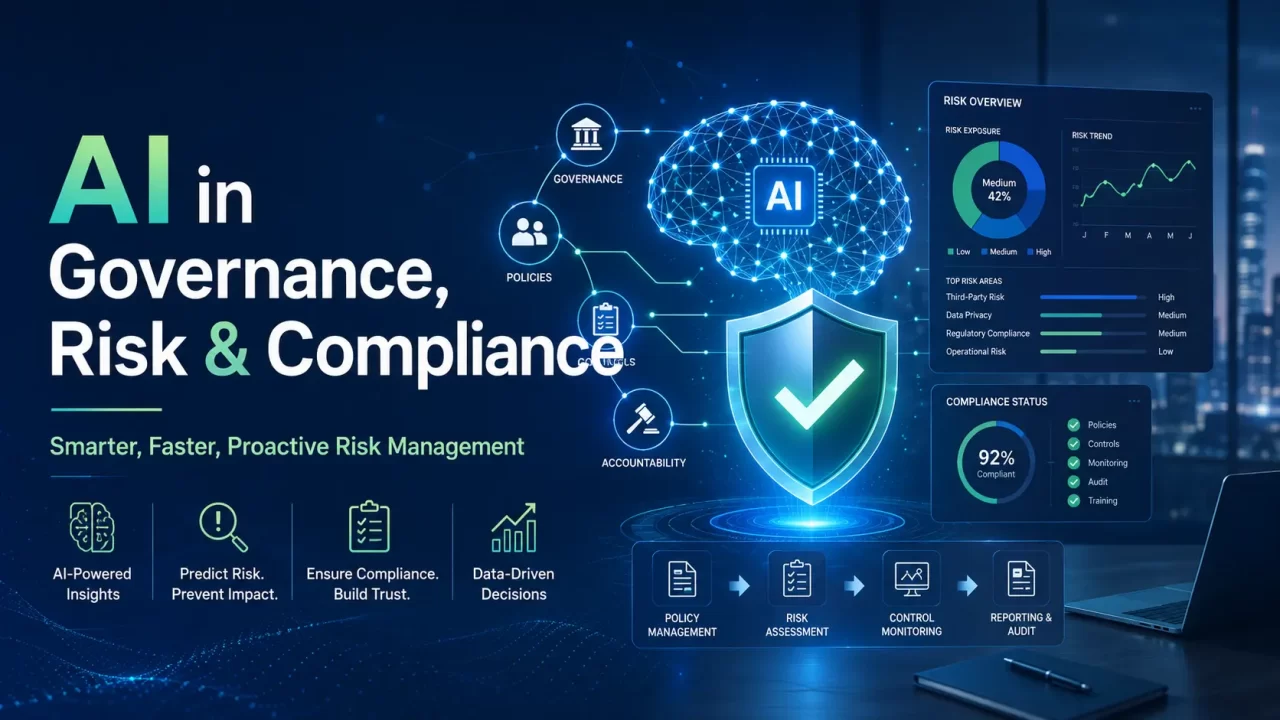
Artificial Intelligence (AI) is transforming how organizations manage governance, identify risks, and ensure regulatory compliance. By leveraging machine learning, natural language processing (NLP), predictive analytics, and intelligent automation, AI enables businesses to shift from reactive compliance to proactive risk management. Instead of merely responding to incidents after they occur, organizations can detect anomalies early, predict emerging risks, and make faster, data-driven decisions.
What is AI in GRC?
AI in Governance, Risk, and Compliance refers to the application of artificial intelligence technologies to automate, enhance, and optimize GRC activities. Rather than replacing governance professionals, AI augments their capabilities by processing massive volumes of structured and unstructured data, identifying patterns, generating insights, and supporting informed decision-making.
AI technologies commonly used in GRC include:
- Machine Learning (ML) for predictive risk analysis
- Natural Language Processing (NLP) for regulatory document analysis
- Robotic Process Automation (RPA) for repetitive compliance tasks
- Predictive Analytics for forecasting risk trends
- Generative AI for policy drafting, compliance reporting, and audit documentation
- Intelligent Monitoring for continuous compliance assessment
Together, these technologies create a smarter, faster, and more adaptive GRC ecosystem.
Why AI is Important in GRC
Modern organizations face several challenges:
- Constantly changing regulatory requirements
- Increasing cybersecurity threats
- Large volumes of compliance documentation
- Manual audit preparation
- Human errors in risk assessments
- Limited visibility into enterprise-wide risks
AI addresses these challenges by enabling continuous monitoring, real-time insights, and automated workflows. Instead of conducting compliance checks quarterly or annually, AI systems continuously analyze operational data, helping organizations detect compliance violations and emerging risks before they become major issues.
AI also improves consistency in governance processes by reducing manual intervention and ensuring standardized evaluations across departments.
Real-World Use Case Scenarios
1. Financial Services: Fraud Detection and Regulatory Compliance
Banks process millions of financial transactions daily. AI continuously analyzes transaction patterns to identify suspicious activities such as money laundering, fraud, or unauthorized access.
For example, an AI system can instantly flag an unusually large international transfer that deviates from a customer’s normal behavior, allowing investigators to respond before financial loss occurs.
Benefits include:
- Faster fraud detection
- Reduced false positives
- Improved regulatory reporting
- Enhanced customer trust
2. Healthcare: HIPAA and Patient Data Protection
Healthcare organizations manage highly sensitive patient information. AI continuously monitors access logs, detects unauthorized data access, and ensures compliance with healthcare regulations.
If an employee accesses patient records outside normal working hours without authorization, AI can immediately generate an alert for investigation.
Benefits include:
- Improved patient privacy
- Faster compliance audits
- Reduced data breaches
- Automated policy enforcement
3. Manufacturing: Operational Risk Management
Manufacturing companies use AI to monitor equipment performance and operational processes.
By analyzing sensor data from machines, AI predicts equipment failures before they happen, reducing operational risks and ensuring compliance with workplace safety regulations.
Benefits include:
- Predictive maintenance
- Reduced downtime
- Improved workplace safety
- Lower operational costs
4. Cybersecurity Governance
Modern cybersecurity frameworks require continuous monitoring.
AI-powered security systems analyze network traffic, user behavior, login patterns, and endpoint activities to detect anomalies.
For example, if an employee account suddenly logs in from multiple countries within minutes, AI identifies the activity as suspicious and automatically triggers security controls.
Benefits include:
- Faster incident response
- Continuous risk monitoring
- Reduced cybersecurity risks
- Improved governance visibility
5. Internal Audit Automation
Preparing for audits traditionally requires collecting evidence from multiple systems.
AI automatically gathers audit logs, policy documents, user access reports, and compliance evidence, significantly reducing manual effort.
Auditors can then focus on evaluating risks rather than collecting documentation.
Benefits include:
- Faster audits
- Improved accuracy
- Reduced manual work
- Better audit readiness
Key Benefits of AI in GRC
1. Improved Risk Identification
AI analyzes massive datasets to uncover hidden patterns that humans may overlook, enabling organizations to identify emerging risks before they escalate.
2. Continuous Compliance Monitoring
Rather than relying on periodic reviews, AI continuously evaluates organizational activities against regulatory requirements, providing real-time compliance visibility.
3. Increased Operational Efficiency
Routine tasks such as document reviews, control testing, report generation, and evidence collection are automated, allowing GRC teams to focus on strategic initiatives.
4. Enhanced Decision-Making
AI provides predictive insights and data-driven recommendations that help executives make informed governance and risk management decisions.
5. Reduced Human Errors
Manual compliance processes are susceptible to inconsistencies and oversight. AI improves accuracy through standardized evaluations and automated validation.
6. Faster Regulatory Response
AI can quickly analyze new regulations, identify impacted business processes, and recommend necessary policy updates, reducing compliance implementation time.
7. Cost Savings
By automating repetitive activities and preventing costly compliance violations, organizations reduce operational expenses while improving overall productivity.
8. Better Audit Readiness
AI continuously collects compliance evidence, making organizations audit-ready throughout the year rather than scrambling before scheduled audits.
Challenges of Implementing AI in GRC
While AI offers significant advantages, organizations should also consider several implementation challenges:
- Ensuring high-quality and reliable data
- Maintaining transparency in AI-driven decisions
- Protecting sensitive organizational information
- Addressing ethical concerns and bias in AI models
- Integrating AI with existing GRC platforms
- Meeting evolving AI governance regulations
Successful AI adoption requires a strong governance framework that combines technology, people, and well-defined processes.
Best Practices for Adopting AI in GRC
Organizations can maximize AI’s value by following these best practices:
- Begin with high-impact use cases such as compliance monitoring or fraud detection.
- Establish strong data governance to ensure AI models rely on accurate and consistent information.
- Keep humans involved in reviewing critical AI-generated decisions.
- Continuously monitor and retrain AI models as regulations and business conditions evolve.
- Integrate AI with existing GRC tools and enterprise systems for seamless workflows.
- Develop clear AI governance policies covering ethics, transparency, accountability, and security.
The Future of AI in GRC
The future of GRC is becoming increasingly intelligent, predictive, and autonomous. As generative AI, large language models, and advanced analytics continue to mature, organizations will move beyond automated compliance toward intelligent governance.
Future AI-powered GRC platforms will be capable of:
- Predicting regulatory changes before they take effect
- Automatically recommending policy updates
- Continuously assessing enterprise-wide risks
- Generating real-time executive dashboards
- Supporting strategic decision-making through predictive insights
- Enabling autonomous compliance monitoring with human oversight
Organizations that adopt AI strategically will be better equipped to manage uncertainty, strengthen governance, and maintain regulatory compliance in an increasingly complex business environment.
Conclusion
Artificial Intelligence is redefining Governance, Risk, and Compliance by making processes smarter, faster, and more proactive. From automating compliance tasks and detecting fraud to predicting operational risks and improving audit readiness, AI empowers organizations to manage governance with greater confidence and efficiency.
While successful implementation requires careful planning, strong data governance, and ethical oversight, the long-term benefits are substantial. Organizations that embrace AI-driven GRC can reduce risks, enhance compliance, improve operational resilience, and make better strategic decisions.
As regulatory environments become more dynamic and business risks continue to evolve, AI is no longer just an innovation—it is becoming an essential capability for building resilient, compliant, and future-ready organizations.