
A perspective from Timus Consulting Services
Governance, Risk, and Compliance (GRC) has always been a data-heavy, document-heavy discipline. Policies, control frameworks, audit findings, regulatory filings, risk registers — the raw material of GRC work is enormous, and most of it is unstructured. For decades, GRC teams have managed this volume with spreadsheets, manual reviews, and platforms that are excellent at storage and workflow but still depend on people to read, interpret, and enter the substance.
That dependency is what AI is now beginning to remove — not by replacing GRC judgment, but by accelerating the parts of the job that are mechanical: extraction, classification, drafting, and pattern recognition across thousands of records a human reviewer would never have time to read in full.
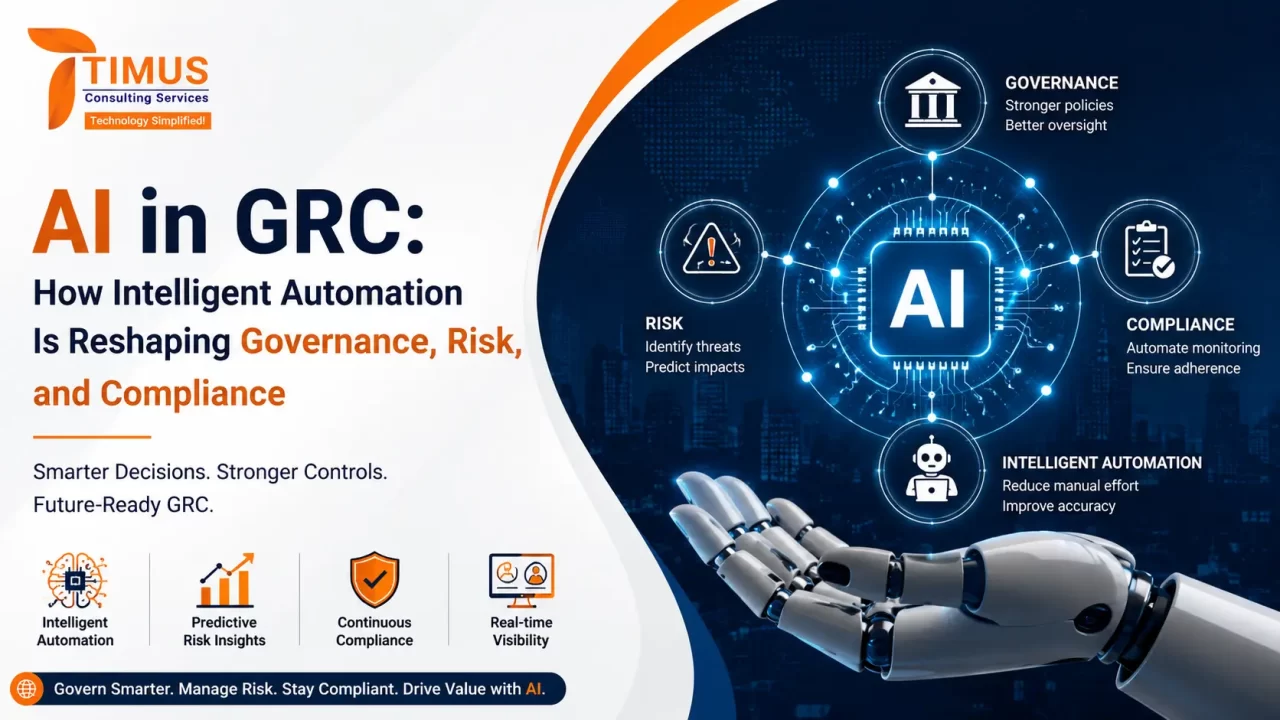
Where AI Actually Fits in a GRC Program
It helps to be specific about where AI adds value, because “AI in GRC” is often pitched as a single capability when it’s really several distinct ones stitched together:
1. Document and audit intelligence. Audit reports, control narratives, and third-party assessments arrive as Word documents, PDFs, and spreadsheets in every format an organization’s history of vendors has produced. Large language models can read these documents, extract findings, risk ratings, and recommendations, and structure them into the fields a GRC platform expects — turning a multi-day manual intake process into a same-day one.
2. Risk and control classification. Mapping a newly identified risk to the right control library, regulatory citation, or business process is a categorization problem AI is well suited to, especially when trained or prompted against an organization’s own taxonomy rather than a generic one.
3. Narrative generation and review support. Drafting management action plans, control descriptions, and risk narratives from source evidence is a place where AI can produce a strong first draft, leaving human reviewers to verify and refine rather than start from a blank page.
4. Anomaly and pattern detection. Once risk and control data is structured, statistical and ML techniques can surface control gaps, repeat findings, or emerging risk concentrations that would be difficult to spot by scanning records individually.
5. Continuous monitoring augmentation. AI models can watch structured data feeds — transaction logs, access records, vendor risk signals — and flag deviations for review, complementing rather than replacing existing control monitoring.
None of these replace the judgment calls GRC professionals are trained and licensed to make. What they do is compress the time between “the evidence exists” and “the evidence is usable” — which is where most GRC programs actually lose time today.
A Practical Example: Automating Audit Finding Intake
One useful illustration of this in practice is audit report ingestion into a platform like IBM OpenPages. Traditionally, converting a third-party audit report into structured Finding and Action Plan objects means a GRC analyst manually reading the report and re-typing content into the platform’s forms — theme, background, risk rating, recommendation, target date, responsible officer, and so on.
An AI-assisted pipeline can take the same source document, extract that structured content directly, and stage it for review before it’s committed to the platform. Done well, this doesn’t remove the human from the loop — a person still validates ratings and content — but it removes the transcription work, which is often the single largest time cost in the process. Applied across a full portfolio of audits, this kind of automation turns intake from a bottleneck into a fast, repeatable step in the GRC lifecycle.
Real-World Use Cases
These aren’t hypothetical scenarios — they reflect the kind of AI-in-GRC work being delivered today:
Audit finding ingestion for IBM OpenPages. A two-pass pipeline reads third-party audit reports (Word and Excel) and populates OpenPages Finding and Action Plan objects automatically — Finding Theme, Background, Risk Rating, Recommendation, Management Action Plan, Target Date, and Responsible Officer. The first pass creates stub records; the second populates full content once extraction is validated. What used to be days of manual re-typing per audit cycle becomes a same-day intake process, with analysts reviewing structured output instead of transcribing from scratch.
Cloud asset risk enrichment. An automated pipeline discovers cloud assets (compute, storage, database, container services), maps them against known vulnerability databases using standard severity scoring, and uses an LLM to enrich each finding with plain-language risk context before creating corresponding risk items in the GRC platform, tagged to the relevant control framework (e.g., SOX, ISO 27001). This turns a manual, periodic vulnerability review into a continuously running risk-identification process.
Financial control monitoring via BI and anomaly detection. Accounts payable and receivable data pulled from ERP systems (e.g., Odoo) into Power BI dashboards isn’t just for finance reporting — aging analysis, unreconciled balances, and variance measures also double as informal control monitoring, surfacing unusual vendor payment patterns or reconciliation gaps that would otherwise wait for a scheduled audit to catch.
Messy document ingestion at scale. A modular pipeline that accepts DOCX, PDF, HTML, XML, XLSX, and CSV inputs, extracts structured data using an LLM, and writes it into a relational data store gives compliance teams a way to bring years of inconsistent legacy documentation into a searchable, reportable format — without a multi-year manual data entry project.
GRC platform specification from mockups. Translating a dashboard mockup or requirements document into a full implementation specification — object types, query subjects, field mappings, styling rules, and a step-by-step build checklist — is itself a task AI can accelerate, giving implementation teams a head start before configuration work begins in tools like IBM OpenPages or Cognos Analytics.
Across all of these, the common thread is the same: AI handles the volume and the first draft, and a person handles the judgment call before anything becomes part of the official record.
Why This Matters Now, Not Just Eventually
Three forces are converging to make this a near-term priority rather than a future one:
- Regulatory volume keeps growing. Financial services, insurance, and public-sector organizations face an expanding set of frameworks and reporting obligations, and headcount rarely grows at the same rate as regulatory scope.
- GRC platforms are AI-ready. Modern GRC and risk platforms — IBM OpenPages among them — increasingly expose APIs that make it practical to integrate AI-driven extraction and classification directly into existing workflows, rather than bolting on a separate tool.
- Language models have crossed a usability threshold. Extracting structured risk data from messy, inconsistent documents used to require expensive, brittle, purpose-built NLP pipelines. Current-generation models handle this reliably enough to be a production tool rather than an experiment, provided the pipeline is designed with proper validation and human review built in.
What “Doing This Well” Requires
Organizations that get real value from AI in GRC tend to share a few practical habits:
- Keep a human in the loop at the point of judgment — risk ratings, control conclusions, and regulatory interpretations should be AI-assisted, not AI-decided.
- Design for the platform’s actual data model, not a generic one — field limits, enumerated values, and object hierarchies (in OpenPages or any GRC platform) need to be respected from the start, or the integration creates as much rework as it saves.
- Treat AI output as a draft, not a record — a staged review step before data is committed to the system of record catches errors before they become part of an audit trail.
- Start narrow. Audit finding intake, control narrative drafting, or risk classification are good first use cases precisely because they’re bounded and their output is easy to check against the source document.
Closing Thought
AI in GRC isn’t about replacing risk and compliance professionals with automation — it’s about giving them back the time currently spent on transcription, formatting, and first-draft writing so they can spend it on the judgment calls that actually require expertise. The organizations that will benefit most are the ones that treat AI as an accelerant built into existing GRC platforms and workflows, rather than a separate system layered on top.
Timus Consulting Services helps organizations design and implement GRC programs — including IBM OpenPages implementations, AI-assisted audit and risk workflows, and platform integrations — that turn governance from a manual burden into a scalable, well-governed process. Get in touch to discuss your GRC and AI roadmap.