
Introduction
Cyber risk has moved from the server room to the boardroom. As organisations accelerate cloud adoption, expand remote and hybrid operations, and deepen their dependence on third-party technology providers, the digital attack surface has grown faster than most security teams can defend it. IT risk and cyber security are no longer isolated technical concerns owned exclusively by the IT department — they are enterprise risks with direct implications for financial performance, regulatory standing, customer trust, and business continuity.
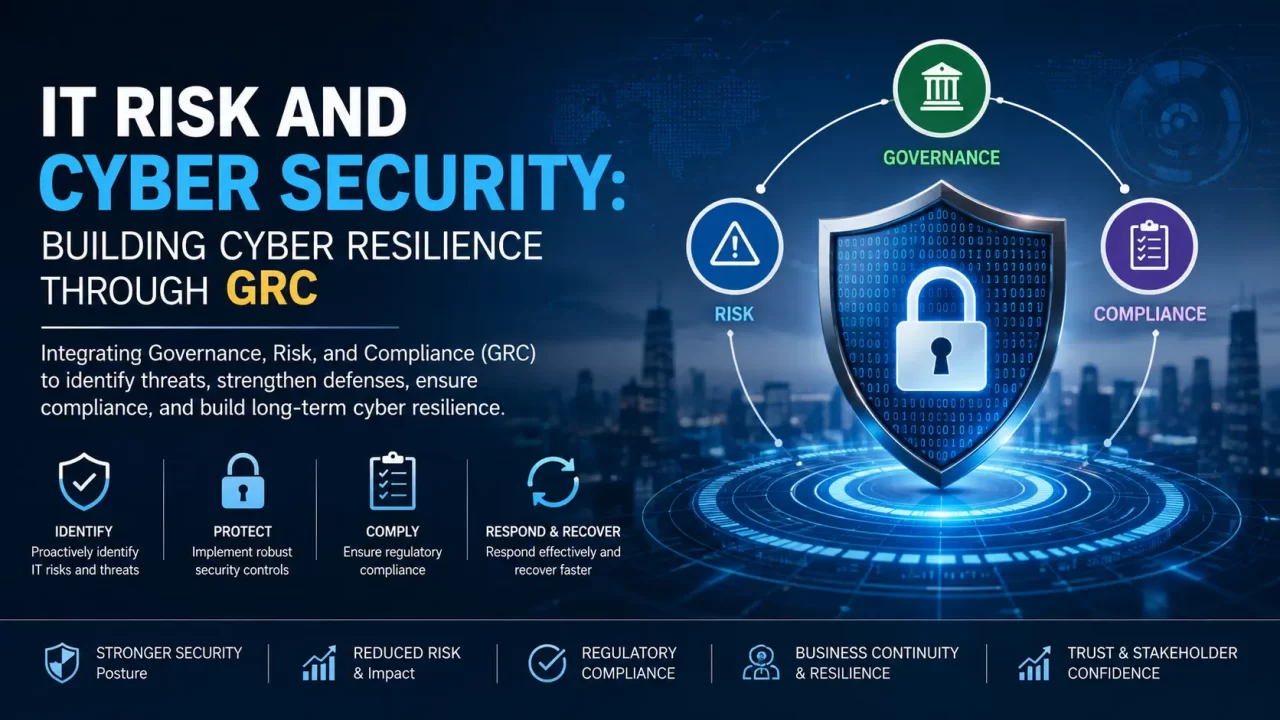
Governance, Risk, and Compliance (GRC) provides the framework needed to manage this reality. By embedding IT risk and cyber security into a unified GRC strategy, organisations gain a consolidated view of technology risk, connect security controls to compliance obligations, and give leadership the real-time intelligence needed to make informed decisions. Cyber resilience is no longer achieved through firewalls and antivirus software alone — it requires structured governance, continuous monitoring, and integration with the broader enterprise risk landscape.
Why IT Risk and Cyber Security Matters Now:
- Global cybercrime costs are projected to exceed $10.5 trillion annually by 2025, up from roughly $3 trillion a decade earlier.
- The average cost of a data breach climbed to $4.88 million in 2024 — the highest figure on record.
- A ransomware attack occurs somewhere in the world approximately every 11 seconds, with average recovery time extending beyond three weeks.
- Human error contributes to over 74% of confirmed data breaches, underscoring the limits of technology-only defences.
- More than 65% of corporate boards now rank cyber risk among their top three enterprise risks, up from under 40% just five years ago.
The message is unambiguous: IT risk and cyber security are business-critical disciplines, and GRC is the framework that makes them manageable at scale.
Key Challenges in IT Risk and Cyber Security Management
Expanding attack surface. Cloud migration, IoT proliferation, remote and hybrid work, and growing third-party integrations have multiplied the number of entry points into enterprise environments. Traditional perimeter-based defences were never designed for an ecosystem this distributed, leaving organisations exposed to threats that bypass conventional controls entirely.
Fragmented risk visibility. IT security, compliance, and enterprise risk teams frequently operate in disconnected systems, each tracking a partial view of the organisation’s cyber exposure. Without a centralised risk register, leadership cannot answer basic questions about which systems are most vulnerable, which controls are failing, or where remediation should be prioritised.
Cybersecurity talent shortage. The global cybersecurity workforce gap now exceeds 4 million professionals, leaving existing teams stretched across an ever-growing volume of alerts, vulnerabilities, and compliance obligations. Manual processes only widen this gap further, consuming scarce analyst time on tasks that automation could otherwise absorb.
Regulatory complexity and disclosure pressure. Organisations must now navigate an expanding web of frameworks and mandates — including the NIST Cybersecurity Framework, ISO 27001, the EU’s Digital Operational Resilience Act (DORA), and the SEC’s cyber incident disclosure rule — each with distinct reporting timelines and evidentiary requirements. Falling short on any one of these carries financial, legal, and reputational consequences.
Core Elements of IT Risk and Cyber Security Management
| GRC Capability | Role in IT Risk and Cyber Security Management |
| IT Risk Register | Centralised inventory of technology assets, systems, and the cyber risks associated with each. |
| Threat & Vulnerability Management | Continuously identifies, prioritises, and remediates vulnerabilities before they can be exploited. |
| Control Mapping & Testing (ITGC) | Links cybersecurity controls to regulatory and framework requirements, validating their ongoing effectiveness. |
| Third-Party & Vendor Risk Management | Assesses and monitors the cyber exposure introduced by vendors, partners, and the broader supply chain. |
| Incident Response & Breach Management | Structured workflows for detecting, containing, escalating, and reporting security incidents. |
| Continuous Control Monitoring | Provides real-time assurance that security controls remain effective, replacing point-in-time audits. |
Together, these capabilities create a cyber risk management ecosystem that is structured, scalable, and continuously aligned with the evolving threat landscape. A well-maintained IT risk register enables accurate vulnerability prioritisation; effective control mapping supports reliable testing; and continuous monitoring gives leadership the confidence to report to boards and regulators with accuracy.
Traditional IT Security vs. GRC-Integrated Cyber Risk Management: A Strategic Comparison
| Dimension | Traditional IT Security | GRC-Integrated Cyber Risk Management |
| Risk Visibility | Siloed within the IT department | Unified, enterprise-wide cyber risk view |
| Vulnerability Management | Periodic scans and scheduled patch cycles | Continuous monitoring and prioritised remediation |
| Third-Party Risk | Manual, point-in-time questionnaires | Continuous vendor risk monitoring and scoring |
| Incident Response | Ad hoc, IT-led response | Cross-functional workflow integrated with risk and compliance |
| Regulatory Reporting | Reactive, post-incident documentation | Proactive, audit-ready evidence and disclosure readiness |
| Scalability | Constrained by tooling and headcount | Scales with automation and a centralised platform |
This comparison reveals the fundamental limitation of traditional IT security: it was built for a slower, more contained threat environment. GRC-integrated cyber risk management, by contrast, is built for the distributed, fast-moving digital landscape organisations actually operate in — providing the agility to respond to emerging threats, the structure to manage technology risk at scale, and the visibility to demonstrate resilience with confidence.
Benefits of GRC-Integrated IT Risk and Cyber Security Management
Unified Cyber Risk Visibility A GRC platform provides a single, consolidated view of technology assets, threats, vulnerabilities, and controls — mapped to the business processes they support. This eliminates the fragmentation that plagues traditional security programmes and gives leadership a real-time picture of the organisation’s cyber exposure.
Faster Threat Detection and Response Organisations using integrated cyber-GRC platforms report cutting incident response time by up to 50%. Automated alerting, prioritised remediation queues, and cross-functional workflows ensure threats are addressed before they escalate into full-scale incidents.
Reduced Compliance and Audit Burden By automating evidence collection, control testing, and reporting, GRC platforms reduce the manual workload associated with cybersecurity compliance by an estimated 40-60%. This frees security teams to focus on threat management rather than documentation.
Stronger Third-Party and Supply Chain Oversight Continuous vendor risk monitoring replaces static, annual questionnaires with ongoing visibility into supplier security postures — critical as supply chain attacks continue to rise as a primary breach vector.
Board-Level Cyber Risk Intelligence GRC dashboards translate technical vulnerabilities and control gaps into business-relevant risk metrics, giving boards and executive leadership the clarity needed to allocate resources, assess exposure, and meet growing disclosure expectations.
Real-World Use Cases
Financial Services Banks and financial institutions face some of the most stringent cyber regulatory regimes in the world, including DORA, PCI DSS, and FFIEC guidance. GRC platforms enable continuous ICT risk monitoring, structured incident reporting, and regulator-ready documentation — reducing both enforcement risk and the cost of regulatory submissions.
Healthcare and Life Sciences Healthcare organisations must protect patient data under HIPAA while managing the growing risk surface introduced by connected medical devices and third-party vendors. GRC-integrated cyber risk management centralises this exposure and produces audit evidence on demand — essential where non-compliance carries both financial and patient safety consequences.
Technology and SaaS Rapidly scaling technology companies rely on GRC platforms to manage IT general controls (ITGC) required for SOC 2 and ISO 27001 certifications, while continuously monitoring cloud infrastructure risk as their environments expand.
Manufacturing and Critical Infrastructure The convergence of operational technology (OT) and IT has introduced new risks to industrial control systems. GRC frameworks help manufacturers manage this convergence while maintaining compliance with standards such as NERC CIP.
Government and Public Sector Government agencies face persistent nation-state threats alongside strict continuous monitoring mandates such as FedRAMP. GRC platforms provide the structured control environment needed to defend critical systems while maintaining public accountability.
Choosing the Right IT Risk and Cyber Security Strategy
| Organisational Profile | Recommended IT Risk and Cyber Security Approach |
| Highly regulated enterprise | Continuous control monitoring + integrated incident reporting workflows |
| Rapidly scaling technology company | Automated ITGC testing + cloud-native risk monitoring |
| Complex multi-vendor ecosystem | Continuous third-party risk monitoring + centralised vendor risk register |
| Resource-constrained security team | Workflow automation + prioritised vulnerability remediation |
| Digitally transforming organisation | Integrated cyber-GRC platform aligned with enterprise risk strategy |
Organisations beginning their cyber-GRC journey should prioritise building a centralised IT risk register and control mapping framework before investing in advanced automation. A phased approach — starting with visibility, then layering in workflow automation, and finally adding continuous monitoring and predictive analytics — delivers sustainable value while managing implementation complexity. Aligning this journey with established GRC platforms such as IBM OpenPages ensures cyber risk capabilities are embedded within enterprise governance infrastructure from the outset.
Conclusion
The threat landscape organisations face today is not going to slow down. Attack surfaces will keep expanding, adversaries will keep evolving their tactics, and the consequences of inadequate cyber risk management will continue to escalate — in financial losses, regulatory penalties, and reputational damage. Against this backdrop, the organisations that build genuine resilience will be those that transform IT risk and cyber security from a reactive, siloed function into a structured, intelligence-driven discipline embedded within enterprise governance.
GRC is the architecture that makes this transformation possible. By centralising technology risk, integrating cyber security with enterprise risk management, automating control testing and evidence collection, and providing real-time visibility into the organisation’s cyber posture, GRC platforms give security and risk teams the capability to defend the enterprise at scale — without proportional increases in cost or headcount.
The data is clear: organisations with mature, GRC-integrated cyber risk programmes detect threats faster, respond more effectively, and demonstrate resilience with far greater confidence than those relying on fragmented, manual approaches. As regulators around the world continue to raise the bar on cyber governance and disclosure, building an integrated IT risk and cyber security function is not a competitive advantage — it is a business imperative. The question is no longer whether your organisation can afford to invest in GRC-integrated cyber risk management — it is whether it can afford not to.