
A perspective from Timus Consulting Services
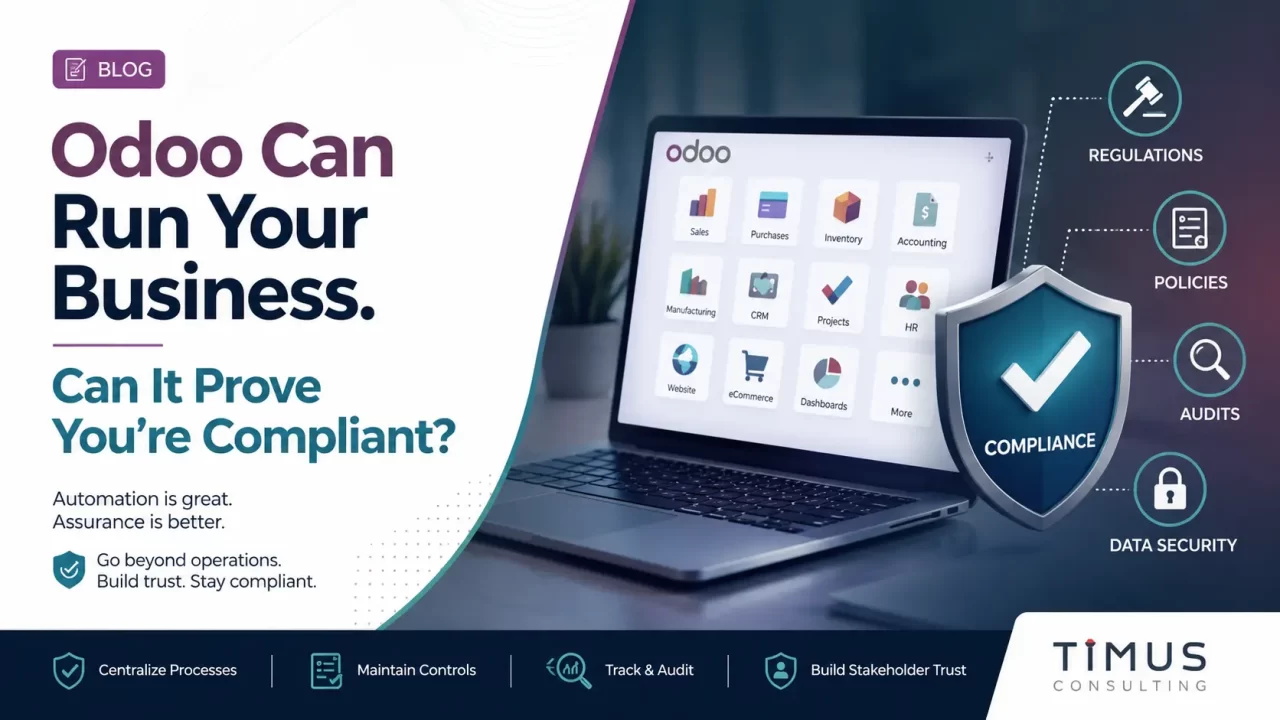
Odoo 19 shipped something quiet but important this year: ESG reporting, built into the core platform. No add-on, no third-party module, no separate login. If you’re running Odoo, it’s just… there now.
Most implementation partners will mention this in a release-notes email and move on. We think it’s the most important thing to happen to Odoo in years — and almost nobody’s talking about why.
Here’s the thing. For most of Odoo‘s life, compliance was something you added after the ERP was live. You’d get your sales, inventory, and accounting running smoothly, go live, breathe a sigh of relief — and then, six months or a year later, an auditor would ask for a control that didn’t exist, or a regulator would want an audit trail nobody thought to design in. So, you’d bolt something on. A spreadsheet here, a manual sign-off process there, maybe a separate GRC tool that doesn’t talk to your ERP at all.
That gap — between “the system works” and “the system can prove it’s compliant” — is the single most expensive mistake we see growing businesses make with ERP. Not because compliance is hard. Because it’s an afterthought.
Why this is the wrong year to keep treating it that way
A few things are converging in 2026 that make this gap more expensive than it used to be:
- Regulatory reporting keeps tightening, not loosening. GST rules, e-invoicing mandates, and data-handling requirements get updated with nearly every release cycle now — in India and everywhere else Odoo operates. A system that can’t produce a clean audit trail on demand is a liability that compounds every quarter you leave it unaddressed.
- ESG reporting stopped being optional for anyone selling into a supply chain. If your customers are large enterprises, they’re already asking their suppliers for governance data. Having it live in your ERP, versus scrambling to assemble it in Excel, is the difference between a five-minute answer and a two-week fire drill.
- AI is moving into ERP workflows fast — Odoo 19 alone added AI agents for reconciliation, lead scoring, and document processing. That’s a good thing. But every AI action taken inside your system is another decision that eventually needs an audit trail, an owner, and a control. Speed without governance just means you make mistakes faster.
None of this means “don’t implement Odoo” or “don’t use AI.” It means the businesses that treat governance as part of the ERP design — not a phase two problem — are going to spend a lot less time firefighting in 2027 than the ones who don’t.
What we have actually seen happen without it
We’ve walked into enough Odoo environments to know what the gap looks like in practice, not just in theory:
- Finance and projects living in separate silos, with month-end close taking days of manual reconciliation because nothing was designed to talk to anything else.
- Field operations tracked over phone and email, with no way to prove an SLA was met until someone goes digging through inboxes.
- Multi-currency operations reconciled by hand, because the accounting setup assumed a single-currency business from day one.
- Reporting built as an afterthought — a request that gets escalated to IT every time leadership wants a real answer instead of a stale spreadsheet.
Every one of these is fixable. The businesses that fix it before go-live spend a fraction of the time and money that the businesses fixing it after go-live do.
Where we come from — and why it shapes how we build
Timus didn’t start as an ERP shop that later added compliance work. It’s the other way round. We’re built on governance, risk & compliance consulting — our team is ISO 27001 and ISO 22301 certified — and Odoo implementation grew out of that foundation, not the other way around. When we design a rollout, the control framework and the workflow get built by the same team, at the same time. Approvals carry an owner. Audit trails exist because they were designed in, not requested later.
That’s shown up as real outcomes for the businesses we’ve worked with — an engineering consultancy in Germany that took month-end close from days to hours once finance, projects, and BI reporting lived on one platform; a solar energy company across two Indian states that stopped managing field tickets over the phone once SLA tracking became native to the system; a petroleum distributor in Zimbabwe that collapsed a multi-currency ledger into one live view instead of a monthly reconciliation exercise. Different industries, different countries, same underlying pattern: the systems that were designed with governance in mind from day one needed far less rescuing later.
Three questions worth asking before your next Odoo project
Whether you work with Timus or anyone else, these are worth asking any implementation partner before you sign anything:
- Who owns the control framework — and when do they start? If the answer is “we’ll figure that out after go-live,” that’s the bolt-on pattern repeating itself.
- Can you show me an audit trail for a real transaction, today, in a live system — not a mockup? If a partner can’t produce this from an existing client, be cautious.
- What happens when a regulator or auditor asks for something the system wasn’t built to produce? The honest answer should be “we designed for that,” not “we will build a workaround.”
If those questions get confident, specific answers, you’re in good hands regardless of who you choose. If they get vague ones, you’re looking at a bolt-on compliance problem with a delivery date six months out.
Timus Consulting Services is a GRC-first consultancy delivering Odoo ERP, AI/ML, Cloud, and business consulting across India, the UAE, the UK, Ireland, Canada, and the US. If you’d like a candid look at where your own systems stand on the governance question — no pitch, just an honest audit — get in touch with our team at timusconsulting.com or reach out at business@timusconsulting.com.
FAQs
1. Can Odoo help businesses maintain compliance?
Yes, Odoo can support compliance by providing structured workflows, automated processes, access controls, reporting, and record tracking that help organizations maintain regulatory requirements.
2. Does Odoo provide audit trails for compliance purposes?
Odoo includes logging and tracking capabilities that help businesses monitor changes, approvals, and transactions, creating better visibility for audits.
3. How does Odoo improve financial compliance?
Odoo Accounting helps organizations maintain accurate financial records, automate invoicing, manage taxes, and generate reports required for financial reviews and audits.
4. Can Odoo support industry-specific compliance requirements?
Yes, Odoo can be customized with modules, configurations, and integrations to support compliance needs across industries such as healthcare, manufacturing, retail, and finance.
5. Is Odoo enough for complete governance and risk management?
Odoo helps manage operational compliance, but organizations may require additional GRC solutions for advanced risk management, control monitoring, and enterprise governance.