
Introduction
Artificial Intelligence is no longer a future technology. Organizations across industries are actively exploring how AI can improve efficiency, automate workflows, enhance customer experiences, and support better decision-making.
Yet despite growing interest, many businesses struggle to move beyond experimentation. They invest in AI tools, run pilot projects, or test public AI platforms, but often fail to achieve measurable business outcomes.
The challenge is not the technology itself. The challenge is knowing where AI can create real value, how to implement it responsibly, and how to align it with business goals.
Successful AI adoption requires more than tools—it requires strategy, governance, intelligent solutions, and strong risk and compliance consulting to ensure AI initiatives remain secure, compliant, and aligned with business objectives.
Organizations that approach AI strategically are transforming curiosity into business value.
Why Many AI Initiatives Struggle
While AI offers significant opportunities, many projects fail to deliver expected results.
Common challenges include:
- Unclear business objectives
- Lack of AI readiness
- Poor data quality and accessibility
- Difficulty identifying valuable use cases
- Security and compliance concerns
- Limited internal expertise
- Overreliance on generic AI tools
Many organizations begin with technology instead of business needs. As a result, AI projects often remain isolated experiments rather than scalable business solutions.
To achieve meaningful outcomes, organizations need a structured approach to AI adoption.
The Timus Approach to AI Adoption
AI success isn’t just about implementing new technology. It requires the right strategy, solutions, and governance.
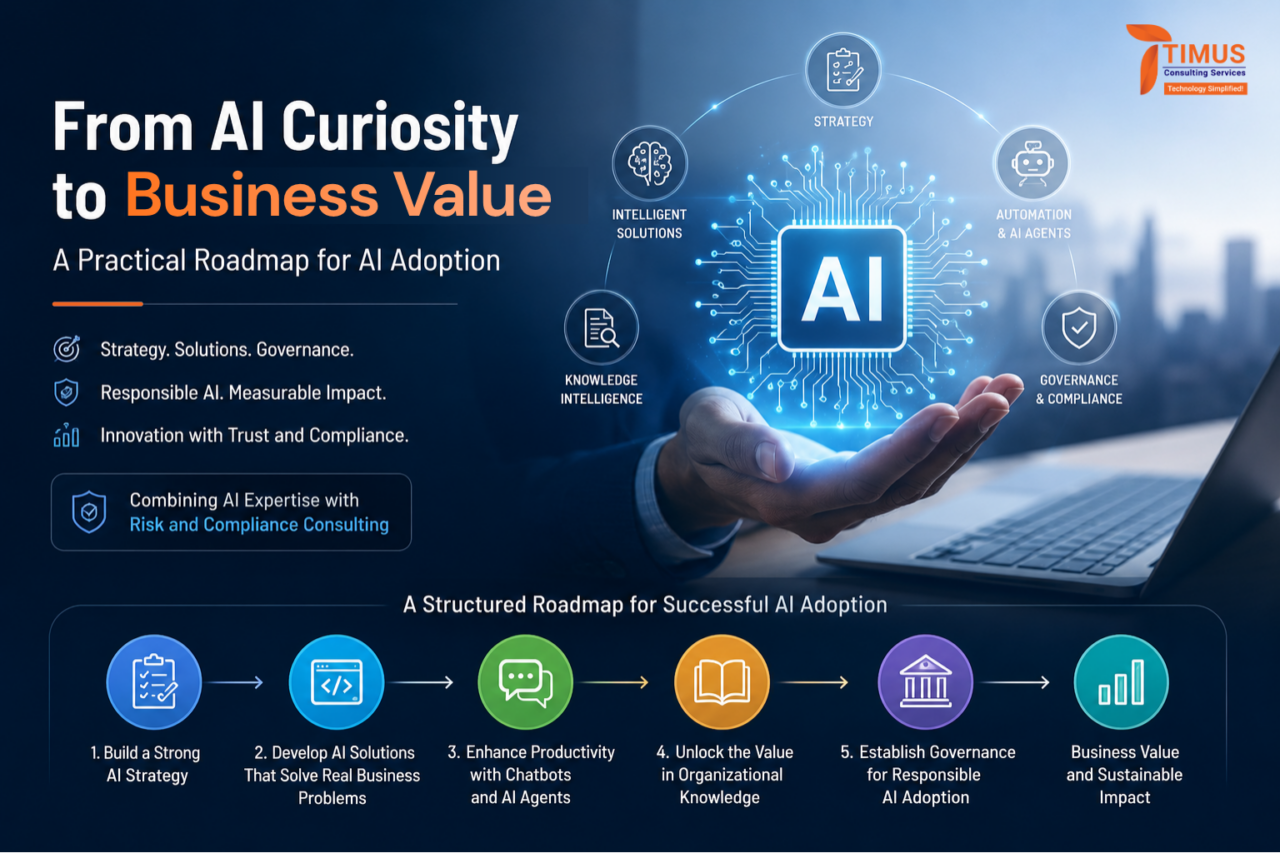
At Timus Consulting, we help organizations move from AI curiosity to business value through a practical and structured approach to AI adoption, combining AI expertise with risk and compliance consulting.
The following roadmap highlights the key stages of a successful AI journey.
Step 1: Build a Strong AI Strategy
Before implementing AI, organizations must understand where they stand and where they want to go.
A strong AI strategy begins with:
– AI Readiness Assessment
Organizations should evaluate:
- Data availability and quality
- Existing technology landscape
- Security and governance requirements
- Business process maturity
- Organizational readiness
Understanding these factors helps reduce risk and identify areas where AI can deliver value.
– AI Opportunity Discovery
Not every process requires AI.
The most successful organizations focus on high-impact opportunities such as:
- Customer support
- Knowledge management
- Compliance operations
- Workflow automation
- Employee productivity
- Decision support
– AI Roadmap Development
A practical roadmap helps organizations prioritize initiatives, allocate resources, and implement AI in manageable phases.
Rather than pursuing isolated projects, businesses can build a sustainable AI adoption strategy aligned with long-term goals.
Organizations operating in regulated industries often benefit from specialized risk and compliance consulting to ensure AI adoption aligns with governance frameworks, regulatory requirements, and internal controls.
Step 2: Develop AI Solutions That Solve Real Business Problems
Once priorities are identified, organizations can begin building AI solutions tailored to their specific needs.
Modern AI development goes far beyond chat interfaces.
Examples include:
– Custom AI Applications
AI-enabled business applications can automate processes, support decision-making, and improve operational efficiency.
Examples include:
- Contract review assistants
- Risk analysis tools
- Compliance intelligence platforms
- Business process automation solutions
– LLM-Based Solutions
Large Language Models (LLMs) can be customized to support enterprise use cases, helping organizations generate insights, answer questions, and process information more effectively.
– AI-Powered Workflows
AI can automate repetitive activities such as:
- Document processing
- Data extraction
- Approval routing
- Follow-up actions
- Reporting tasks
– AI Copilots
AI copilots support employees by providing recommendations, generating content, answering questions, and assisting with daily tasks.
– AI-Enabled Portals and Integrations
Organizations often gain the most value by integrating AI directly into existing enterprise systems, portals, and business applications rather than introducing standalone tools.
The goal is not simply to implement AI—but to create practical enterprise AI solutions that deliver measurable business value.
Step 3: Enhance Productivity with Chatbots and AI Agents
One of the most practical and widely adopted applications of AI is the use of intelligent assistants.
Modern AI chatbots and AI agents are helping organizations improve service delivery, streamline operations, and increase productivity.
– Enterprise Chatbots
AI-powered chatbots can support a wide range of business functions, including:
- Customer support chatbots
- Internal knowledge chatbots
- HR chatbots
- Compliance assistants
- IT helpdesk chatbots
- Document Q&A bots
These solutions help users access information quickly, reduce support workloads, and improve service experiences.
– AI Agents for Task Automation
AI agents go beyond answering questions. They can perform actions, manage tasks, trigger workflows, and support business processes.
Organizations are increasingly using AI agents to automate:
- Approvals and follow-ups
- Document processing
- Workflow orchestration
- Operational tasks
- Decision-support activities
– Multi-Agent Business Workflows
Advanced AI environments can leverage multiple AI agents working together to automate complex business operations across departments and functions.
Step 4: Unlock the Value Hidden in Organizational Knowledge
Many organizations possess vast amounts of information spread across documents, policies, reports, contracts, procedures, and internal systems.
– Custom Model Training
Organizations can train AI solutions using their own business knowledge, creating systems that understand company-specific terminology, processes, policies, and requirements.
– Model Fine-Tuning
Fine-tuned models deliver more relevant and accurate responses for specific industries, business functions, and operational needs.
– Retrieval-Augmented Generation (RAG)
RAG combines AI with enterprise knowledge sources, allowing users to receive responses grounded in trusted business information.
– Enterprise Knowledge Bases
AI-enabled knowledge platforms make organizational information searchable, accessible, and actionable.
– Policy and Procedure Intelligence
Employees can quickly locate relevant policies, procedures, and compliance requirements without manually searching through large repositories.
– Document Search and Summarization
AI can analyze large volumes of information and provide concise summaries, helping teams make decisions faster and more effectively.
Step 5: Establish Governance for Responsible AI Adoption
As AI capabilities expand, organizations must ensure these technologies are implemented responsibly.
AI governance helps organizations address:
- Security
- Privacy
- Transparency
- Accountability
- Regulatory compliance
- Ethical AI practices
Key governance activities include:
– AI Governance Frameworks
Defining policies, controls, and oversight structures for AI adoption.
– Responsible AI Policies
Establishing principles that guide safe, ethical, and transparent AI usage.
– AI Risk and Compliance Advisory
Identifying risks associated with AI systems and ensuring alignment with regulatory requirements and governance expectations.
What Successful AI Adoption Looks Like
Organizations that approach AI strategically can achieve measurable benefits, including:
- Improved operational efficiency
- Faster decision-making
- Better access to organizational knowledge
- Reduced manual effort
- Enhanced customer experiences
- Smarter workflow automation
- Stronger governance and compliance
- Increased business agility
The most successful organizations view AI not as a standalone technology initiative, but as a business transformation capability.
Conclusion
AI has moved beyond experimentation. Organizations now have an opportunity to improve operations, empower employees, strengthen decision-making, and unlock the value hidden within their data and knowledge.
However, successful adoption requires more than deploying technology. It requires a combination of strategy, governance, intelligent solutions, and practical implementation.