
Artificial Intelligence is no longer something businesses explore simply because it sounds innovative. The real question today is much more practical:
“Where can AI actually improve our business?”
That is where AI consulting services become valuable.
AI consulting is not just about introducing companies to ChatGPT, machine learning, or automation tools. It is about understanding how a business works, identifying where intelligence and automation can create measurable value, and then designing AI solutions that are secure, scalable, and useful in the real world.
AI Doesn’t Start With Technology. It Starts With a Problem.
Imagine a company with hundreds of employees.
Its finance team spends hours reviewing documents. The support team answers the same questions repeatedly. Security analysts manually investigate alerts. Managers prepare reports by collecting information from several systems. Valuable company knowledge is scattered across documents, emails, databases, and applications.
The company may say:
“We need AI.”
An AI consultant asks a different question:
“Which problem should AI solve first?”
That small difference is important.
Successful AI adoption is not about putting AI everywhere. It is about finding processes where AI can reduce repetitive work, improve decision-making, increase accuracy, lower operational costs, or create a better customer experience.
What Are AI Consulting Services?
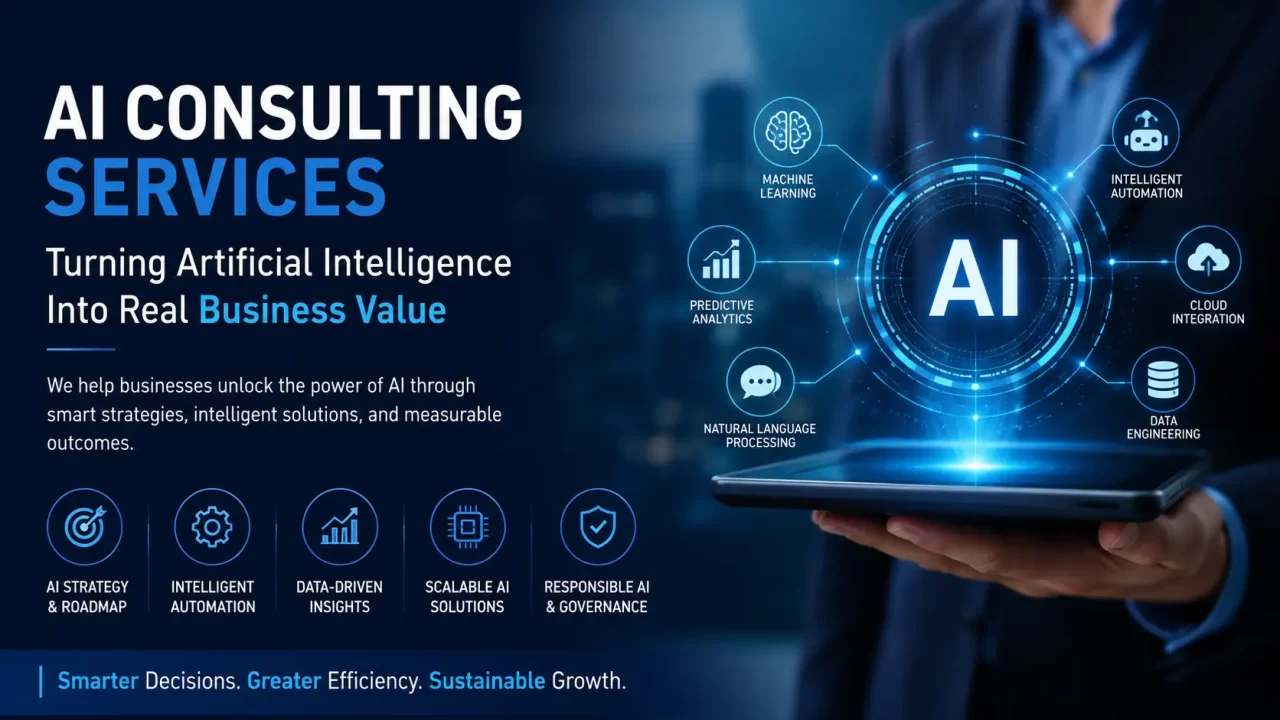
AI consulting services help organizations plan, design, implement, integrate, govern, and improve AI solutions according to their business requirements.
Depending on the organization, this can include:
- AI Strategy & Readiness Assessment — evaluating whether the organization, its processes, infrastructure, and data are ready for AI.
- AI Use-Case Discovery — identifying high-value opportunities where AI can deliver measurable results.
- Generative AI Solutions — developing enterprise assistants, knowledge systems, document intelligence, copilots, and content-generation workflows.
- AI Agents — creating intelligent agents capable of analyzing information, performing defined tasks, interacting with business systems, and assisting employees.
- Process Automation — combining AI with existing workflows to automate repetitive and time-consuming activities.
- Machine Learning Solutions — building predictive models for forecasting, classification, anomaly detection, recommendation, and risk analysis.
- AI Integration — connecting AI capabilities with existing CRM, ERP, cloud, security, support, and business applications.
- AI Governance & Security — establishing controls around privacy, access, data protection, model usage, monitoring, compliance, and responsible AI.
- AI Optimization — continuously measuring accuracy, cost, performance, reliability, and business impact.
The objective is simple: turn AI from an interesting technology into a working business capability.
From “Can We Use AI?” to “Where Should We Use AI?”
One of the biggest mistakes organizations can make is implementing AI before defining the problem.
A better AI consulting approach follows a structured journey:
Business Problem → Process Analysis → AI Opportunity → Data Assessment → Solution Design → Prototype → Integration → Governance → Deployment → Continuous Improvement
For example, consider a cybersecurity team reviewing thousands of cloud security findings.
Instead of asking analysts to manually investigate every alert, an AI-enabled system could help:
- Analyze the security finding.
- Correlate technical evidence.
- Evaluate potential business impact.
- Prioritize the finding based on risk.
- Map it to relevant compliance requirements.
- Recommend remediation steps.
- Generate an audit-ready explanation.
The AI does not necessarily replace the security professional. It gives the professional better context, faster analysis, and more time for high-value decisions.
This principle applies across industries.
What Can Businesses Build With AI?
The possibilities extend far beyond chatbots.
Intelligent Knowledge Assistants
Organizations often have thousands of policies, manuals, reports, procedures, and internal documents.
An enterprise AI assistant can allow employees to ask questions naturally and receive answers grounded in approved organizational information.
Instead of searching through dozens of documents, an employee could ask:
“What is our procedure for approving privileged access?”
The system could locate the relevant policy, summarize the requirement, and provide the appropriate source.
AI-Powered Customer Support
AI can classify customer requests, retrieve relevant information, suggest responses, summarize conversations, route complex cases, and help human agents resolve problems faster.
The goal should not simply be “remove the human.”
The better objective is:
Let AI handle repetition while humans handle judgment, relationships, and exceptions.
Document Intelligence
Businesses process enormous amounts of unstructured information.
AI can assist with extracting, classifying, comparing, summarizing, and validating information from invoices, contracts, reports, applications, policies, and other documents.
A process that previously required hours of manual review can potentially become a supervised workflow completed in minutes.
AI Agents
The next evolution of enterprise AI is moving from systems that only answer questions toward systems that can perform controlled actions.
For example, an AI agent might:
Observe → Analyze → Decide → Act → Validate → Report
A security agent could collect configuration data, identify suspicious conditions, create a finding, recommend remediation, and send the case to a human analyst for approval.
This creates a powerful combination:
AI speed + Human accountability.
AI Consulting Is Also About Knowing Where Not to Use AI
This is an often-overlooked part of good AI consulting.
Not every business process needs artificial intelligence.
If a deterministic rule can solve a problem reliably, introducing a large AI model may unnecessarily increase cost and complexity.
If a decision involves significant legal, financial, safety, privacy, or regulatory consequences, organizations may require stronger human oversight.
A mature AI strategy therefore separates processes into categories such as:
Automate → AI Assist → Human Review → Human Only
This prevents organizations from adopting AI simply for the sake of appearing innovative.
The Hidden Challenge: Enterprise AI Must Be Trusted
A prototype that works during a demonstration is very different from an AI system operating inside a real organization.
Enterprise AI must address questions such as:
Security: Who can access the AI system?
Privacy: What information can employees submit?
Accuracy: How are incorrect or fabricated outputs detected?
Data Governance: Which information is the AI allowed to use?
Compliance: Are regulatory and contractual requirements being followed?
Auditability: Can important AI decisions and actions be traced?
Cost: How much does each AI workflow cost at scale?
Monitoring: How will the organization know when performance deteriorates?
Without these controls, an impressive AI prototype can quickly become a business risk.
That is why AI consulting increasingly combines technology, cybersecurity, governance, compliance, data engineering, and business strategy.
Measuring AI by Business Outcomes
AI success should not be measured by how sophisticated the model sounds.
It should be measured by what changes after implementation.
Organizations can evaluate metrics such as:
Time Saved | Cost Reduction | Accuracy Improvement | Revenue Generated | Response Time | Automation Rate | Error Reduction | Customer Satisfaction | Employee Productivity | Risk Reduction
Consider a process involving 10,000 monthly documents.
If employees previously required five minutes to review each document and an AI-assisted workflow reduces the average human effort to one minute, the important result is not simply:
“We implemented AI.”
The meaningful result is:
“We reduced manual review effort by approximately 80% while maintaining defined quality controls.”
That is business value.
A Better Future Is Human + AI
The most valuable AI systems will not necessarily be the ones attempting to replace entire departments.
They will be the systems that make people significantly more capable.
A financial analyst equipped with intelligent analysis tools.
A doctor supported by better information retrieval.
A cybersecurity analyst who can investigate threats faster.
A customer-service professional who immediately understands the customer’s history.
A compliance auditor who can review thousands of controls without manually searching through every piece of evidence.
The competitive advantage comes from combining:
Human Experience + Organizational Data + Artificial Intelligence + Responsible Automation
Final Thought
The future of AI consulting is not about selling companies another piece of technology.
It is about helping organizations answer three important questions:
What should we automate?
What should AI assist with?
What decisions must remain human?
Companies that answer these questions correctly can move beyond isolated AI experiments and build intelligent systems that become part of everyday business operations.
Because ultimately, the most successful AI transformation is not the one with the most AI.
It is the one where AI creates the most meaningful value.