

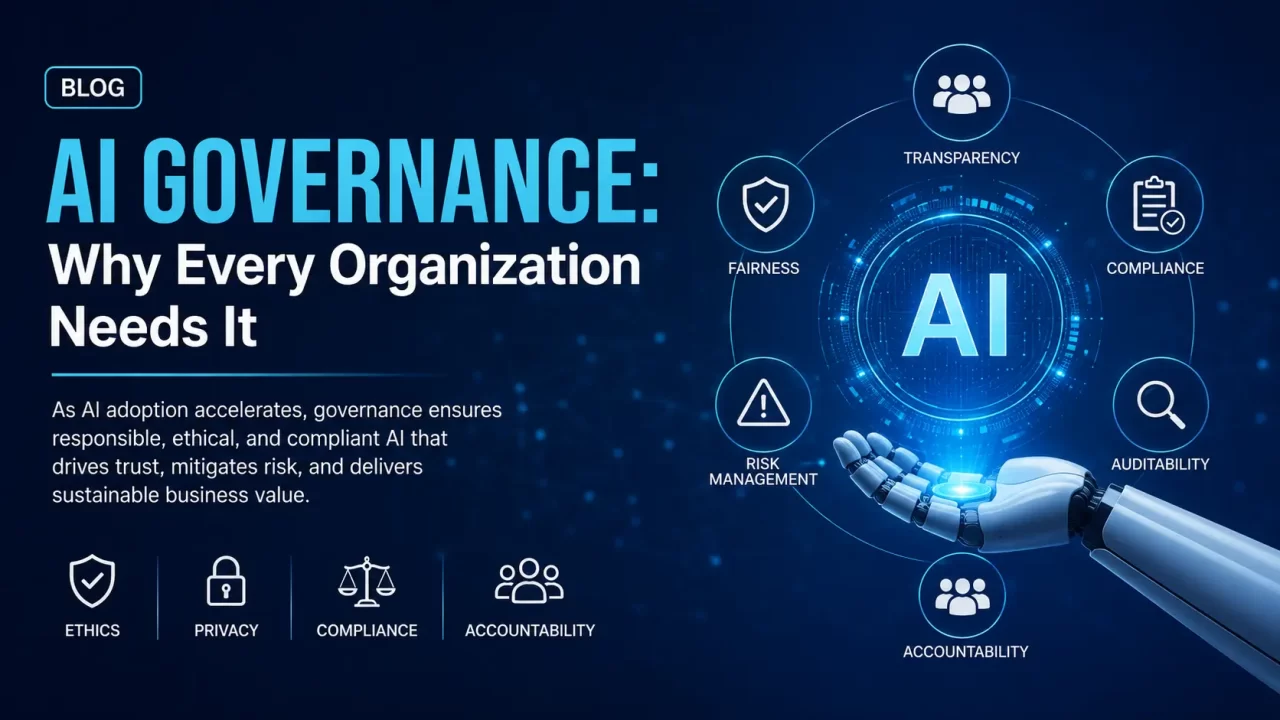
Artificial Intelligence (AI) is rapidly transforming the way organizations operate. From automating routine tasks and analyzing large volumes of data to improving customer experiences and supporting critical business decisions, AI has become an important part of modern business strategy.
However, as organizations increasingly adopt AI, a new challenge is emerging: How can businesses ensure that AI is used responsibly, securely, ethically, and in compliance with applicable regulations?
This is where AI Governance becomes essential.
What Is AI Governance?
AI Governance refers to the policies, processes, controls, roles, and frameworks established by an organization to ensure that AI systems are developed and used in a responsible and controlled manner.
A strong AI Governance framework helps organizations address questions such as:
- Is the AI system being used for an appropriate purpose?
- Is the data being used accurate, secure, and properly authorized?
- Are AI decisions explainable and transparent?
- Are there appropriate human controls over important decisions?
- What risks could arise from the AI system?
- Does the organization comply with relevant laws and regulations?
- How is AI performance monitored after deployment?
AI Governance therefore goes beyond simply managing technology. It brings together technology, risk management, cybersecurity, compliance, data governance, ethics, and business accountability.
Why Is AI Governance Important?
The rapid adoption of generative AI and machine learning has introduced several new risks for organizations.
1. Managing AI Risks
AI systems can produce incorrect, biased, or unexpected results. Organizations need processes to identify, assess, mitigate, and continuously monitor these risks.
For example, an AI system used in recruitment could unintentionally introduce bias into candidate screening. Without proper governance, such risks may remain undetected.
2. Protecting Sensitive Data
AI systems often require large amounts of data. Some of this data may contain confidential business information, customer information, intellectual property, or other sensitive information.
AI Governance can establish controls around:
- Data access
- Data classification
- Data retention
- Privacy
- Third-party AI tools
- Data usage and sharing
These controls help reduce the possibility of data leakage or unauthorized use.
3. Ensuring Responsible AI
Responsible AI focuses on ensuring that AI systems are developed and used in a way that is fair, transparent, safe, accountable, and aligned with organizational values.
Organizations should consider principles such as:
Fairness: AI should not unfairly discriminate against individuals or groups.
Transparency: Users should understand when AI is being used and, where appropriate, how decisions are made.
Accountability: Organizations should clearly define who is responsible for AI systems and their outcomes.
Human Oversight: Critical decisions should have appropriate human involvement rather than relying entirely on automated systems.
AI Governance and GRC
AI Governance is closely connected to Governance, Risk, and Compliance (GRC).
Traditional GRC programs already provide organizations with mechanisms for risk assessment, control management, policy management, audit, compliance monitoring, and reporting.
These capabilities can be extended to AI.
For example:
| GRC Area | AI Governance Application |
|---|---|
| Risk Management | Identify and assess AI-related risks |
| Compliance | Monitor AI regulatory requirements |
| Internal Audit | Assess AI controls and governance processes |
| IT Governance | Establish accountability for AI technologies |
| Cybersecurity | Protect AI systems, models, and data |
| Data Governance | Control data used by AI systems |
| Third-Party Risk | Assess risks associated with external AI providers |
| Business Continuity | Plan for AI system failures and disruptions |
This makes AI Governance an increasingly important component of modern GRC programs.
Building an Effective AI Governance Framework
Organizations should take a structured approach to implementing AI Governance.
Step 1: Establish AI Policies
Organizations should define clear policies covering acceptable and unacceptable AI usage.
For example, employees may need guidance on whether confidential company information can be entered into publicly available generative AI tools.
Step 2: Create an AI Inventory
Organizations should maintain visibility into the AI systems being used across the enterprise.
An AI inventory can capture information such as:
- AI application or model
- Business owner
- Purpose
- Data used
- Vendor
- Risk classification
- Regulatory requirements
- Security controls
- Review status
Step 3: Perform AI Risk Assessments
Not every AI application carries the same level of risk.
An AI tool used for generating marketing content may present relatively limited risk, while an AI system supporting financial decisions, healthcare decisions, or employee evaluations may require significantly stronger controls.
Organizations should therefore classify AI systems according to their risk level.
Step 4: Implement Appropriate Controls
Based on the risk assessment, organizations can establish controls such as:
- Access management
- Data protection
- Model validation
- Human oversight
- Bias testing
- Monitoring
- Logging
- Incident management
- Vendor assessments
- Periodic reviews
Step 5: Continuously Monitor AI
AI Governance should not stop when an AI system goes live.
Models, data, regulations, business processes, and threats can change over time. Continuous monitoring is therefore essential to ensure that AI systems continue to operate as intended.
The Role of Internal Audit
Internal Audit can play an important role in evaluating the effectiveness of AI Governance.
Auditors can assess whether:
- AI policies are properly implemented.
- AI risks have been identified and assessed.
- Appropriate controls are operating effectively.
- Data is being handled securely.
- AI vendors have been appropriately assessed.
- Regulatory requirements are being addressed.
- Human oversight exists where required.
- AI systems are periodically reviewed.
This creates an additional layer of assurance for management and stakeholders.
AI Governance Is Becoming a Business Requirement
AI adoption is no longer limited to technology companies. Organizations across banking, healthcare, manufacturing, retail, insurance, logistics, and professional services are exploring AI-driven solutions.
As AI becomes embedded into business processes, organizations that focus only on AI adoption without considering governance may expose themselves to significant operational, regulatory, cybersecurity, reputational, and financial risks.
The objective should not be to prevent organizations from using AI. Instead, governance should enable organizations to innovate confidently while managing the associated risks.
Conclusion
AI has the potential to significantly improve productivity, decision-making, automation, and customer experience. However, responsible AI adoption requires more than selecting the right technology.
Organizations need a structured approach to AI Governance, Responsible AI, Risk Management, Data Governance, Cybersecurity, Compliance, and Internal Audit.
A mature AI Governance framework can help organizations answer a critical question:
“How can we use AI to create business value while ensuring that it remains secure, responsible, compliant, and accountable?”
As AI continues to evolve, organizations that establish strong governance today will be better positioned to adopt emerging technologies while maintaining trust and managing risk effectively.