
Cloud computing has transformed the way organizations build, deploy, manage, and scale their technology environments. Instead of investing heavily in physical infrastructure and maintaining complex IT environments, businesses can access computing resources, platforms, and applications on demand.
For organizations looking to modernize their technology landscape, three cloud service models are particularly important: Infrastructure as a Service (IaaS), Platform as a Service (PaaS), and Software as a Service (SaaS).
At Timus Consulting Services, we help organizations evaluate and adopt technology solutions that align with their business objectives, operational requirements, governance needs, and digital transformation strategy.
What Are Cloud Services?
Cloud services provide IT resources over the internet, allowing organizations to consume technology based on their requirements rather than owning and maintaining every underlying component.
Depending on the cloud model selected, the service provider may manage everything from physical infrastructure to operating systems, development platforms, applications, security, and updates.
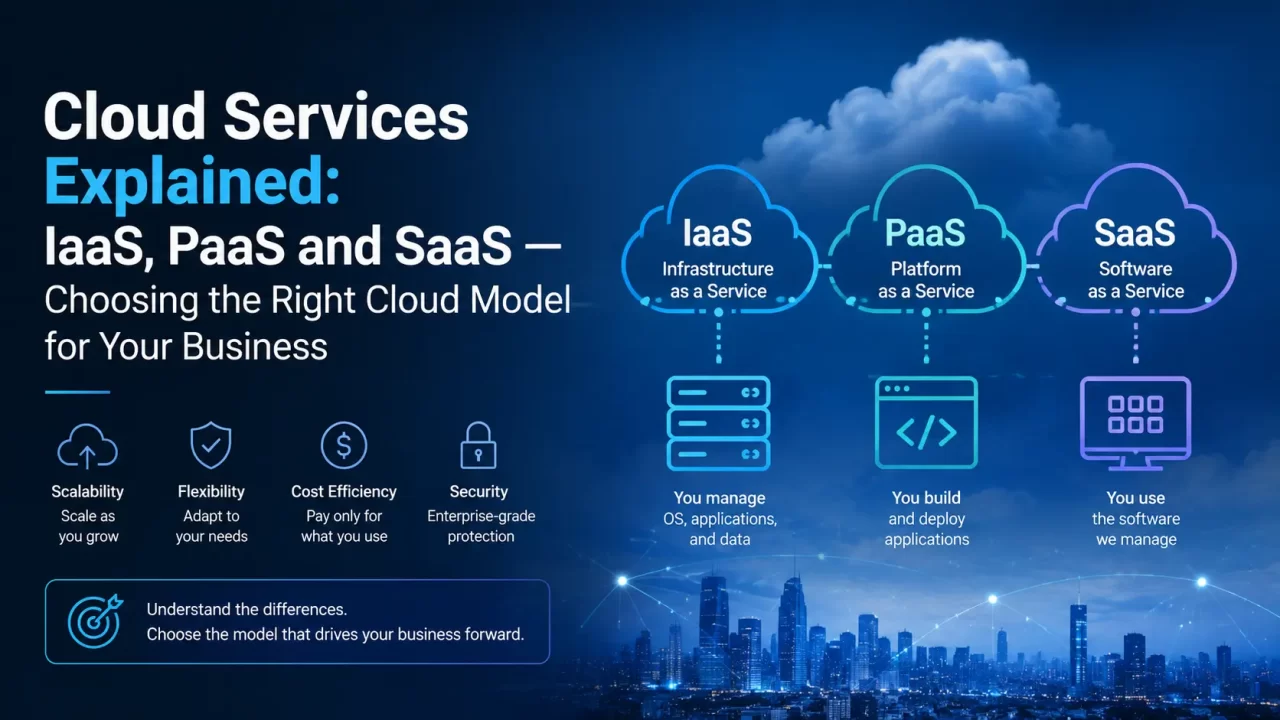
The three primary models can be understood simply:
- IaaS: Rent the infrastructure you need.
- PaaS: Build and deploy applications without managing the underlying infrastructure.
- SaaS: Use ready-to-go software through the internet.
- Infrastructure as a Service (IaaS)
Infrastructure as a Service (IaaS) provides organizations with fundamental computing infrastructure through the cloud.
Instead of purchasing physical servers, storage systems, and networking equipment, organizations can provision these resources as needed.
What Does IaaS Provide?
Typical IaaS capabilities include:
- Virtual machines and computing resources
- Cloud storage
- Networking
- Firewalls and security controls
- Load balancing
- Backup and disaster recovery infrastructure
- Scalable computing capacity
The organization generally remains responsible for managing the operating system, applications, data, and configurations, while the cloud provider manages the underlying physical infrastructure.
Benefits of IaaS
Scalability: Infrastructure can be increased or decreased according to demand.
Cost Optimization: Organizations can reduce upfront capital expenditure on physical infrastructure.
Flexibility: IT teams can select and configure computing environments based on specific requirements.
Business Continuity: Cloud infrastructure can support backup, disaster recovery, and high-availability strategies.
Faster Deployment: New infrastructure can be provisioned significantly faster than traditional physical environments.
When Should Businesses Consider IaaS?
IaaS can be particularly useful for organizations that:
- Are migrating existing workloads to the cloud
- Need scalable infrastructure
- Want greater control over their computing environment
- Are developing or hosting enterprise applications
- Need flexible disaster recovery infrastructure
- Platform as a Service (PaaS)
Platform as a Service (PaaS) provides developers with an environment for building, testing, deploying, and managing applications without requiring them to manage the underlying infrastructure.
With PaaS, the cloud provider typically manages the infrastructure, operating systems, runtime environment, and other platform components.
This allows development teams to concentrate primarily on application development and business functionality.
What Does PaaS Provide?
Depending on the platform, PaaS may include:
- Application development environments
- Databases
- Middleware
- Runtime environments
- Development and testing tools
- APIs and integration capabilities
- Application monitoring
- Deployment tools
Benefits of PaaS
Faster Development: Developers can use pre-configured tools and services rather than building infrastructure from scratch.
Reduced Infrastructure Management: IT teams spend less time maintaining servers and operating systems.
Improved Collaboration: Development teams can work within standardized cloud environments.
Scalability: Applications can be scaled as business requirements change.
Innovation: Developers can focus more on application functionality and new business capabilities.
When Should Businesses Consider PaaS?
PaaS is well suited for organizations that:
- Develop custom applications
- Need faster application deployment
- Want standardized development environments
- Are building APIs and integrations
- Want to modernize legacy applications
- Need to accelerate digital product development
- Software as a Service (SaaS)
Software as a Service (SaaS) is the most familiar cloud service model for many businesses.
With SaaS, organizations access fully developed software applications through the internet. The service provider manages the underlying infrastructure, platform, application maintenance, updates, and much of the technical administration.
Examples include enterprise CRM, ERP, collaboration, HR, project management, and productivity applications delivered through the cloud.
What Does SaaS Provide?
SaaS solutions typically include:
- Ready-to-use business applications
- Web-based access
- Automatic software updates
- Data hosting
- Application maintenance
- Security and availability management
- Subscription-based licensing
Benefits of SaaS
Easy Adoption: Users can access applications without installing and maintaining complex infrastructure.
Lower Upfront Investment: SaaS generally operates through subscription-based pricing.
Automatic Updates: New features, patches, and updates can be delivered by the provider.
Accessibility: Authorized users can access applications from supported locations and devices.
Faster Time to Value: Organizations can implement SaaS applications faster than many traditional software deployments.
When Should Businesses Consider SaaS?
SaaS can be appropriate when organizations need:
- Enterprise business applications
- CRM and ERP solutions
- HR and workforce management systems
- Collaboration and productivity tools
- Customer service platforms
- Governance, risk, and compliance applications
IaaS vs PaaS vs SaaS
The key difference between the three models is how much the organization manages versus how much the cloud provider manages.
| Area | IaaS | PaaS | SaaS |
| Infrastructure | Provider manages | Provider manages | Provider manages |
| Operating System | Customer manages | Provider manages | Provider manages |
| Development Platform | Customer manages | Provider manages | Provider manages |
| Applications | Customer manages | Customer develops/manages | Provider manages |
| Data | Customer manages | Customer manages | Shared responsibility |
| User Access | Customer manages | Customer manages | Customer manages |
| Control | High | Medium | Lower |
| Typical Use | Infrastructure & workloads | Application development | Business applications |
A simple way to remember the difference is:
IaaS → Build your environment
PaaS → Build your application
SaaS → Use the application
How Cloud Services Support Digital Transformation
Cloud adoption is not simply about moving servers or applications to the cloud. A successful cloud strategy should support broader business objectives.
Organizations can use cloud services to:
- Modernize legacy technology
- Improve scalability and agility
- Reduce infrastructure complexity
- Accelerate application development
- Improve collaboration
- Support remote operations
- Strengthen business continuity
- Enable data-driven decision-making
- Integrate enterprise applications
- Improve operational efficiency
However, cloud adoption also introduces important considerations around cybersecurity, data protection, identity and access management, regulatory compliance, vendor management, governance, and risk management.
This is especially important for organizations operating in regulated industries such as banking, insurance, healthcare, pharmaceuticals, energy, and government.
Choosing the Right Cloud Model
There is no single cloud model that is right for every organization.
The decision should consider:
- Business requirements — What problem are you trying to solve?
- Control requirements — How much control does your IT team need?
- Security requirements — What security and access controls are necessary?
- Compliance requirements — Are there regulatory or data-residency obligations?
- Existing IT landscape — What applications and infrastructure are already in place?
- Scalability — How quickly might your technology requirements change?
- Total Cost of Ownership — What are the long-term operational and licensing costs?
- Integration — How will the solution connect with existing enterprise systems?
- Skills and resources — Does the organization have the expertise required to manage the selected model?
Cloud + Governance, Risk and Compliance
As organizations increasingly move critical workloads to cloud environments, cloud governance becomes an important component of enterprise risk management.
Organizations should establish appropriate controls for:
- Identity and access management
- Data security
- Third-party and vendor risk
- Regulatory compliance
- Business continuity
- Security monitoring
- Auditability
- Risk assessment
- Policy management
- Incident management
A strong cloud strategy therefore needs to balance innovation, flexibility, security, cost, and governance.
How Timus Consulting Services Can Help
At Timus Consulting Services, we help organizations navigate technology transformation by combining consulting, implementation, enterprise applications, workflow transformation, and governance expertise.
Our approach can help organizations:
- Assess their current technology landscape
- Identify appropriate cloud adoption opportunities
- Evaluate IaaS, PaaS, and SaaS options
- Develop cloud transformation roadmaps
- Modernize enterprise applications
- Integrate cloud and on-premises systems
- Strengthen governance and risk management
- Improve business processes and workflows
- Support enterprise application implementation and transformation
Our expertise across GRC, ERP, workflow transformation, and enterprise technology platforms enables us to look beyond infrastructure and consider the broader business and governance implications of cloud adoption.
Conclusion
IaaS, PaaS, and SaaS represent three different approaches to consuming cloud technology.
IaaS provides flexibility and infrastructure control.
PaaS enables faster application development and deployment.
SaaS provides ready-to-use business applications with minimal infrastructure management.
The right choice depends on an organization’s business objectives, technology landscape, security requirements, compliance obligations, budget, and long-term transformation strategy.
Cloud adoption should not be viewed simply as a technology initiative. When planned effectively, it can become a foundation for business agility, operational efficiency, innovation, and sustainable digital transformation.
Timus Consulting Services — Enabling organizations to transform technology into business value.
#CloudComputing #IaaS #PaaS #SaaS #CloudTransformation #DigitalTransformation #CloudStrategy #EnterpriseTechnology #GRC #ERP #TimusConsultingServices