

Introduction
Modern applications are commonly developed using object-oriented programming (OOP) languages such as Java, Python, C#, and JavaScript. At the same time, many applications store their data in relational databases such as MySQL, PostgreSQL, Oracle, and Microsoft SQL Server.
This creates a fundamental difference between the way applications represent data and the way relational databases store it.
Object-oriented applications work with objects and classes, while relational databases work with tables, rows, and columns.
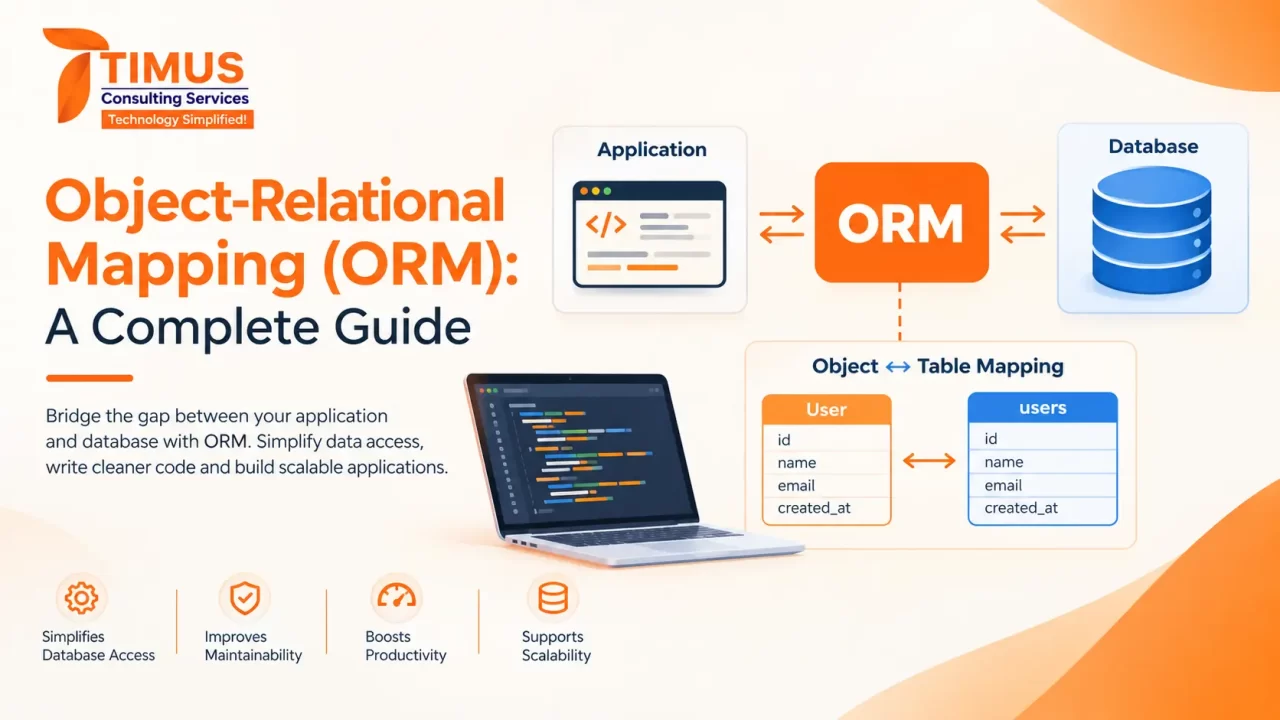
Object-Relational Mapping (ORM) provides a mechanism to bridge this gap by mapping objects in an application to records in a relational database.
What is Object-Relational Mapping?
Object-Relational Mapping is a programming technique that allows developers to interact with a relational database using objects rather than writing SQL queries for every database operation.
In simple terms:
Application Objects ↔ ORM ↔ Relational Database
For example, consider a Customer class in an application:
Customer
----------------
id
name
email
phone
The corresponding database table might be:
CUSTOMER
----------------
ID
NAME
EMAIL
PHONE
The ORM framework establishes the relationship between the Customer object and the CUSTOMER table.
Instead of manually writing SQL such as:
SELECT * FROM CUSTOMER WHERE ID = 101;
a developer can work with an object through the ORM framework.
The ORM translates the application’s object-oriented operations into the appropriate SQL statements.
Why is ORM Needed?
Object-oriented programming and relational databases use different approaches to represent information.
Object-Oriented Model
Applications typically use:
- Classes
- Objects
- Attributes
- Methods
- Inheritance
- Encapsulation
- Relationships
Relational Model
Databases typically use:
- Tables
- Rows
- Columns
- Primary keys
- Foreign keys
- Joins
- Constraints
This difference is often called the object-relational impedance mismatch.
ORM helps reduce this mismatch by providing a mapping between the two models.
How ORM Works
An ORM framework generally operates between the application and database.
The basic architecture can be represented as:
Application
↓
ORM Framework
↓
Database Driver
↓
Relational Database
The application interacts with objects, while the ORM translates those operations into database queries.
For example:
Application:
customer.name = "John"

        ↓

ORM

        ↓

SQL

UPDATE CUSTOMER
SET NAME = 'John'
WHERE ID = 101;
The ORM then sends the SQL statement to the database and maps the returned data back into application objects.
Object-to-Table Mapping
One of the fundamental concepts of ORM is mapping a class to a database table.
For example:
Java Class              Database Table
-----------             --------------
Employee       →        EMPLOYEE
Department     →        DEPARTMENT
Project        →        PROJECT
Similarly, class attributes can be mapped to table columns.
Employee.name           → EMPLOYEE.NAME
Employee.email          → EMPLOYEE.EMAIL
Employee.salary         → EMPLOYEE.SALARY
This allows developers to work with application objects without constantly translating data manually.
Mapping Relationships
ORM also supports relationships between objects and database tables.
One-to-One
One object is associated with one other object.
Example:
Employee → EmployeeProfile
A database representation could be:
EMPLOYEE
    |
    | 1:1
    |
EMPLOYEE_PROFILE
One-to-Many
One object is associated with multiple objects.
For example:
Department
    |
    ├── Employee 1
    ├── Employee 2
    └── Employee 3
A department can have multiple employees.
In a relational database, this is commonly represented using a foreign key.
Many-to-Many
Multiple objects can be associated with multiple other objects.
For example:
Student ↔ Course
A student can enroll in multiple courses, and a course can have multiple students.
A join table is commonly used:
STUDENT
COURSE
STUDENT_COURSE
ORM frameworks can manage these relationships through object associations.
Popular ORM Frameworks
Several ORM frameworks are widely used across different programming languages.
Java
Hibernate is one of the widely used ORM frameworks in the Java ecosystem.
Other technologies include:
- Jakarta Persistence (JPA)
- EclipseLink
- Spring Data JPA
Python
Popular options include:
- SQLAlchemy
- Django ORM
- Peewee
.NET
The Microsoft ecosystem provides:
- Entity Framework
- Entity Framework Core
JavaScript / TypeScript
Popular ORM and database-mapping tools include:
- Sequelize
- TypeORM
- Prisma
The specific choice depends on the programming language, application architecture, database, and project requirements.
Example Using ORM
Consider an application that manages employees.
The application might define an Employee class:
Employee
----------------
id
name
email
department
The corresponding database table might be:
EMPLOYEE
----------------
ID
NAME
EMAIL
DEPARTMENT
With an ORM, developers can create an employee object:
employee = Employee(
    name = "John",
    email = "john@example.com",
    department = "IT"
)
The ORM can translate this operation into an SQL INSERT statement.
Similarly, retrieving an employee can result in an SQL SELECT, while modifying an employee can result in an UPDATE.
The developer therefore works primarily with objects while the ORM handles much of the database interaction.
CRUD Operations with ORM
ORM frameworks commonly simplify CRUD operations.
CRUD stands for:
- Create
- Read
- Update
- Delete
For example:
Create  → Create an object and persist it
Read    → Retrieve an object from the database
Update  → Modify an existing object
Delete  → Remove an object
This can significantly reduce repetitive database-access code.
Advantages of ORM
1. Reduced SQL Boilerplate
Developers do not need to manually write SQL for every basic database operation.
2. Improved Developer Productivity
Developers can work with familiar programming-language objects and structures.
3. Maintainability
Database interactions can be centralized through ORM mappings and repositories, making applications easier to maintain.
4. Relationship Management
ORM frameworks provide mechanisms for managing relationships between related objects.
5. Database Abstraction
Applications can become less dependent on database-specific SQL syntax, although complete database independence is not guaranteed.
6. Security Support
ORM frameworks can help reduce risks associated with manually constructed SQL queries, particularly SQL injection, when parameterized queries and ORM APIs are used correctly.
7. Object-Oriented Design
ORM allows database operations to fit more naturally into object-oriented application architectures.
Challenges and Limitations of ORM
Although ORM provides many benefits, it is not always the best solution for every database operation.
Performance Overhead
ORM-generated SQL may sometimes be less efficient than carefully optimized SQL written by an experienced developer.
Complex Queries
Highly complex reporting or analytical queries may be easier to implement and optimize using native SQL.
Learning Curve
Developers need to understand both ORM concepts and the underlying database behavior.
N+1 Query Problem
Poorly configured object relationships can result in many unnecessary database queries.
For example:
1 query → retrieve departments

N queries → retrieve employees for each department
This can negatively affect application performance.
Abstraction Can Hide Database Behavior
Because ORM abstracts SQL operations, developers may not always immediately see what queries are being executed.
For this reason, understanding SQL and database fundamentals remains important even when using ORM.
ORM and Database Performance
Using ORM effectively requires an understanding of how the underlying database works.
Developers should pay attention to:
- Indexes
- Joins
- Query execution plans
- Lazy loading
- Eager loading
- Transactions
- Connection pooling
- Pagination
- Caching
For performance-sensitive applications, developers should inspect the SQL generated by the ORM and optimize queries where necessary.
ORM vs Traditional SQL
ORM and direct SQL are not necessarily competing approaches.
| Aspect | ORM | Direct SQL |
|---|---|---|
| Development | Object-oriented | Query-oriented |
| Basic CRUD | Usually simpler | Requires SQL |
| Complex queries | Can become complicated | Often highly flexible |
| Database abstraction | Higher | Lower |
| SQL control | Less direct | Full control |
| Productivity | Often higher for standard operations | Depends on application |
| Performance tuning | Requires understanding generated SQL | Direct control |
Many real-world applications use a hybrid approach, using ORM for common operations and native SQL for specialized or performance-critical queries.
Best Practices for Using ORM
To use ORM effectively, developers should follow several practices:
Understand the Generated SQL
Do not treat ORM as a replacement for understanding databases.
Avoid Unnecessary Data Retrieval
Retrieve only the data required by the application.
Manage Relationships Carefully
Use lazy and eager loading appropriately to avoid unnecessary queries.
Use Transactions Correctly
Transactions should be designed according to the application’s consistency requirements.
Monitor Performance
Monitor database queries and identify slow or excessive queries.
Use Indexes Appropriately
Database indexes should support frequently executed queries and access patterns.
Keep ORM Mappings Clear
Well-defined mappings make the application easier to understand and maintain.
ORM in Modern Application Development
ORM continues to play an important role in modern software development, particularly in enterprise applications and systems that interact extensively with relational databases.
Modern ORM tools increasingly provide features such as:
- Migration management
- Query builders
- Caching
- Transaction management
- Relationship handling
- Type safety
- Repository patterns
- Integration with application frameworks
However, ORM should be viewed as an abstraction layer rather than a replacement for database knowledge.
Conclusion
Object-Relational Mapping (ORM) provides a bridge between object-oriented applications and relational databases.
By mapping classes to tables, attributes to columns, and object relationships to database relationships, ORM allows developers to interact with relational data using programming-language objects.
It can improve productivity, maintainability, and application design, particularly for applications with significant CRUD and transactional requirements.
At the same time, effective ORM usage requires developers to understand the underlying database. Performance issues such as inefficient joins, excessive queries, and the N+1 query problem can occur when ORM mappings are not designed carefully.
The most effective approach is therefore not simply to choose ORM over SQL, but to understand when abstraction provides value and when direct database control is necessary.
When used appropriately, ORM becomes a powerful tool for building maintainable, scalable, and database-driven applications.