
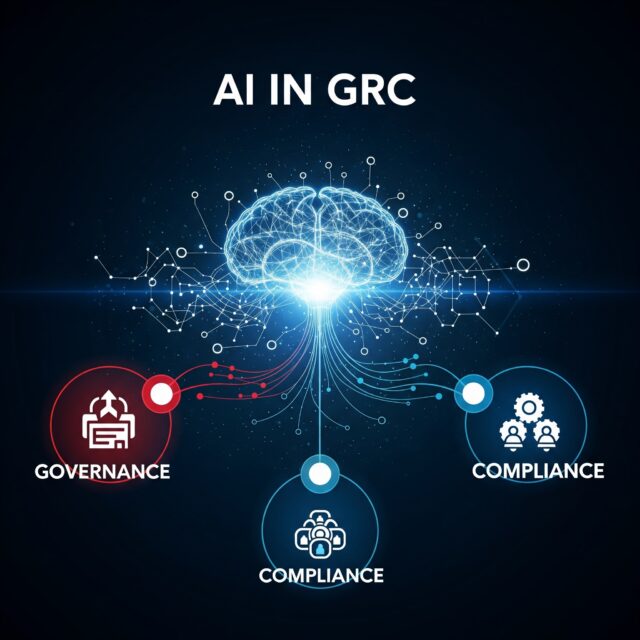
Artificial Intelligence (AI) is transforming the way organizations approach Governance, Risk, and Compliance (GRC), shifting it from a reactive, manual process to a proactive, data-driven strategy. By leveraging technologies like machine learning, natural language processing (NLP), and predictive analytics, businesses can enhance efficiency, accuracy, and foresight in their GRC frameworks.
Key Applications of AI in GRC
AI is being applied across various GRC functions to automate and improve processes.
-
Automated Regulatory Compliance
AI can continuously monitor and analyze vast amounts of legal and regulatory texts from different jurisdictions. This allows organizations to stay ahead of evolving regulations, automatically identifying changes and suggesting necessary policy updates, which significantly reduces the risk of non-compliance and associated fines.
-
Enhanced Risk Management
AI excels at processing and analyzing large datasets to identify patterns and anomalies that human analysts might miss. For example, AI-powered systems can use predictive analytics to forecast potential risks like cybersecurity vulnerabilities or financial fraud before they escalate. This enables proactive risk mitigation and strengthens an organization’s resilience.
-
Continuous Monitoring
Unlike traditional, periodic audits, AI provides a capability for real-time monitoring of transactions, systems, and user behavior. This constant surveillance helps to instantly detect potential compliance breaches or fraudulent activities, allowing for a swift and informed response.
-
Third-Party Vendor Risk Assessment
AI simplifies the complex process of evaluating third-party risks by automating due diligence and providing continuous oversight. AI can analyze vendor information, financial health, and news mentions to generate real-time risk scores, ensuring that risks are actively managed throughout the relationship.
Benefits of Adopting AI in GRC
The integration of AI into GRC offers a multitude of benefits that lead to a more effective and efficient operational framework.
-
Increased Efficiency and Cost Savings
By automating time-consuming and repetitive tasks—such as data collection, document review, and report generation—AI frees up GRC professionals to focus on higher-value activities like strategic planning and stakeholder engagement. This automation reduces operational costs and minimizes the potential for human error.
-
Improved Accuracy
AI applies consistent rules and logic to data analysis, reducing the inaccuracies that can result from manual processes. This leads to more reliable outcomes and stronger compliance.
-
Real-Time Insights and Data-Driven Decisions
AI provides real-time dashboards and alerts, giving leaders immediate situational awareness to act swiftly on emerging risks. By uncovering patterns and forecasting trends, AI empowers GRC teams to make more informed decisions based on concrete data rather than assumptions.
-
Scalability
AI systems can handle increased data volumes and complexity as a company grows, scales operations, or enters new markets without requiring a proportionate increase in human resources.
Challenges to Implementation
Despite the clear advantages, implementing AI in GRC is not without its challenges. Organizations must be mindful of potential issues to ensure a successful and ethical adoption.
-
Data Quality and Availability
The effectiveness of AI models is entirely dependent on the quality and quantity of the data they are trained on. Fragmented, inconsistent, or biased data can lead to flawed insights and inaccurate risk assessments.
-
The “Black Box” Problem
Many advanced AI models lack transparency, making it difficult for humans to understand how they arrive at a particular decision. This can pose a significant challenge for auditing and accountability, especially when a decision leads to a compliance lapse or legal issue.
-
Ethical Concerns and Algorithmic Bias
AI systems can inherit and amplify biases present in their training data, leading to unfair or discriminatory outcomes. Organizations must establish robust governance frameworks to ensure fairness, transparency, and accountability in their AI systems.
-
Integration and Human Oversight
Successfully integrating AI into existing legacy systems can be technically complex. Furthermore, a human element remains crucial for providing context and making nuanced judgments. AI should be viewed as an augmentation tool to support human decision-making, not a replacement.
In conclusion, AI is not just an efficiency tool for GRC; it is a strategic asset that can help organizations build more resilient, agile, and trustworthy compliance and risk management programs. By addressing the implementation challenges proactively, businesses can harness the full power of AI to gain a competitive edge in today’s dynamic regulatory environment.
About us
We are Timus Consulting Services, a fast-growing, premium Governance, Risk, and compliance (GRC) consulting firm, with a specialization in the GRC implementation, customization, and support.
Our team has consolidated experience of more than 15 years working with financial majors across the globe. Our team is comprised of experienced GRC and technology professionals that have an average of 10 years of experience. Our services include:
- GRC implementation, enhancement, customization, Development / Delivery
- GRC Training
- GRC maintenance, and Support
- GRC staff augmentation
Our team
Our team (consultants in their previous roles) have worked on some of the major OpenPages projects for fortune 500 clients across the globe. Over the past year, we have experienced rapid growth and as of now we have a team of 15+ experienced and fully certified OpenPages consultants, OpenPages QA and OpenPages lead/architects at all experience levels.
Our key strengths:
Our expertise lies in covering the length and breadth of the IBM OpenPages GRC platform. We specialize in:
- Expert business consulting in GRC domain including use cases like Operational Risk Management, Internal Audit Management, Third party risk management, IT Governance amongst others
- OpenPages GRC platform customization and third-party integration
- Building custom business solutions on OpenPages GRC platform
Connect with us:
Feel free to reach out to us for any of your GRC requirements.
Email: Business@timusconsulting.com
Phone: +91 9665833224
WhatsApp: +44 7424222412
Website: www.Timusconsulting.com