
The Way Organizations Govern Risk Has Changed Forever — Here’s What You Need to Know
Introduction:
1. GRC Has Left the Back Office
For decades, Governance, Risk, and Compliance (GRC) was treated as a necessary burden — the department that said “no,” the team that produced reports nobody read, the function that existed to keep auditors happy. That era is over.
In 2026, GRC consulting services is no longer in transition. The operating environment has already shifted, and the expectations of regulators, boards, and stakeholders are now firmly established. Artificial intelligence is accelerating at a pace that no traditional risk framework was designed to handle. Regulatory regimes have moved from implementation to enforcement — demanding evidence of effectiveness, not just intent. Supply chains have become so interconnected that the failure of a single vendor can cascade across entire industries overnight.
The organizations thriving in this environment share one thing in common: they’ve transformed GRC consulting services from a reactive control function into a forward-looking strategic discipline. GRC leaders today are not just managing risk — they are shaping how their organizations make decisions, build trust, and sustain resilience under sustained pressure.
This blog explores the latest GRC landscape in 2026, why it matters more than ever, the strategies leading organizations are deploying, and real-world use cases that show what modern GRC looks like in action.
2. Why GRC Matters More in 2026 Than Ever Before
The Risk Environment Has Fundamentally Changed
Several converging forces are rewriting the rules of risk management simultaneously:
Artificial Intelligence is reshaping how risk behaves. AI is no longer something organizations choose to adopt — it’s embedded in vendor products, financial systems, HR tools, and customer platforms, often with limited transparency into how decisions are being made. This creates accountability gaps that regulators are beginning to scrutinize aggressively.
The cost of inadequate GRC consulting services has never been higher. Regulatory fines, reputational damage, operational disruptions, and loss of stakeholder confidence can now unfold at digital speed. Conversely, organizations with mature, proactive GRC frameworks gain a genuine competitive advantage — faster decision-making, stronger investor confidence, and greater operational resilience when disruptions inevitably occur.
GRC in 2026 is not about checking boxes. It’s about building the organizational capacity to lead confidently in an uncertain world.
3. Key Strategies for Modern GRC in 2026
Strategy 1: Govern Vendors by Business Criticality, Not Assessment Cycles
The days of treating all third parties the same — sending annual questionnaires and calling it due diligence — are finished. In 2026, leading GRC consulting services teams are mapping their vendor ecosystems based on genuine business criticality: which providers are so deeply embedded in core operations that their failure would be immediately devastating?
Practical action: Tier your vendor portfolio by operational criticality and focus your oversight resources on the top tier. Conduct dependency mapping to understand cascading failure scenarios, not just individual vendor risks.
Strategy 2: Establish AI Governance Before Widespread Deployment
AI governance has emerged as one of the most urgent priorities in GRC for 2026. Many organizations are discovering that their risk and compliance teams are being brought in only after AI tools are already live across the business — leaving unclear accountability, undefined risk tolerances, and no established guardrails.
Effective AI governance in 2026 requires treating AI as its own risk category, distinct from general IT risk. That means defining who owns AI-related risks, establishing clear decision rights for which AI applications can be deployed and under what conditions, creating audit trails for AI-driven decisions, and maintaining human oversight for high-stakes outcomes.
Strategy 3: Shift from Compliance Readiness to Demonstrable Proof
The regulatory standard has moved. In 2026, it is no longer sufficient to have policies in place and documentation prepared. Regulators — particularly in financial services, healthcare, and critical infrastructure — want organizations to demonstrate how their risk response and recovery actually function under pressure, not just in theory.
Practical action: Move from annual point-in-time assessments to continuous control monitoring and regular resilience exercises. Build a unified resilience narrative that connects cyber, vendor, and continuity functions into a single, defensible story for regulators and boards.
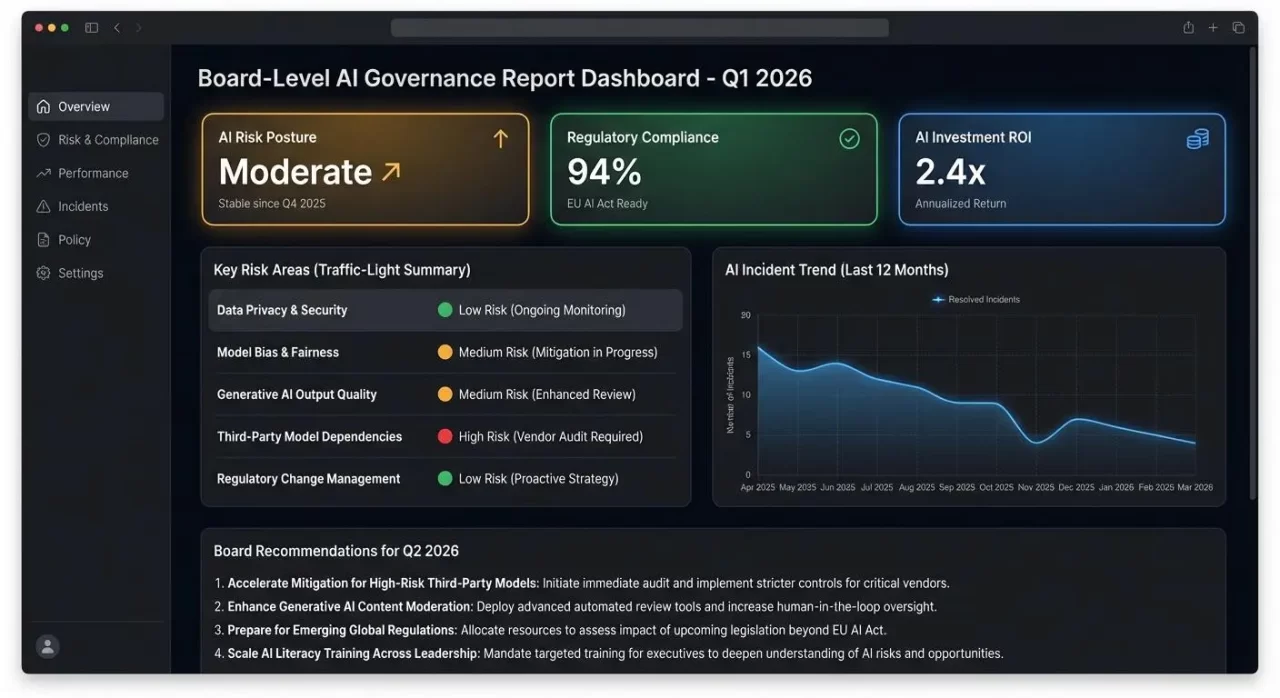
Strategy 4: Transform Risk Reporting into Decision Support
Most board-level risk reporting in 2026 still fails at its most basic job: helping leaders make better decisions. Dense risk registers, voluminous heat maps, and data-heavy dashboards tell boards what risks exist — but not what to do about them.
Practical action: Redesign board risk reporting around three questions — What are the top three risks requiring board-level decisions right now? Who owns them? What are the options and their tradeoffs? Eliminate reporting that informs without enabling action.
Strategy 5: Invest in Data Quality as a GRC Foundation
Agentic and generative AI systems are being embedded into GRC workflows — automating monitoring, generating compliance assessments, simulating risk scenarios, and identifying governance gaps. But these systems are only as reliable as the data underlying them. In 2026, data quality has emerged as the defining differentiator between GRC programs that can trust their AI-generated insights and those that cannot.
Practical action: Audit your GRC data infrastructure before deploying AI. Prioritize integration between GRC platforms and core enterprise systems (ERP, HR, finance, cybersecurity) to ensure AI models are working from a single source of truth.
4. Use Case Scenarios: Modern GRC in Action
Use Case 1: AI Governance at a Global Financial Institution
The Situation: A major international bank had deployed AI tools across credit decisioning, fraud detection, customer service, and HR screening — mostly through third-party vendors. When regulators began requesting documentation of how AI-driven credit decisions were made, the bank’s compliance team realized it had no centralized inventory of AI systems, no defined accountability for AI risk, and no audit trail for algorithmic decisions.
The Outcome: The bank produced its first AI governance report to regulators within six months, demonstrating clear accountability and control structures. They identified three vendor AI tools that failed their risk threshold and renegotiated contracts to require greater transparency. AI governance is now a standing agenda item at every board risk committee meeting.
Use Case 2: Vendor Dependency Risk in Critical Infrastructure
The Situation: A national energy utility relied heavily on a single cloud platform provider for operational monitoring, grid management software, and customer billing. The provider experienced a major outage that lasted 18 hours — causing cascading disruptions across the utility’s operations, customer service failures, and regulatory scrutiny over its business continuity arrangements.
The Outcome: Eighteen months later, when a second significant outage hit a major SaaS provider, the utility activated its contingency protocols and maintained uninterrupted operations. The regulator cited their improved vendor resilience program as an example of best practice in its next industry review.
Use Case 3: Continuous Compliance Monitoring in Healthcare
The Situation: A large hospital network operating across multiple states struggled to maintain consistent compliance with healthcare privacy regulations, accreditation requirements, and state-specific licensing rules. Annual compliance audits were catching issues that had been festering for months, resulting in costly remediation and reputational damage.
The Outcome: The time between a compliance issue arising and its detection dropped from an average of 4.5 months to under 72 hours. The network passed its next regulatory audit with zero significant findings — the first time in over a decade. The GRC team’s headcount remained flat while compliance coverage expanded significantly.
Use Case 4: Board-Ready Risk Reporting at a Multinational Retailer
The Situation: The board of a global retail company was receiving quarterly risk reports that ran to 80+ pages of heat maps, risk registers, and control status updates. Board members admitted in a private assessment that they found the reports difficult to navigate and rarely used them to guide decisions. After a major supply chain disruption caught the board largely unprepared, the CEO mandated a complete overhaul of risk reporting.
The Outcome: Board engagement with risk topics increased dramatically — members began asking substantive questions at meetings rather than simply receiving updates. When a geopolitical risk materialized in a key sourcing region, the board was able to make a sourcing diversification decision within two weeks, having already reviewed the scenario and tradeoffs in the prior quarter’s risk report.
Use Case 5: Agentic GRC in a Technology Company
The Situation: A fast-growing technology company managing compliance across SOC 2, ISO 27001, GDPR, and the EU AI Act faced an impossible manual workload. Their 12-person GRC team was spending 70% of its time on evidence collection, control testing, and status reporting — leaving little bandwidth for strategic risk work.
The Outcome: Time spent on routine compliance tasks fell by 60%. The GRC team redirected that capacity toward proactive risk identification, vendor risk management, and AI governance — areas where human judgment added the most value. The company achieved multi-framework compliance certification in half its previous timeline, while the GRC team reported significantly higher job satisfaction from focusing on meaningful work rather than administrative burden.
5. The Road Ahead: GRC as Strategic Leadership
The trajectory of GRC consulting services in 2026 points clearly toward one conclusion: the function that was once seen as a cost center and compliance overhead is becoming a strategic leadership capability.
The organizations that will define best practice in the years ahead are those that treat GRC not as a set of controls to maintain, but as the organizational nervous system through which risk intelligence flows to decision-makers at every level — from the front line to the boardroom.
Agentic AI will handle more and more of the routine monitoring, testing, and reporting work. Human GRC professionals will increasingly be valued for their ability to interpret complex risk environments, communicate clearly with boards and regulators, and guide strategic decisions under uncertainty.
Conclusion: GRC Is No Longer Optional at the Strategy Table
The era of GRC consulting services as a back-office compliance function is definitively over. In 2026, governance, risk, and compliance is central to how organizations lead, decide, and compete.
The organizations that grasp this — building proactive, AI-augmented, board-connected GRC programs — will navigate an increasingly complex world with greater confidence, speed, and resilience. Those that continue treating GRC as a checkbox exercise will find themselves unprepared for the risks that define this decade.
The shift is already happening. The only question is whether your organization is leading it or reacting to it.