

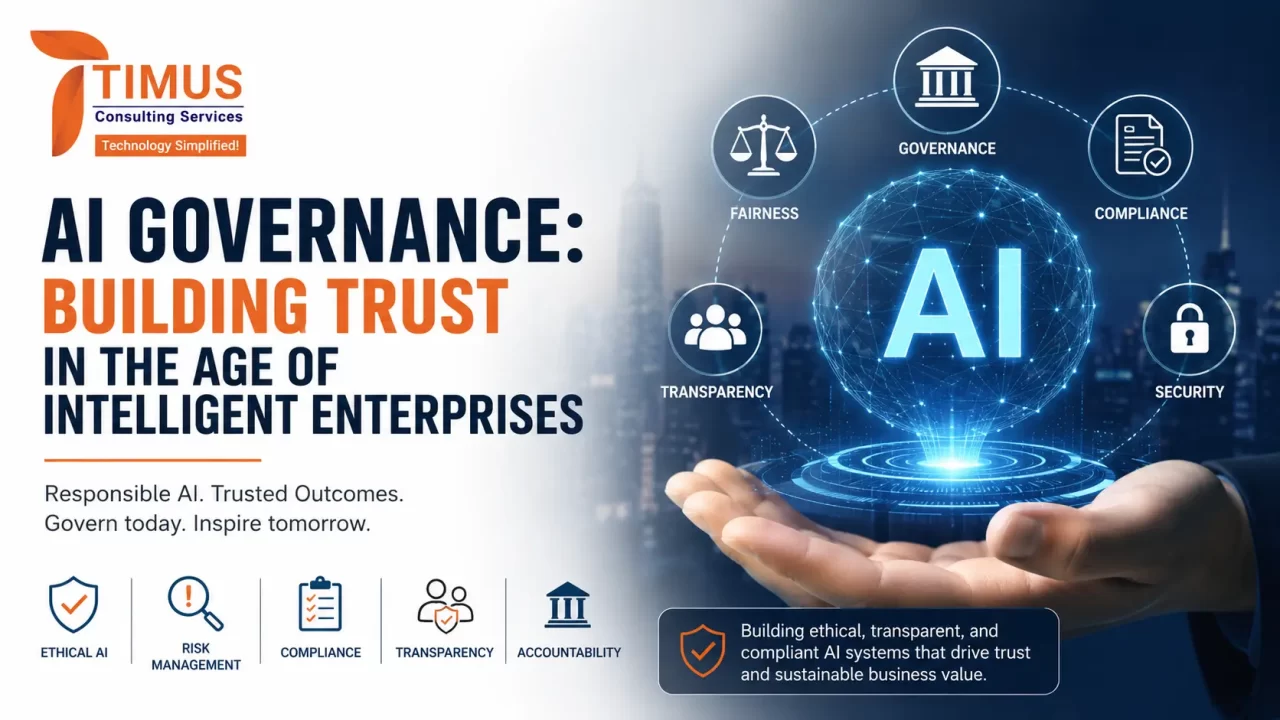
Artificial Intelligence has rapidly evolved from an emerging technology to a strategic business capability. Today, organizations are leveraging AI to automate processes, improve decision-making, enhance customer experiences, and uncover insights from vast amounts of data. From financial services and healthcare to government and manufacturing, AI is transforming the way enterprises operate.
Yet, as AI adoption accelerates, organizations face a fundamental challenge: How do we ensure that AI remains trustworthy, transparent, and aligned with business objectives?
The answer lies in AI Governance.
AI Governance is no longer a future consideration or a regulatory checkbox—it is becoming the cornerstone of responsible digital transformation. Organizations that establish strong AI governance frameworks will not only mitigate risks but also unlock sustainable innovation and build greater confidence among customers, regulators, employees, and stakeholders.
Understanding AI Governance
AI Governance is the framework of policies, processes, controls, and accountability mechanisms that guide the development, deployment, monitoring, and continuous improvement of AI systems.
Its objective is not to limit innovation but to ensure that AI solutions are:
- Ethical and fair
- Transparent and explainable
- Secure and resilient
- Compliant with regulations
- Aligned with organizational values and business goals
Much like corporate governance ensures responsible business operations, AI Governance ensures that intelligent systems operate responsibly throughout their lifecycle.
Why AI Governance Has Become a Business Imperative
As AI becomes embedded in enterprise decision-making, organizations must address questions that extend far beyond technology.
Can AI-driven decisions be explained?
How do we identify and reduce algorithmic bias?
Who is accountable when an AI model makes an incorrect recommendation?
How do we ensure sensitive data is protected?
How do we comply with evolving regulations governing AI usage?
These are governance challenges—not just technical ones.
Without clear governance, organizations risk making decisions that are difficult to explain, challenging to audit, and potentially damaging to customer trust and regulatory compliance.
The organizations that will lead in the AI era will not simply be those that adopt AI the fastest—they will be those that adopt it responsibly.
The Five Pillars of Effective AI Governance
Although every organization has unique business objectives and regulatory obligations, successful AI Governance programs generally share five foundational principles.
Transparency
AI systems should produce decisions that are understandable and explainable. Stakeholders should have confidence in how recommendations are generated, particularly when AI influences business-critical decisions.
Accountability
Every AI solution must have defined ownership across its lifecycle—from development and validation to deployment, monitoring, and retirement. Governance ensures that accountability remains clear rather than distributed across multiple teams.
Risk Management
AI introduces new forms of enterprise risk, including bias, inaccurate predictions, cybersecurity threats, privacy concerns, model drift, and regulatory exposure. These risks should be managed with the same discipline applied to enterprise risk management.
Compliance
Organizations must ensure that AI solutions comply with applicable regulations, internal policies, industry standards, and ethical principles. As global AI regulations continue to evolve, governance provides the structure needed to adapt confidently.
Continuous Monitoring
AI models are dynamic. Business environments change, data evolves, and model performance can deteriorate over time. Continuous monitoring enables organizations to validate performance, detect anomalies, and maintain confidence in AI-driven outcomes.
AI Governance Is More Than a Technology Initiative
One of the most common misconceptions is that AI Governance belongs solely to technology teams.
In reality, AI Governance is an enterprise-wide responsibility.
Successful organizations establish collaboration between executive leadership, business functions, risk management, compliance, cybersecurity, legal teams, internal audit, data governance, and technology teams.
AI increasingly influences strategic decisions, customer interactions, financial outcomes, and operational resilience. Therefore, governance must be embedded into business strategy rather than treated as an afterthought.
Turning AI Governance into Operational Reality
While governance frameworks define what should be done, organizations also require technology that enables governance to be implemented consistently at scale.
This is where enterprise Governance, Risk, and Compliance (GRC) platforms play a significant role.
IBM OpenPages, enhanced with IBM watsonx capabilities, enables organizations to operationalize AI Governance by integrating governance processes, risk management, compliance activities, and intelligent insights within a unified platform.
Rather than replacing human expertise, AI augments decision-making by helping organizations manage increasing complexity with greater speed and consistency.
Some of the ways intelligent governance platforms support AI Governance include:
Intelligent Risk Identification
AI can analyze structured and unstructured information to identify emerging risks, detect unusual patterns, and highlight potential control weaknesses before they become significant business issues.
Smarter Internal Audit
AI-assisted analytics can help internal audit teams prioritize audits based on risk exposure, identify recurring control deficiencies, and focus assurance efforts where they create the greatest organizational value.
Automated Regulatory Intelligence
As regulatory landscapes continue to evolve, AI can assist organizations in identifying regulatory changes, mapping requirements to internal controls, and supporting compliance assessments more efficiently.
Enhanced Issue Management
By learning from historical incidents, remediation activities, and control failures, AI can identify recurring trends, recommend corrective actions, and support continuous improvement initiatives.
Third-Party Risk Monitoring
Organizations increasingly depend on external vendors and strategic partners. AI can assist in continuously monitoring third-party risks, identifying potential vulnerabilities, and providing timely insights that support informed vendor management decisions.
Executive Decision Support
Generative AI capabilities within IBM watsonx can summarize complex governance information, provide contextual insights, and help leadership teams quickly understand enterprise risk exposure without manually reviewing extensive reports.
However, technology alone does not constitute governance.
AI recommendations must remain transparent, explainable, auditable, and subject to appropriate human oversight. Human judgment, ethical considerations, and governance frameworks remain essential to ensuring responsible AI adoption.
The true value of platforms such as IBM OpenPages and IBM watsonx lies not merely in automation, but in enabling organizations to make better-informed, more consistent, and more accountable decisions.
The Road Ahead
Artificial Intelligence will continue to redefine industries, reshape business models, and influence nearly every aspect of enterprise operations.
Yet, one principle will remain constant:
Trust will determine the success of AI adoption.
Organizations that invest in robust AI Governance today will be better positioned to innovate confidently, comply with evolving regulations, strengthen stakeholder trust, and build resilient digital enterprises.
AI Governance is not about slowing innovation—it is about ensuring that innovation is responsible, sustainable, and aligned with long-term business objectives.
As enterprises continue their digital transformation journeys, governance will become the foundation that transforms intelligent systems into trusted systems.
In the age of AI, technology may power innovation, but governance ensures that innovation creates lasting value.
Mansi Bhanot
Global Program Manager