
Artificial Intelligence (AI) is reshaping the way businesses operate, make decisions, and deliver value to customers. From intelligent automation and predictive analytics to generative AI and AI-powered enterprise applications, organizations are embracing AI to improve productivity, accelerate innovation, and gain a competitive advantage.
However, the rapid adoption of AI also introduces important challenges related to data privacy, cybersecurity, fairness, transparency, accuracy, and regulatory compliance.
As businesses increasingly rely on AI to support critical decisions, one question becomes essential: How can organizations innovate with AI while ensuring it remains safe, ethical, transparent, and accountable?
The answer is Responsible AI.
At Timus Consulting Services, we believe responsible technology adoption requires more than implementing new tools. It requires a strong foundation of governance, risk management, compliance, and effective business processes that enable organizations to innovate with confidence.
What Is Responsible AI?
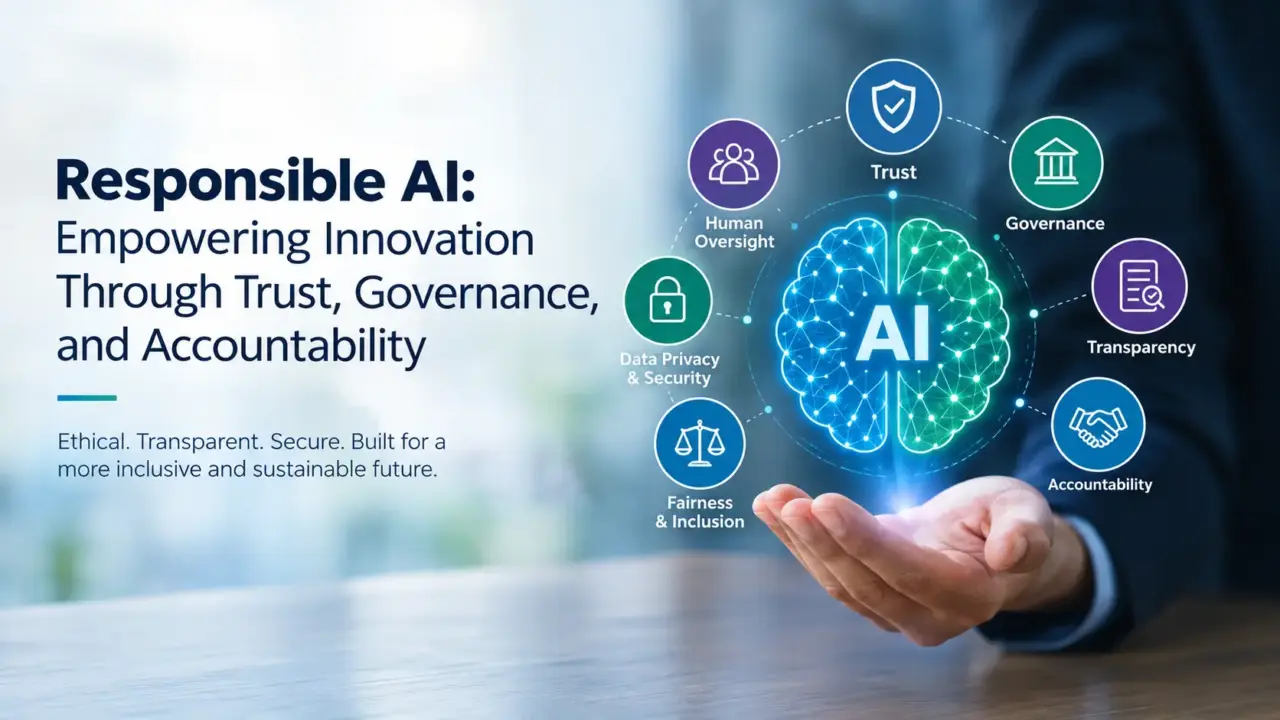
Responsible AI is the practice of designing, developing, deploying, and monitoring artificial intelligence systems in ways that are ethical, secure, transparent, fair, and accountable.
It ensures that AI technologies are aligned with organizational values, business objectives, applicable regulations, and the interests of the people affected by their use.
Responsible AI considers the complete AI lifecycle, from selecting use cases and preparing data to developing models, deploying applications, monitoring outcomes, and addressing incidents.
Its primary objectives include:
- Promoting fairness and reducing unintended bias.
- Protecting personal and confidential information.
- Improving transparency and explainability.
- Establishing clear accountability for AI-driven outcomes.
- Maintaining accuracy, reliability, and security.
- Supporting regulatory compliance.
- Ensuring appropriate human oversight.
Responsible AI is not simply a technical initiative. It is an essential component of modern corporate governance and enterprise risk management.
Why Is Responsible AI Important for Growing Businesses?
As organizations expand their use of AI, the potential benefits and risks grow together.
An AI-powered recruitment system may unintentionally disadvantage certain candidates. A generative AI application may produce inaccurate information. An AI assistant may expose confidential business data if access controls are inadequate.
Without appropriate governance, these issues can result in financial losses, reputational damage, regulatory consequences, and reduced customer confidence.
A structured Responsible AI framework helps businesses address these challenges while continuing to explore new opportunities.
Key Benefits of Responsible AI
1. Building Trust and Confidence
Customers, employees, business partners, and regulators need confidence that AI systems are being used responsibly. Transparent practices and clear accountability help strengthen stakeholder trust.
2. Reducing Business Risks
Responsible AI helps organizations identify and manage risks related to bias, inaccurate outputs, cybersecurity, data misuse, and inappropriate automation.
3. Supporting Regulatory Compliance
A structured approach helps organizations identify applicable AI-related obligations, maintain documentation, implement controls, and demonstrate compliance where required.
4. Improving Decision-Making
Responsible AI encourages organizations to validate AI-generated recommendations and establish appropriate review processes before using them in important decisions.
5. Enabling Sustainable Innovation
By integrating governance and risk controls into AI initiatives from the beginning, organizations can scale successful use cases more confidently.
The Core Principles of Responsible AI
An effective Responsible AI strategy should be built around the following principles.
1. Fairness and Bias Prevention
AI systems can reproduce or amplify biases present in historical data, training processes, or decision-making practices.
Organizations should evaluate data quality, test AI outcomes across relevant user groups, investigate potential discrimination, and establish processes for correcting unfair results.
Fairness is particularly important in recruitment, lending, insurance, healthcare, and other applications that can significantly affect individuals.
2. Transparency and Explainability
Organizations should understand where AI is being used, why it is being used, and how its outputs influence business decisions.
Depending on the application, transparency may involve disclosing AI interactions, documenting model limitations, explaining significant decisions, and maintaining records of system performance.
The goal is to ensure that relevant stakeholders can understand and appropriately evaluate AI-generated outcomes.
3. Privacy and Data Protection
AI applications may process sensitive customer information, employee records, financial data, and confidential business information.
Organizations must establish appropriate safeguards for collecting, processing, storing, and sharing such data.
These safeguards may include data minimization, encryption, access restrictions, retention policies, privacy assessments, and controls governing the use of external AI tools.
Employees should also understand which information can and cannot be entered into approved AI applications.
4. Security and Reliability
AI systems must be protected against unauthorized access, data leakage, malicious inputs, and other emerging threats.
Organizations should implement appropriate security testing, access management, monitoring, validation, and incident response procedures.
AI systems should also be assessed for accuracy, reliability, and performance under different operating conditions.
5. Accountability and Human Oversight
AI should not remove responsibility from the organization using it.
Businesses must clearly define who approves AI use cases, manages associated risks, monitors system performance, and responds to incidents.
Human review and intervention are particularly important when AI influences high-impact decisions involving employees, customers, finances, safety, or legal rights.
6. Continuous Monitoring and Improvement
AI models, data, business requirements, and regulatory expectations can change over time.
Responsible AI therefore requires continuous monitoring rather than a one-time approval.
Organizations should regularly review performance, investigate unexpected outcomes, assess emerging risks, and update controls as needed.
Responsible AI and Governance, Risk and Compliance (GRC)
Responsible AI becomes more effective when it is integrated into an organization’s existing Governance, Risk and Compliance framework.
Rather than treating AI governance as a separate activity, businesses can connect it with established enterprise risk and control processes.
An integrated approach can include:
- Enterprise Risk Management: Identifying and assessing AI-related business risks.
- Risk and Control Management: Mapping AI risks to preventive and detective controls.
- Compliance Management: Tracking applicable regulatory and internal policy requirements.
- Third-Party Risk Management: Assessing AI vendors, cloud providers, and external model dependencies.
- Internal Audit: Reviewing the design and effectiveness of AI governance controls.
- Issue and Remediation Management: Tracking AI incidents, control deficiencies, and corrective actions.
- Policy Management: Maintaining AI policies, standards, and employee guidelines.
This approach provides management with better visibility into AI-related risks, responsibilities, and control effectiveness.
The Role of Technology in Responsible AI
Technology can help organizations establish consistent and scalable AI governance processes.
Depending on their requirements, organizations may use enterprise platforms to centralize AI inventories, risk assessments, control documentation, compliance obligations, approvals, issues, and management reporting.
For example, a centralized AI governance process could follow this workflow:
AI Use Case Identification → Risk Assessment → Governance Review → Approval → Deployment → Ongoing Monitoring → Periodic Reassessment
Each stage should have appropriate ownership, documentation, and approval criteria.
Enterprise GRC and workflow platforms can help coordinate these activities, reduce manual effort, and improve visibility across business and technology teams. However, technology alone cannot guarantee responsible AI; effective policies, skilled people, sound processes, and ongoing oversight remain essential.
Responsible AI in Enterprise Applications
AI is increasingly being incorporated into business applications and operational workflows.
Examples include:
IT Service Management: AI-assisted incident categorization, ticket summarization, and suggested resolutions require appropriate accuracy checks and data protection controls.
Enterprise Risk Management: AI-supported risk analysis can help identify patterns and summarize information, but risk owners must validate important findings.
Compliance Management: AI can assist with regulatory research and evidence analysis, subject to verification and appropriate controls.
Human Resources: AI-enabled recruitment and workforce analytics require careful consideration of fairness, privacy, and applicable employment requirements.
Customer Service: AI chatbots and virtual agents need access restrictions, escalation procedures, and safeguards against inaccurate or misleading responses.
For every use case, organizations should evaluate the potential impact, establish suitable controls, and determine when human intervention is necessary.
Responsible AI and Regulatory Readiness
AI governance expectations are evolving globally. Relevant frameworks include the European Union AI Act, applicable data protection legislation such as the GDPR, and the NIST AI Risk Management Framework.
These instruments differ in scope and legal status. Their applicability depends on factors such as geography, industry, intended use, and an organization’s role in developing or deploying AI systems.
Businesses should therefore take a risk-based approach to regulatory readiness by:
- Identifying applicable legal and regulatory obligations.
- Maintaining an inventory of AI systems and use cases.
- Assessing the risks associated with each use case.
- Defining policies, responsibilities, and approval processes.
- Implementing appropriate controls and documentation.
- Monitoring changes in technology, risks, and regulatory requirements.
Early preparation can help organizations reduce uncertainty and build a more sustainable approach to AI adoption.
Common Challenges in Responsible AI Adoption
Organizations may encounter several challenges when establishing an AI governance program.
Limited Visibility: Employees may use unapproved AI tools without formal oversight.
Unclear Accountability: Business, technology, legal, and risk teams may have different expectations about who is responsible for AI governance.
Data Quality Issues: Incomplete, inaccurate, or biased data can undermine AI outputs.
Insufficient Testing: AI solutions may be deployed without adequate validation of accuracy, security, or fairness.
Third-Party Dependencies: Organizations may lack visibility into how external AI providers process data or manage security risks.
Fragmented Governance: Managing AI risks through disconnected spreadsheets and documents can make reporting, monitoring, and evidence collection difficult.
Addressing these challenges requires collaboration between leadership, technology teams, risk and compliance professionals, and employees who use AI in their daily work.
How Timus Consulting Services Can Help
At Timus Consulting Services, we help organizations strengthen their Governance, Risk and Compliance capabilities while supporting enterprise technology transformation.
Our approach focuses on helping businesses establish the governance structures, risk assessments, and controls needed to adopt AI responsibly.
Our services can support organizations with:
- AI Governance: Defining roles, responsibilities, policies, and approval processes.
- AI Risk and Control Management: Identifying AI-related risks and mapping them to appropriate controls.
- GRC Transformation: Integrating AI governance with enterprise risk, compliance, internal audit, and remediation processes.
- Policy Management: Establishing guidelines for acceptable AI use, data protection, security, and human oversight.
- Third-Party Risk Management: Evaluating risks associated with external AI providers and technology partners.
- Compliance Readiness: Supporting the assessment of applicable requirements and the organization of compliance evidence.
- Workflow Automation: Streamlining governance reviews, assessments, approvals, and issue tracking.
- Management Reporting: Improving visibility into AI risks, control gaps, and remediation progress.
Through our experience with enterprise GRC and technology platforms, including IBM OpenPages and ServiceNow, we can help organizations evaluate approaches to embedding governance and risk management into their broader technology landscape.
The right approach depends on each organization’s AI maturity, business priorities, risk exposure, and regulatory obligations.
Conclusion: Innovate Responsibly, Grow Confidently
Artificial Intelligence offers businesses significant opportunities to improve efficiency, accelerate innovation, and transform how work gets done.
However, sustainable AI adoption requires more than powerful technology. It requires fairness, transparency, privacy, security, accountability, and effective governance.
Organizations that integrate Responsible AI into their business strategy can better understand potential risks, strengthen stakeholder trust, and establish a foundation for long-term innovation.
Responsible AI is not about slowing down progress. It is about ensuring that progress creates value without compromising trust, security, or accountability.
At Timus Consulting Services, we believe that the future of digital transformation depends on bringing together innovation, governance, and business objectives.
Timus Consulting Services — Technology Simplified. Responsible Innovation. Trusted Transformation.
Frequently asked questions (FAQs)
1. What is responsible AI?
Responsible AI refers to developing, deploying, and using artificial intelligence in ways that are ethical, transparent, secure, fair, and accountable.
2. Why is responsible AI important for businesses?
Responsible AI helps businesses manage AI-related risks, protect sensitive data, build customer trust, improve decision-making, and support sustainable innovation.
3. What are the key principles of responsible AI?
Key principles include fairness, transparency, accountability, privacy, security, reliability, explainability, and human oversight.
4. What is AI governance?
AI governance is the set of policies, procedures, roles, and controls organizations use to manage AI systems throughout their lifecycle and ensure responsible use.
5. How can organizations implement responsible AI?
Organizations can establish AI governance policies, assess risks, monitor model performance, test for bias, protect data, document AI decisions, and maintain appropriate human oversight.