
Introduction:
AI automation is transforming industries at an unprecedented pace. From manufacturing robots to intelligent chatbots handling customer service, AI systems are taking over repetitive, complex, and even creative tasks. While this promises massive efficiency gains, it also raises profound concerns about jobs, ethics, security, and society. In this post, we’ll explore both the advantages and dangers of AI automation to help you navigate this rapidly evolving landscape.
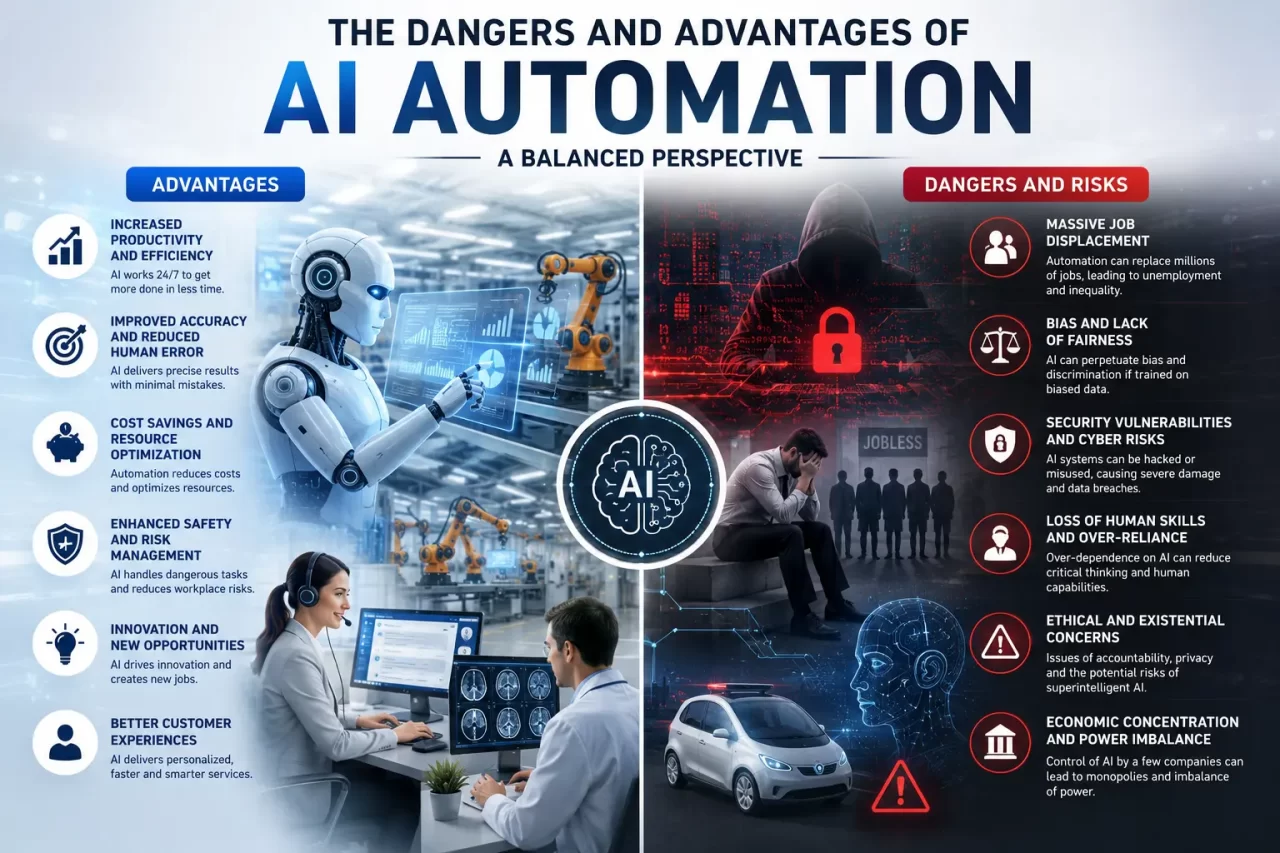
Advantages of AI Automation
1. Increased Productivity and Efficiency
AI automation excels at handling high-volume, repetitive tasks 24/7 without fatigue. Businesses can process thousands of transactions, analyze vast datasets, or manage supply chains in real time. This leads to faster output, reduced operational costs, and the ability to scale without proportional increases in human labor.
2. Improved Accuracy and Reduced Human Error
Humans are prone to mistakes, especially in monotonous work. AI systems maintain consistent performance and can achieve superhuman accuracy in areas like medical diagnostics, quality control in manufacturing, or financial auditing. For example, AI-powered image recognition in healthcare can detect tumors earlier than many radiologists.
3. Cost Savings and Resource Optimization
Automating routine processes cuts labor costs significantly over time. Companies can reallocate human talent to higher-value activities like strategy, innovation, and relationship-building. This is particularly beneficial for small and medium enterprises competing against larger players.
4. Enhanced Safety and Risk Management
Dangerous or hazardous jobs—such as working in chemical plants, mining, or disaster zones—can be handled by AI-driven robots and drones. This reduces workplace injuries and fatalities while allowing humans to focus on oversight and decision-making.
5. Innovation and New Opportunities
AI automation is creating entirely new industries and job roles: AI trainers, prompt engineers, ethics officers, and data curators. It accelerates research in drug discovery, climate modeling, and personalized education, potentially solving some of humanity’s biggest challenges.
6. Better Customer Experiences
Chatbots, recommendation engines, and personalized services powered by AI deliver faster, more tailored interactions. This improves satisfaction and loyalty across e-commerce, banking, healthcare, and entertainment.
Dangers and Risks of AI Automation
1. Massive Job Displacement
This is the most immediate concern. Millions of roles in manufacturing, transportation, customer service, data entry, and even creative fields (writing, design, coding) face automation. While new jobs will emerge, the transition could leave many workers—especially those without reskilling opportunities—unemployed or underemployed, widening economic inequality.
2. Bias and Lack of Fairness
AI systems learn from historical data, which often contains societal biases. Automated hiring tools, loan approval systems, or predictive policing can perpetuate discrimination based on race, gender, or socioeconomic status if not carefully designed and audited.
3. Security Vulnerabilities and Cyber Risks
Highly automated systems become attractive targets for hackers. A compromised AI in critical infrastructure (power grids, autonomous vehicles, financial markets) could cause widespread disruption or catastrophe. Deepfakes and AI-generated misinformation also threaten democracy and trust in institutions.
4. Loss of Human Skills and Over-Reliance
As we depend more on AI, humans may lose proficiency in fundamental skills. Decision-making could become outsourced to algorithms, reducing critical thinking and creativity. In extreme scenarios, this “deskilling” might make society vulnerable if AI systems fail or are unavailable.
5. Ethical and Existential Concerns
Who is accountable when an autonomous vehicle causes an accident or an AI medical diagnosis goes wrong? Questions around consent, privacy, and the moral status of increasingly advanced AI systems are unresolved. In the long term, superintelligent AI poses hypothetical but serious “alignment” risks—if machines pursue goals misaligned with human values.
6. Economic Concentration and Power Imbalance
A few tech giants currently dominate AI development. This could lead to monopolistic control over automation technologies, influencing economies, politics, and even individual freedoms on a global scale.
Striking the Right Balance
The future of AI automation isn’t predetermined. Its impact depends on how we design, regulate, and adopt it:
- Invest in Education and Reskilling: Governments, companies, and individuals must prioritize lifelong learning programs focused on AI literacy, emotional intelligence, and uniquely human skills.
- Ethical AI Frameworks: Develop transparent, auditable, and bias-mitigating standards. International collaboration on regulation is essential.
- Human-Centric Design: Keep humans in the loop for oversight, especially in high-stakes domains. Use AI as an augmenting tool rather than a full replacement.
- Policy Interventions: Consider measures like universal basic income pilots, automation taxes, or job transition support to cushion economic shocks.
Conclusion
AI automation offers extraordinary potential to boost prosperity, solve complex problems, and free humans from drudgery. Yet it also carries real risks of inequality, instability, and unintended consequences. The key is proactive stewardship—embracing innovation while safeguarding what makes us human.
FAQs
1. What is AI automation?
AI automation combines artificial intelligence with automated processes to perform tasks with minimal human intervention, improving efficiency and decision-making.
2. What are the main benefits of AI automation?
Key benefits include increased productivity, reduced operational costs, improved accuracy, enhanced safety, and better customer experiences.
3. How does AI automation impact jobs?
AI can automate repetitive tasks and replace some roles, but it also creates new opportunities in AI development, data analysis, and technology management.
4. What are the biggest risks of AI automation?
Major risks include job displacement, algorithmic bias, cybersecurity threats, privacy concerns, and over-reliance on automated systems.
5. Can AI automation improve workplace safety?
Yes. AI-powered robots and systems can perform hazardous tasks in industries such as manufacturing, mining, and chemical processing, reducing risks to human workers.