

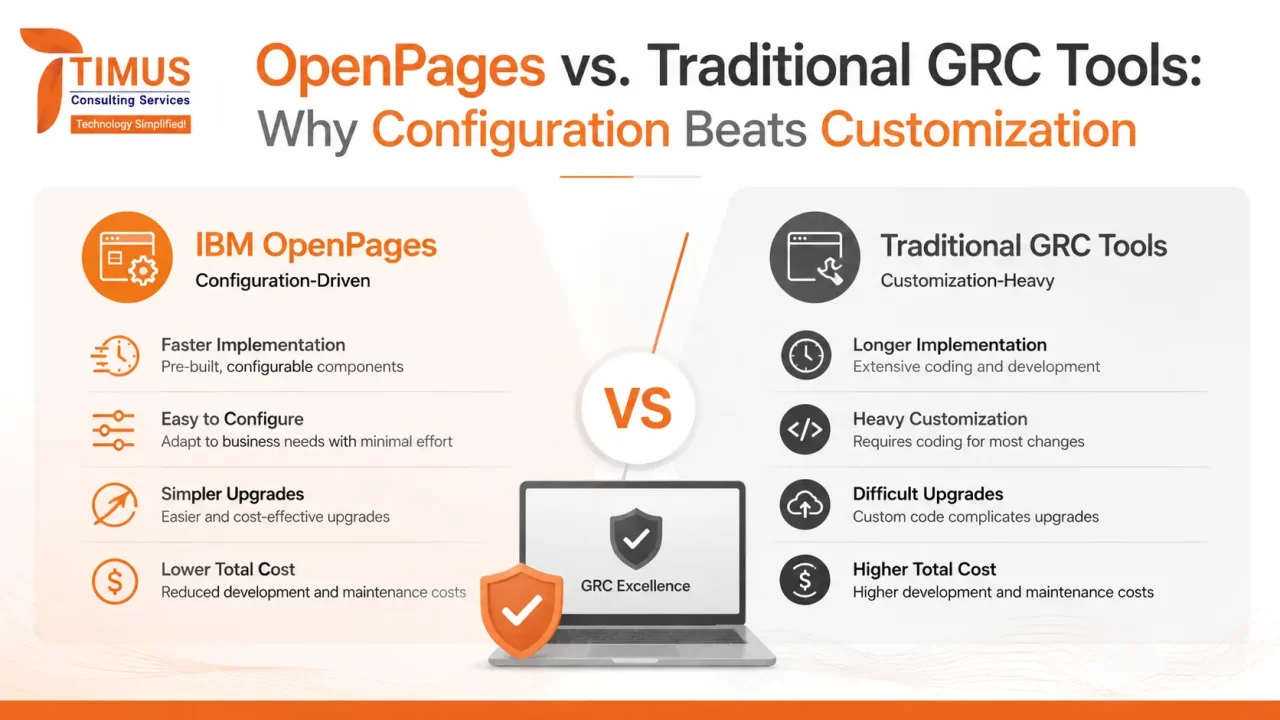
Every GRC platform evaluation eventually runs into the same question: how much of this will we have to build ourselves? The answer separates two fundamentally different philosophies — customization-heavy legacy tools versus configuration-first platforms like IBM OpenPages. That difference shows up not in the sales demo, but 18 months later, when the first regulatory change lands and someone has to update the system.
The Hidden Cost of Customization
Most traditional GRC tools were built as generic workflow or document-management engines and later stretched to cover risk and compliance use cases. To make them fit RCSA, KRI monitoring, or loss event management, implementation teams end up writing custom code — bespoke database tables, hardcoded business logic, one-off UI screens.
This works fine for phase one. The trouble starts later:
- Upgrades become projects. Custom code often breaks or requires re-testing with every platform upgrade, turning routine patches into multi-week regression cycles.
- Institutional knowledge gets trapped. Only the developers who wrote the customization understand it. When they leave, so does the ability to safely change anything.
- Regulatory change becomes a development cycle. A new BCBS 239 reporting requirement or a shift in Basel III capital treatment shouldn’t require a sprint of custom development — but in a heavily customized tool, it usually does.
- Total cost of ownership creeps upward. Every customization is a maintenance liability that compounds year over year.
What “Configuration-First” Actually Means in OpenPages
OpenPages was architected around a metadata-driven Object Model rather than hardcoded application logic. Risk types, controls, loss events, KRIs, third parties, and their relationships are all defined as configurable objects, fields, and hierarchies — not custom code.
In practice, this means:
1. Object Model changes without a developer. Adding a new custom field to a control object, introducing a new risk taxonomy, or extending the vendor object for a new TPRM attribute is a configuration task in the OpenPages UI — not a code deployment.
2. RBAC and hierarchy are native, not bolted on. Role-based access control and organizational hierarchy (business unit, entity, region) are core to the Object Model. Segregating access for a maker-checker workflow across geographies is a configuration exercise, not a permissions hack layered on top of the application.
3. Workflows are declarative. Stage-based workflows — for RCSA sign-off, event escalation, or investigation and root cause analysis — are built using OpenPages’ workflow designer. Conditional routing, SLA timers, and approval chains are configured through rules and stages rather than scripted from scratch.
4. Calculations live in configuration, not custom code. Risk scoring formulas, inherent-vs-residual risk calculations, weighted aggregation logic, and KRI threshold breach detection are built using OpenPages’ calculated fields and expression engine. When a regulator or internal audit changes a scoring methodology, the formula is updated in configuration — auditable, versioned, and without a code release.
5. Reporting stays in sync automatically. Because reports and dashboards (via embedded BI/Cognos) read directly from the configured Object Model, a new field or relationship is immediately reportable — no separate data warehouse remapping exercise.
Why This Matters for Regulated Institutions
Frameworks like BCBS 239, SOX, and AML/KYC don’t stay static. Regulatory expectations evolve, examiners issue new guidance, and internal audit findings routinely require methodology changes. A platform that treats these as configuration changes lets a GRC or risk team respond in days. A platform that treats them as development requests puts every change behind IT prioritization, testing cycles, and budget approval.
This is also why configuration-first platforms tend to hold up better across multi-phase rollouts. A pattern seen repeatedly in Operational Risk Management implementations: Phase 1 covers event capture and RCSA; Phase 2 extends into KRI and issue management; Phase 3 adds TPRM. Each phase builds on the same Object Model and workflow engine rather than introducing new custom subsystems — which keeps the platform coherent instead of becoming a patchwork of point solutions.
The Trade-Off Worth Naming
Configuration-first isn’t a free lunch. It requires genuine platform expertise — understanding the Object Model deeply enough to configure it well the first time, rather than working around limitations with quick customizations. Poorly planned configuration (overly rigid hierarchies, workflows with too many hardcoded conditions) can be just as brittle as bad custom code. The advantage isn’t that configuration is effortless — it’s that the effort stays inside the platform’s supported, upgrade-safe boundary instead of leaking into custom code that has to be maintained indefinitely.
Conclusion:
The real cost of a GRC platform isn’t visible in the initial implementation — it shows up in how easily the system absorbs the next regulatory change, the next audit finding, the next merger that reshapes the org hierarchy. Configuration-first platforms like OpenPages are built on the premise that risk and compliance requirements change constantly, so the system should be designed to change with them — without every change becoming a development project.
FAQs
1. What is the difference between IBM OpenPages and traditional GRC tools?
IBM OpenPages is a configurable GRC platform that allows organizations to adapt workflows, forms, and policies without extensive coding, while traditional GRC tools often require custom development.
2. Why is configuration better than customization in GRC?
Configuration reduces implementation time, lowers maintenance costs, simplifies upgrades, and enables organizations to respond quickly to changing compliance requirements.
3. Can IBM OpenPages be customized if needed?
Yes. While OpenPages emphasizes configuration, it also supports customization and integrations for advanced business requirements when necessary.
4. Does configuration improve upgrade compatibility?
Yes. Configured solutions are generally easier to upgrade because they rely on platform features instead of custom code that may need redevelopment.
5. Which organizations benefit most from IBM OpenPages?
Enterprises in highly regulated industries such as banking, healthcare, insurance, manufacturing, and government benefit from OpenPages due to its scalable and configurable GRC capabilities.