
Introduction: Your Business Is Growing. Are Your Workflows Keeping Up?
Imagine an organization with 10,000 employees, hundreds of applications, multiple IT departments, and thousands of service requests every month.
An employee needs access to a business application. An IT engineer must resolve a critical incident. A security analyst discovers a vulnerability. Meanwhile, HR is onboarding new employees across different locations.
All these activities are connected, yet many organizations still manage them through disconnected systems, emails, spreadsheets, and manual approvals.
The real challenge isn’t a lack of technology. It’s a lack of intelligent coordination between people, processes, and systems.
This is where ServiceNow consulting becomes a strategic business advantage.
What Is ServiceNow Consulting?
ServiceNow consulting is the process of helping organizations design, implement, integrate, optimize, and manage workflows using the ServiceNow platform.
However, successful consulting goes beyond configuring software.
It involves understanding how an organization operates, identifying inefficient processes, designing scalable solutions, and implementing automation that supports measurable business outcomes.
A skilled ServiceNow consulting partner helps businesses move from reactive service management toward proactive, intelligent operations.
Five Ways ServiceNow Consulting Transforms Enterprise Operations
1. IT Service Management: From Ticket Resolution to Service Excellence
Traditional IT service management often focuses on closing tickets as quickly as possible.
Modern enterprises need something more: consistent service delivery, operational visibility, and improved employee experiences.
ServiceNow IT Service Management (ITSM) helps organizations streamline:
- Incident and problem management
- Change enablement
- Service request fulfillment
- Knowledge management
- Service-level management
With properly designed workflows, IT teams can reduce repetitive administrative work, standardize approvals, and improve service consistency.
The transformation: IT becomes a strategic business enabler instead of merely a troubleshooting department.
2. IT Operations Management: Discover Problems Before They Become Disruptions
Consider an organization running thousands of servers, cloud resources, applications, and infrastructure components.
Without accurate visibility, identifying the root cause of a service disruption can become complicated.
ServiceNow IT Operations Management (ITOM) capabilities help enterprises improve infrastructure discovery, service visibility, event management, and operational decision-making.
Experienced consultants help organizations establish reliable configuration data, design service maps, and connect operational alerts with incident-management processes.
The transformation: From fragmented infrastructure monitoring toward connected, service-aware IT operations.
3. Security Operations: Connect Security Findings with Business Action
Cybersecurity teams frequently work with multiple platforms for vulnerability scanning, threat detection, identity management, and compliance tracking.
The challenge is not simply detecting security risks. It is ensuring that identified risks are assigned, prioritized, tracked, and resolved.
ServiceNow Security Operations (SecOps) can help organizations coordinate vulnerability response and security incident workflows.
A well-designed implementation connects security teams with IT asset owners and remediation teams.
For example:
A vulnerability scanner identifies a critical exposure → the affected asset is identified → business context supports prioritization → a remediation task is assigned → progress is tracked → closure evidence is recorded.
The transformation: Security findings become actionable, traceable remediation workflows instead of isolated reports.
4. HR Service Delivery: Make Employee Experiences Effortless
Employee onboarding often involves HR, IT, facilities, identity management, and departmental approvals.
When these teams operate independently, new employees may experience delayed equipment allocation, missing access permissions, and repetitive documentation.
ServiceNow HR Service Delivery (HRSD) helps organizations coordinate employee requests and lifecycle activities through structured workflows.
Consultants can design employee journeys that integrate HR processes with IT provisioning and approval systems.
The transformation: A fragmented onboarding experience becomes a coordinated digital journey.
5. AI-Powered Workflow Automation: Moving Beyond Manual Decisions
Artificial intelligence is changing how enterprise service management platforms are used.
ServiceNow’s AI capabilities, including Now Assist and supported AI-driven workflows, can help teams summarize information, assist with knowledge creation, and streamline selected service-management activities.
However, implementing AI successfully requires more than enabling a feature.
Organizations need clear governance, reliable data, well-defined approval boundaries, and human oversight.
ServiceNow consultants play an important role in identifying practical AI use cases, validating outputs, and ensuring automation aligns with business objectives.
The transformation: Teams spend less time on repetitive coordination and more time making informed decisions.
Why ServiceNow Implementations Sometimes Fail to Deliver Value
Purchasing enterprise software does not automatically create operational efficiency.
Organizations often encounter challenges such as:
- Replicating inefficient manual processes instead of redesigning them
- Excessive customization that increases maintenance complexity
- Poor configuration management database (CMDB) data quality
- Inconsistent integration between enterprise applications
- Weak governance over roles, permissions, and workflows
- Limited employee adoption after deployment
These problems highlight why ServiceNow consulting should begin with business-process discovery rather than immediate technical implementation.
A successful engagement combines technical expertise, process design, security controls, and organizational change management.
A Smarter Approach: The Five-Stage ServiceNow Consulting Framework
Stage 1 — Discover
Understand existing workflows, operational pain points, stakeholders, dependencies, and business objectives.
Stage 2 — Design
Create an architecture with standardized processes, appropriate integrations, access controls, and measurable success criteria.
Stage 3 — Implement
Configure ServiceNow modules, develop necessary integrations, automate approvals, and establish supporting data structures.
Stage 4 — Validate
Conduct functional testing, integration testing, security reviews, user acceptance testing, and workflow performance checks.
Stage 5 — Optimize
Monitor business outcomes, improve automation, address adoption gaps, and continuously enhance platform performance.
This structured approach helps businesses develop a scalable platform rather than a collection of disconnected workflows.
Measuring the Business Value of ServiceNow Consulting
The success of a ServiceNow transformation should not be measured solely by the number of workflows deployed.
Organizations should evaluate meaningful operational indicators.
| Business Objective | Suggested KPI |
|---|---|
| Faster incident resolution | Mean Time to Resolve (MTTR) |
| Better employee experience | Service satisfaction and fulfillment time |
| Improved automation | Percentage of eligible tasks automated |
| Stronger security response | Vulnerability remediation time |
| Operational reliability | Service availability and incident recurrence |
| Better service delivery | SLA compliance rate |
These measurements help leadership evaluate whether technology investments are producing real organizational value.
The Future of ServiceNow Consulting: Intelligent, Connected, and Governed
The next phase of enterprise digital transformation will not be defined simply by how many applications a company deploys.
It will be defined by how effectively those applications communicate, coordinate activities, and support business decisions.
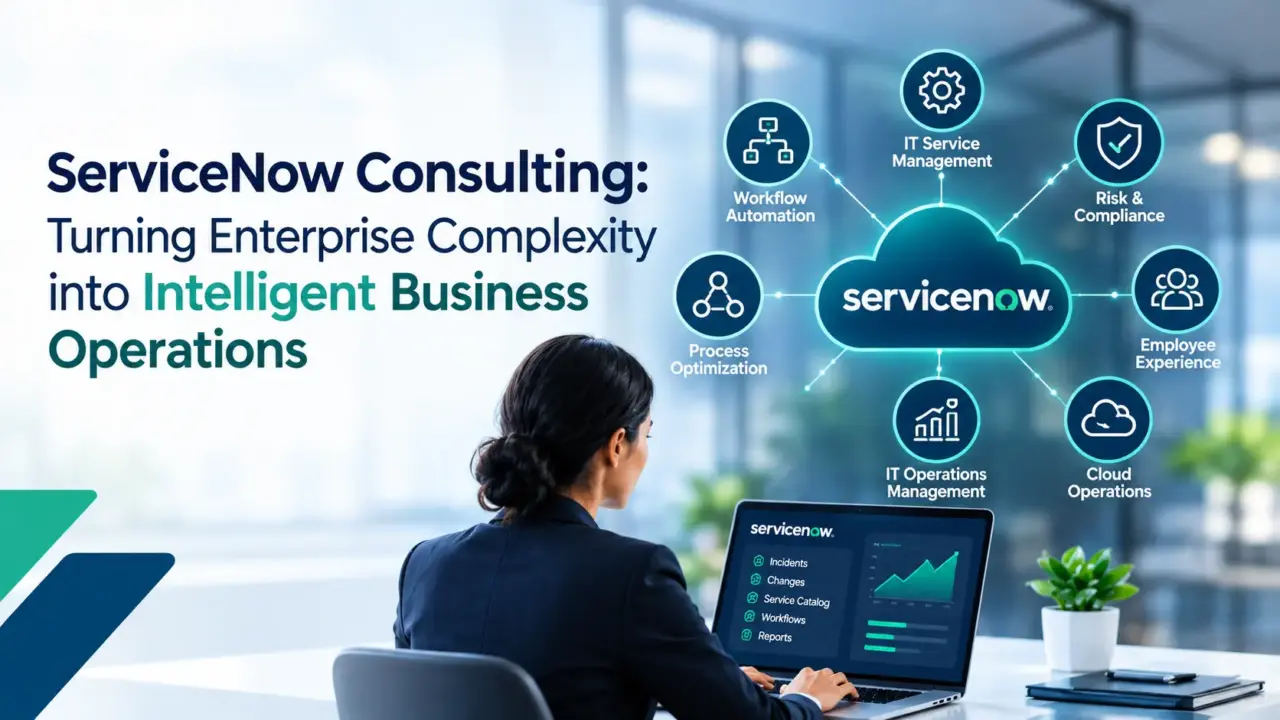
ServiceNow consulting is increasingly about connecting IT operations, security, employee services, automation, and governance into a unified operating model.
As AI-powered workflows evolve, organizations will also need stronger controls around data access, accountability, monitoring, and human decision-making.
Businesses that establish these foundations will be better positioned to scale automation responsibly.
Conclusion: Don’t Just Automate Workflows. Redesign the Way Your Business Operates.
ServiceNow is more than an IT ticketing platform. It provides capabilities for connecting enterprise services, operational data, and business workflows.
But technology alone cannot solve inefficient processes.
The true value of ServiceNow consulting lies in combining the right technology with practical process improvements, strong governance, and clear business objectives.
The goal is not to make existing complexity move faster. The goal is to eliminate unnecessary complexity altogether.
Organizations that approach ServiceNow transformation strategically can build more efficient, resilient, and connected business operations.
FAQs: ServiceNow Consulting — Turning Enterprise Complexity into Intelligent Business Operations
1. What is ServiceNow consulting?
ServiceNow consulting helps businesses implement, customize, and optimize the ServiceNow platform to automate workflows, improve IT service management, and streamline enterprise operations.
2. How can ServiceNow improve business operations?
ServiceNow connects business processes, automates repetitive tasks, improves collaboration, and provides real-time visibility into workflows, helping organizations increase efficiency and productivity.
3. What ServiceNow consulting services does Timus Consulting offer?
ServiceNow consulting can include implementation, configuration, workflow automation, IT service management, integration, platform optimization, and ongoing support tailored to business requirements.
4. Which industries can benefit from ServiceNow solutions?
Industries such as banking, financial services, healthcare, manufacturing, telecommunications, retail, and government can use ServiceNow to improve service delivery and automate operations.
5. Can ServiceNow integrate with existing enterprise systems?
Yes. ServiceNow supports integrations with various enterprise applications and systems, helping organizations connect workflows and improve data exchange across their technology environment.