
AI Governance is no longer a future technology — it is already embedded in hiring tools, fraud detection systems, customer service bots, and compliance workflows. But as AI adoption accelerates, the question is not just “can we use AI?” — it is “are we using it responsibly?”
What Is AI Governance?
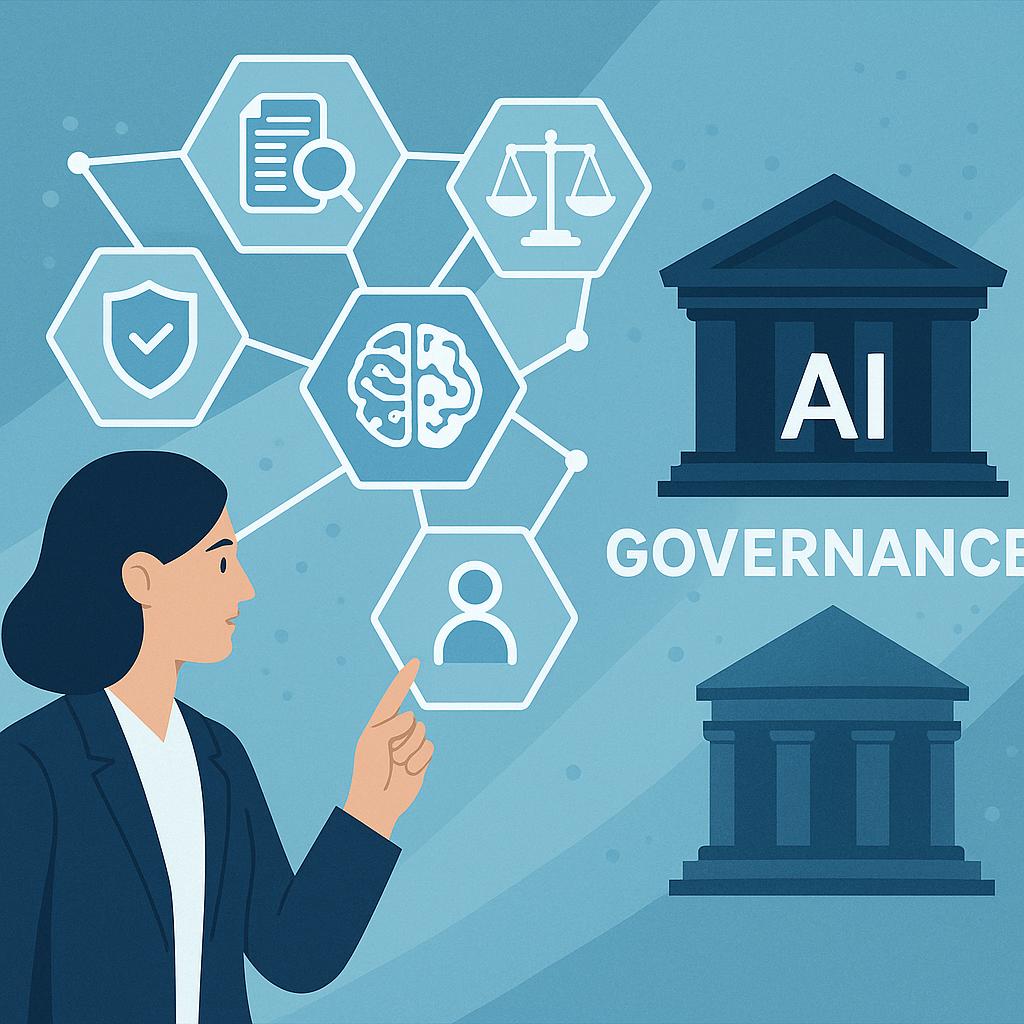
AI Governance refers to the set of policies, processes, standards, and accountability structures that guide how an organisation develops, deploys, and monitors artificial intelligence systems. It ensures that AI is used in a way that is ethical, transparent, legally compliant, and aligned with business objectives.
Think of AI Governance as the rulebook for your AI — defining who makes decisions about AI systems, how those decisions are made, and how the outcomes are monitored and audited over time.
Without governance, AI systems can produce biased outputs, violate data privacy regulations, create undetected operational risks, or lead to regulatory penalties — often before anyone realises there is a problem.
The Key Pillars of a Responsible AI Framework
1. Accountability and Ownership
Every AI system deployed in your organisation should have a named owner — whether that is a business unit head, a data team lead, or a dedicated AI ethics officer. Accountability means someone is responsible for what the AI does, and for correcting it when something goes wrong.
2. Transparency and Explainability
Stakeholders — including employees, customers, and regulators — have a right to understand how AI-driven decisions are made. Black-box models that cannot be explained are increasingly unacceptable under frameworks like the EU AI Act and India’s evolving data protection landscape. Responsible AI requires that decisions can be traced, explained, and challenged.
3. Fairness and Bias Management
AI learns from historical data. If that data reflects past discrimination or systemic bias, the AI will replicate it — often at scale and at speed. Responsible AI Governance demands regular bias audits, diverse training datasets, and ongoing monitoring for discriminatory outcomes across customer segments, geographies, and demographics.
4. Data Privacy and Security
AI systems often process sensitive personal or business-critical data. Your governance framework must align with applicable regulations — such as GDPR, DPDP Act (India), or industry-specific mandates — and enforce strict data access controls, retention policies, and encryption standards. The risk of AI leaking compliance data is real, and prevention starts with governance.
5. Risk Assessment and Model Validation
Before any AI model goes into production, it should pass through a formal risk assessment. What decisions does it influence? What is the impact of an incorrect output? High-risk AI applications — such as credit scoring, fraud detection, or medical triage — demand more rigorous testing, validation, and human oversight than low-risk automation tools.
6. Continuous Monitoring and Auditability
AI models drift over time as the world changes but the model does not. A fraud detection model trained in 2021 may miss entirely new fraud patterns by 2024. Responsible governance means scheduling regular model reviews, tracking performance metrics, and logging AI decisions so they can be audited when needed.
Compliance Management
Organizations must comply with evolving AI regulations and industry standards.
- GDPR compliance
- Data privacy regulations
- Responsible AI guidelines
- Industry-specific standards
Industries Using Governance Services
Many industries require structured governance frameworks.
These industries include:
- Healthcare
- Banking and financial services
- Insurance
- Retail
- Manufacturing
- Government organizations
Each industry faces unique regulatory and operational challenges.
How Timus Consulting Services Helps
Timus Consulting Services provides governance solutions tailored to enterprise requirements.
Our services include:
- governance strategy development
- AI risk and compliance consulting
- Ethical AI framework implementation
- AI security governance
- Data governance solutions
- AI monitoring and reporting
Furthermore, we help organizations create scalable governance models that support innovation and compliance simultaneously.
Governance and GRC: A Natural Fit
Governance, Risk, and Compliance (GRC) professionals are uniquely positioned to lead AI governance initiatives. The skills that drive effective GRC — risk assessment, policy development, internal audit, and regulatory tracking — are exactly the capabilities needed to govern AI responsibly.
What the Regulators Are Saying
Regulators globally are catching up fast. The EU AI Act — the world’s first comprehensive legal framework for AI — classifies AI systems by risk level and mandates specific governance obligations for each tier. Meanwhile, countries across Asia-Pacific, including India, are developing their own AI regulatory approaches.
For businesses operating across borders, this means governance is not optional — it is a compliance requirement. Organisations that build their governance frameworks now will be far better positioned than those scrambling to retrofit controls after legislation takes effect.