

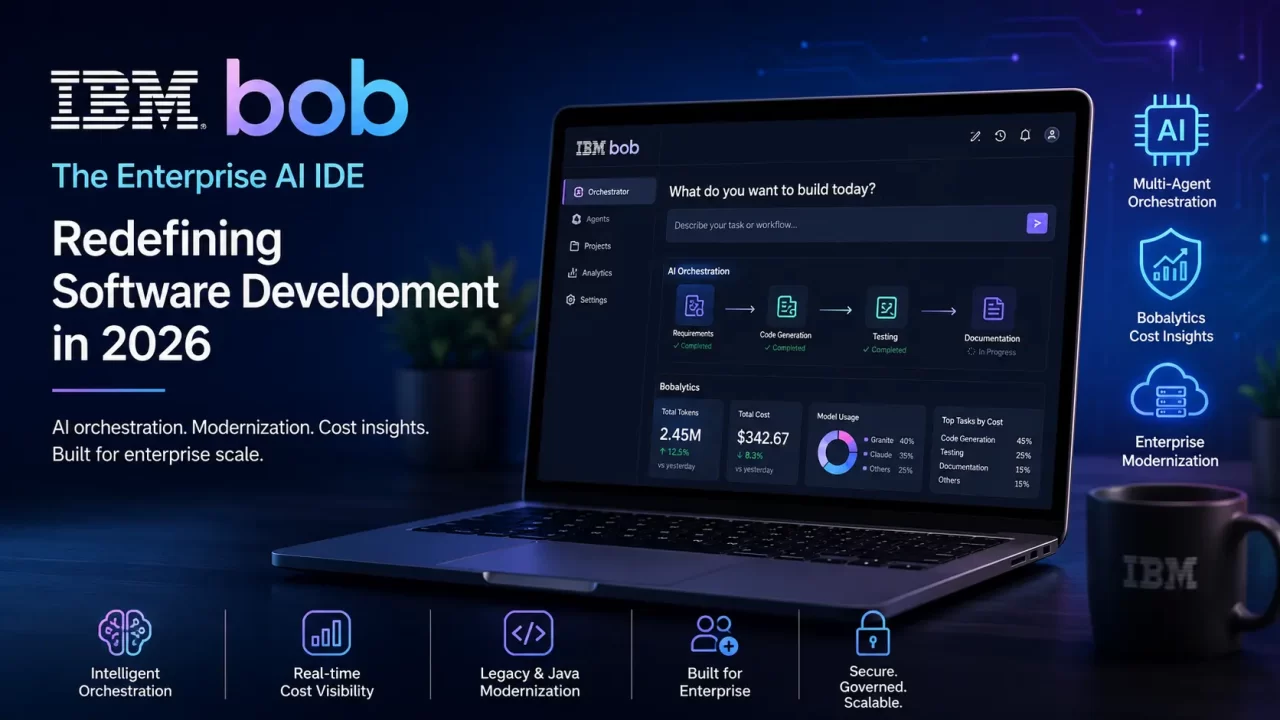
1. IBM Bob: The Enterprise AI IDE
Redefining Software Development in 2026
Artificial Intelligence has transformed software development, making developers more productive than ever before. Tools like GitHub Copilot and other AI coding assistants have become indispensable for generating code snippets, completing functions, and answering programming questions.
However, enterprise software development presents challenges that extend far beyond code completion. Organizations maintaining mission-critical applications, legacy systems, and regulated environments require AI that can understand complex architectures, orchestrate multi-step workflows, manage costs, and modernize decades of business logic.
This is where IBM Bob stands apart.
Rather than being just another AI coding assistant, IBM Bob is designed as an enterprise AI development platform—combining intelligent orchestration, specialized enterprise knowledge, and real-time governance into a single developer experience.
2. Moving Beyond Code Completion
Most coding assistants follow a simple interaction model:
Developer Prompt → AI Response
While this works well for isolated coding tasks, enterprise projects are rarely that straightforward.
Consider a request like:
“Build a React frontend for this existing REST API, generate documentation, create tests, validate dependencies, and ensure compatibility with our enterprise standards.”
A traditional AI assistant may generate pieces of code, but the developer still has to coordinate every step manually.
IBM Bob changes this paradigm.
Instead of simply responding to prompts, Bob functions as an AI orchestration engine. It understands the overall objective, breaks it into manageable tasks, assigns work to specialized AI agents, and executes the workflow while keeping the developer in complete control.
The result is faster development with significantly less manual coordination.
3. What Makes IBM Bob Different?
1. Multi-Agent Coordination with Intelligent Subagents
Enterprise software development involves countless background tasks that interrupt developer focus.
Examples include:
- Reading large codebases
- Searching directories
- Tracing dependencies
- Reviewing architecture
- Running compatibility checks
- Validating generated code
Traditional AI assistants attempt to handle everything within one conversation, quickly consuming context and increasing token usage.
IBM Bob takes a different approach.
It launches specialized subagents inside isolated workspaces.
While the primary AI plans and coordinates the project, background agents independently perform supporting work such as:
- Dependency analysis
- Repository exploration
- Function tracing
- Build validation
- Documentation generation
- Architecture inspection
Only the most relevant findings are returned to the main conversation.
Benefits
- Cleaner AI context
- Better accuracy
- Lower token consumption
- Faster execution
- Improved scalability for large enterprise projects
Instead of overwhelming developers with every intermediate step, Bob delivers only the insights that matter.
2. Bobalytics: Controlling AI Costs Before They Escalate
As AI adoption grows, so do infrastructure costs.
Most coding assistants provide little or no visibility into AI spending.
Engineering leaders often struggle to answer questions like:
- Which AI models are being used?
- How many tokens are consumed each day?
- Which tasks generate the highest costs?
- Where can spending be optimized?
IBM Bob addresses this challenge with Bobalytics, a built-in analytics dashboard designed specifically for AI-powered software development.
Bobalytics provides:
- Real-time AI token consumption
- Model usage analytics
- Cost-per-task tracking
- Team-level AI usage insights
- Optimization recommendations
Whether developers are using IBM Granite, Anthropic Claude, or open-source models, Bobalytics helps organizations maximize productivity while maintaining financial control.
For enterprise IT leaders, this visibility is essential for responsible AI adoption.
3. Specialized Premium Packages for Enterprise Modernization
Generic AI models excel at modern programming languages but often struggle with decades-old enterprise technologies.
IBM Bob addresses this through Premium Packages built specifically for enterprise development.
IBM Z Modernization
Bob assists organizations maintaining mainframe applications by understanding:
- COBOL
- PL/I
- JCL
- IBM Z architectures
It helps developers modernize critical workloads while preserving existing business logic.
IBM i Modernization
Many enterprises continue running applications written in fixed-format RPG.
IBM Bob assists developers by:
- Translating fixed-format RPG into modern free-format RPG
- Improving code readability
- Supporting incremental modernization
- Reducing migration risks
Java Modernization
Large organizations frequently face complex Java upgrades.
Bob helps automate migration tasks such as:
- Compatibility analysis
- API replacement suggestions
- Dependency validation
- Java version upgrades (including Java 25)
This significantly reduces the manual effort involved in large-scale modernization projects.
4. More Than an AI Assistant—An Enterprise IDE
Unlike traditional coding assistants that operate as IDE extensions, IBM Bob is delivered as a full standalone development environment built on Visual Studio Code.
Developers benefit from:
- Integrated AI workflows
- Enterprise-grade project management
- Built-in modernization tools
- Intelligent orchestration
- Seamless collaboration across development teams
Instead of switching between multiple tools, developers work within a unified AI-powered workspace.
5. IBM Bob vs. Standard Coding Assistants
| Capability | Standard Coding Assistants | IBM Bob |
|---|---|---|
| Workspace | IDE extension or chat panel | Full standalone VS Code-based IDE |
| AI Workflow | Single prompt-response | Multi-agent orchestration with specialized subagents |
| Task Execution | Suggests code snippets | Executes multi-step workflows with developer approval |
| Error Resolution | Developer manually pastes errors | Self-debugs, validates, and verifies automatically |
| Legacy Technology Support | Limited COBOL/RPG understanding | Specialized IBM Z, IBM i, and enterprise modernization packages |
| Cost Visibility | Little or no tracking | Real-time analytics through Bobalytics |
| Enterprise Governance | Limited | Built-in visibility, orchestration, and modernization workflows |
6. Why IBM Bob Matters for IBM OpenPages Development
IBM OpenPages implementations often involve:
- Java customization
- REST API integration
- Workflow development
- Business rule configuration
- Regulatory reporting
- Enterprise security requirements
- Integration with other IBM products
IBM Bob can significantly accelerate these activities.
Faster Custom Development
Developers can describe requirements in natural language, and Bob orchestrates the implementation across multiple components instead of generating isolated code snippets.
Smarter API Integration
Bob can analyze existing REST APIs, generate integration layers, validate dependencies, and recommend best practices for connecting OpenPages with external enterprise systems.
Simplified Modernization
Organizations upgrading OpenPages versions often need to refactor Java code and validate compatibility.
Bob’s modernization capabilities help automate much of this process while reducing upgrade risks.
Better Documentation
Subagents can automatically generate technical documentation, API references, and implementation notes, making maintenance easier for future teams.
Cost-Aware AI Adoption
With Bobalytics, OpenPages development teams gain visibility into AI usage and costs, enabling enterprise-wide governance and optimization.
7. Why Enterprises Need More Than Code Generation
Modern enterprises require AI platforms that support:
- Large-scale modernization
- Regulatory compliance
- Legacy technology expertise
- Multi-team collaboration
- Cost transparency
- Intelligent orchestration
IBM Bob delivers these capabilities through a development environment purpose-built for enterprise software engineering.
Rather than simply helping developers write code, Bob helps organizations plan, build, modernize, validate, and manage software at enterprise scale.
8. Final Thoughts
The future of AI-assisted development isn’t about generating more code—it’s about orchestrating entire software engineering workflows.
IBM Bob represents this next evolution. By combining multi-agent coordination, enterprise-specific modernization packages, real-time AI cost visibility through Bobalytics, and a dedicated AI-powered IDE, it goes far beyond the capabilities of traditional coding assistants.
For organizations building and maintaining complex enterprise applications—including IBM OpenPages, IBM Z, IBM i, and large Java ecosystems—IBM Bob offers a smarter, more governed, and more scalable approach to AI-powered software development.
As enterprises continue their AI transformation journey, tools that combine productivity with governance, modernization, and cost control will define the next generation of software engineering. IBM Bob is positioned to be one of those platforms.