
What is AI-powered GRC Automation?
AI-powered GRC (Governance, Risk, and Compliance) automation leverages artificial intelligence to streamline and enhance risk and compliance processes by reducing manual effort across key workflows. These capabilities include regulatory change analysis, control assessments, risk evaluations, issue management, and remediation routing.
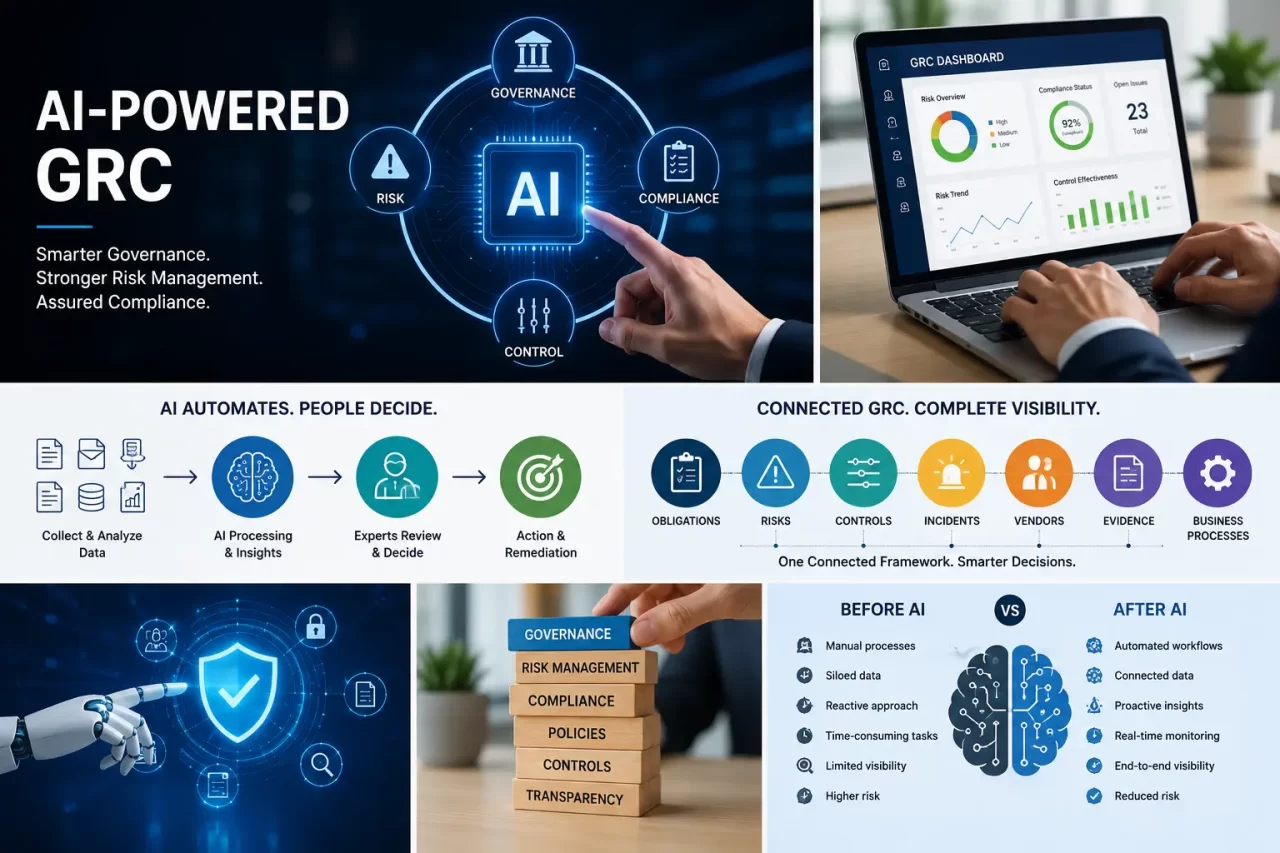
Rather than replacing human expertise and judgment, AI automates repetitive and data-intensive tasks such as information collection, reconciliation, monitoring, and follow-up activities. This enables GRC professionals to focus on higher-value activities, including risk analysis, decision-making, and strategic planning.
When obligations, controls, risks, incidents, and related compliance data are integrated within a unified platform, AI can analyze relationships across this shared context. By understanding these connections, AI can identify potential impacts, highlight emerging risks, recommend appropriate actions, and prioritize remediation efforts based on business significance and risk exposure.
How does AI reduce manual work in GRC Processes?
AI reduces manual effort in GRC by automating the collection, correlation, and analysis of information that risk and compliance teams would traditionally assemble manually.
When a regulatory change is introduced, AI can assess its relevance, map it to existing obligations, controls, policies, and risks, and identify impacted business processes, systems, and third parties. Instead of starting with a blank slate, analysts receive a contextualized view of potential impacts and recommended areas for review.
In addition, AI streamlines coordination activities by automatically assigning tasks, routing evidence requests, tracking remediation progress, and monitoring follow-through within the same workflow. By handling these administrative and data-intensive activities, AI enables GRC professionals to shift their focus from information gathering and process management to risk evaluation, decision-making, and strategic oversight.
What is Connected GRC and Why Does it Matter in AI?
Connected GRC is an operating model in which obligations, controls, risks, vendors, incidents, findings, evidence, and business processes are linked within a unified framework rather than managed in separate, siloed systems. By establishing relationships among these governance, risk, and compliance elements, organizations create a shared source of context that enables greater visibility, consistency, and operational efficiency across risk and compliance functions.
This connected foundation is particularly important for AI-driven GRC. Effective AI reasoning depends on understanding how regulatory requirements, risks, controls, and business activities are interconnected. Without a connected GRC model, AI can automate individual tasks but remains limited to isolated analysis.
With an integrated data model, AI can evaluate the broader impact of changes and events across the organization. For example, a single regulatory update can trigger the identification of vendors whose criticality may increase, open findings that become more significant, controls that require retesting, and business processes that may need adjustment. This enables organizations to move from reactive compliance activities to proactive, risk-informed decision-making.
Benefits of AI in GRC Automation
Artificial Intelligence (AI) is transforming Governance, Risk, and Compliance (GRC) by reducing manual effort, accelerating decision-making, and improving the effectiveness of risk and compliance programs. By automating repetitive tasks and analyzing large volumes of structured and unstructured data, AI enables organizations to operate more efficiently while maintaining stronger oversight and control.
1. Increased Operational Efficiency
AI automates time-consuming activities such as data collection, evidence gathering, control testing, issue tracking, and workflow routing. This reduces administrative overhead and allows GRC professionals to focus on risk analysis, strategic planning, and decision-making.
2. Faster Regulatory Change Management
AI can continuously monitor regulatory updates, identify relevant changes, map them to existing obligations and controls, and highlight impacted business areas. This significantly reduces the time required to assess and respond to new regulatory requirements.
3. Improved Risk Identification and Assessment
By analyzing data across multiple sources, AI can identify emerging risks, detect patterns, and uncover relationships that may not be visible through manual reviews. This enables more proactive risk management and earlier intervention.
4. Enhanced Decision-Making
AI provides contextual insights by connecting risks, controls, incidents, findings, vendors, and business processes. Decision-makers receive prioritized recommendations and impact assessments, enabling more informed and timely actions.
5. Better Compliance Monitoring
AI can continuously evaluate compliance activities, monitor control performance, and identify potential gaps or exceptions in near real time. This improves compliance visibility and reduces the likelihood of regulatory violations.
6. Streamlined Issue and Remediation Management
AI can automatically assign ownership, prioritize issues based on risk, track remediation progress, and escalate overdue actions. This helps organizations resolve issues more efficiently and improves accountability.
Before AI vs After AI
| Traditional GRC | AI-Powered GRC |
|---|---|
| Manual regulatory reviews | Automated regulatory impact analysis |
| Siloed risk and compliance data | Connected GRC data model |
| Reactive issue management | Predictive risk identification |
| Manual evidence collection | Automated evidence routing |
| Spreadsheet-based tracking | Workflow-driven monitoring |
| Weeks to assess impacts | Near real-time impact assessment |
| Analysts gather information | Analysts focus on decisions |