
Introduction:
For decades, Governance, Risk, and Compliance (GRC) has been one of the most document-heavy, manually intensive disciplines in enterprise management. Risk assessments filled in spreadsheets. Audit findings tracked across disconnected email threads. Compliance evidence gathered from dozens of business units, manually collated, and painstakingly mapped to regulatory frameworks. The process was — and in many organisations still is — exhausting, slow, and prone to human error.
Artificial Intelligence is changing that. Not in some distant, theoretical future — right now, in production environments, at organisations that have chosen to move forward.
At Timus Consulting Services, we are at the centre of that change. With deep expertise spanning IBM OpenPages GRC consulting services implementation, AI-powered automation, ERP integration, and enterprise technology consulting, we are helping organisations transform the way they manage risk and compliance. This post explores the state of AI in GRC today, the practical use cases that are already delivering results, and what organisations should be thinking about as they plan their own AI-enabled GRC journey.
Why GRC Has Always Been a Prime Candidate for AI
GRC is, at its core, an information problem. Organisations generate enormous volumes of structured and unstructured data — policies, contracts, audit reports, risk registers, regulatory notices, incident logs, control assessments — and must continuously analyse, map, and act on that data to stay compliant and resilient.
The challenge is not a lack of data. It is the inability to process it at the speed and scale that modern regulatory environments demand.
Consider what a traditional internal audit team does: they read through hundreds of pages of process documentation, interview control owners, write findings, map findings to risk frameworks, create action plans, and then monitor remediation — often over a cycle of six to twelve months. By the time a finding is remediated, the business context may have already shifted.
This is exactly the kind of structured, repetitive, high-stakes cognitive work that AI is exceptionally good at augmenting.
Five Transformative AI Use Cases in GRC
1. Automated Audit Report Ingestion and Finding Extraction
One of the highest-value AI applications in internal audit is the automatic extraction, classification, and structuring of findings from narrative audit reports.
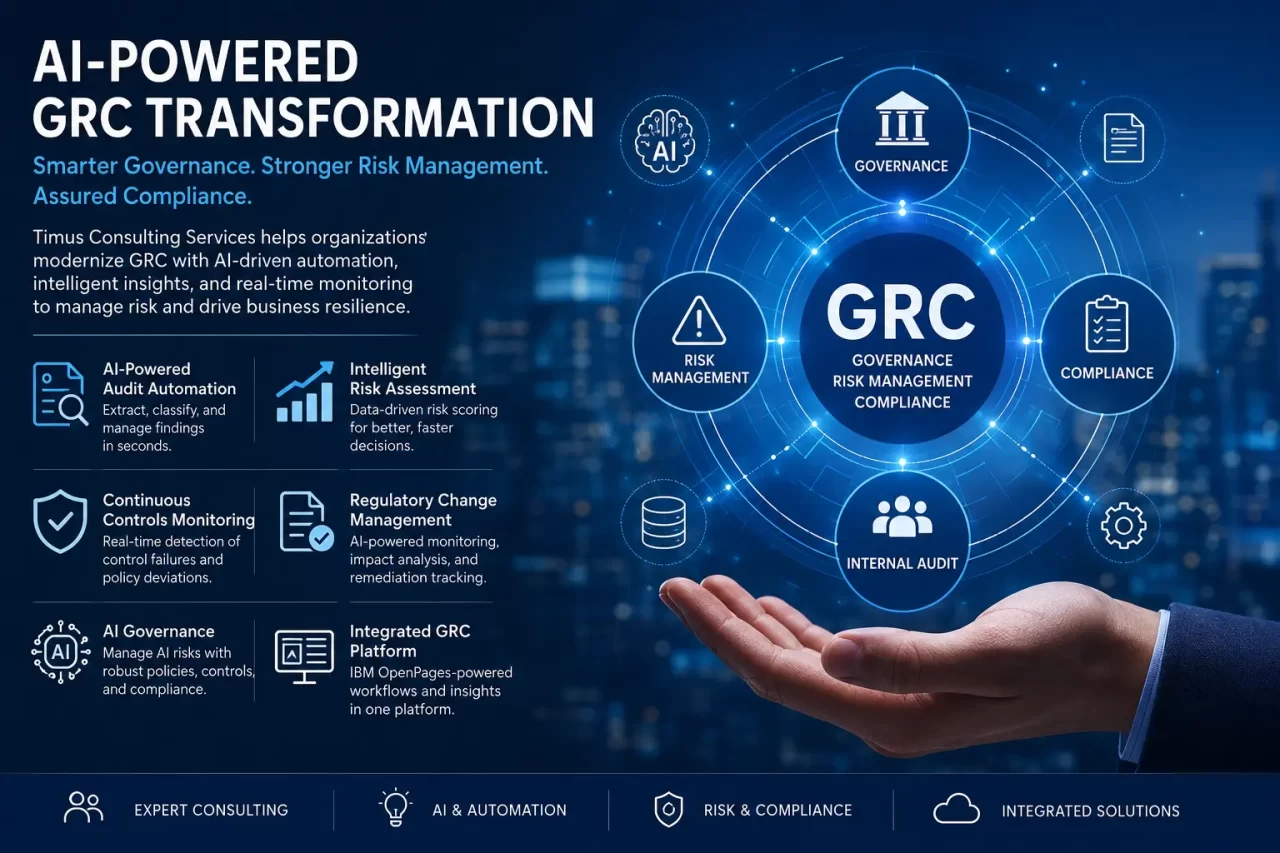
Traditional GRC consulting services platforms require audit findings to be manually entered field by field — a process that is slow, inconsistent, and adds no analytical value. With large language models (LLMs), it is now possible to ingest a full audit report document, extract key findings, identify root causes, suggest risk ratings, and populate a GRC system automatically — in seconds.
At Timus Consulting, we have built precisely this kind of pipeline. Our Equiti IAM System uses a two-pass AI architecture (powered by the Anthropic Claude API) to ingest internal audit reports, extract structured findings and action plans, and push them directly into IBM OpenPages — eliminating hours of manual data entry per engagement and ensuring consistent, high-quality data across the GRC platform.
This is not a prototype. It is a production system, running today.
2. Intelligent Risk Assessment and Scoring
Traditional risk scoring relies on subjective human judgment applied against semi-structured questionnaires. The results vary widely depending on who fills in the questionnaire, their familiarity with the risk framework, and the time they have available.
AI-assisted risk assessment changes this by:
- Analysing historical incident data to identify patterns and calibrate likelihood scores objectively
- Scanning external threat intelligence feeds to adjust risk scores dynamically as the threat landscape evolves
- Identifying previously undetected correlations between risks that siloed human assessments would miss
- Normalising assessment responses across business units for consistent enterprise-wide risk aggregation
The result is a risk register that is not just more accurate, but continuously updated — moving GRC from a periodic compliance exercise to a live operational capability.
3. Continuous Controls Monitoring
One of the most significant limitations of traditional GRC consulting services is the point-in-time nature of control assessments. Controls are tested quarterly, semi-annually, or annually. Between assessments, organisations are essentially flying blind.
AI-powered Continuous Controls Monitoring (CCM) addresses this directly by connecting GRC platforms to operational data sources — ERP systems, HRMS, financial ledgers, access management logs — and applying rule-based and machine learning models to detect control failures in real time.
For example:
- A segregation of duties violation in an ERP system (such as Odoo) can be flagged the moment it occurs, rather than being discovered months later during an audit.
- Anomalous payment patterns can be detected and escalated automatically, triggering a remediation workflow before a loss event occurs.
- User access changes that deviate from policy can be surfaced immediately for review.
This is an area where Timus Consulting’s combined expertise in GRC platforms and ERP systems (including Odoo 16 and 18) creates a distinctive advantage. We understand both the risk frameworks and the data structures of the underlying systems.
4. Regulatory Change Management
Keeping pace with regulatory change is a full-time job for compliance teams. New regulations, updated guidance, revised standards — the volume of regulatory output across jurisdictions has increased dramatically in recent years, particularly in areas like data privacy, ESG reporting, and AI governance.
AI-assisted regulatory change management uses natural language processing to:
- Monitor and classify regulatory publications across jurisdictions automatically
- Identify which internal policies, controls, and processes are affected by a regulatory change
- Generate impact assessments and suggested remediation steps for compliance teams to review
- Track implementation progress through to closure within the GRC consulting services platform
What previously required a team of compliance analysts working for weeks can now be reduced to hours of targeted human review of AI-generated analysis.
5. AI Governance — Managing the Risk of AI Itself
Perhaps the most forward-looking and rapidly growing area of GRC is AI Governance — the discipline of managing the risks introduced by AI systems themselves.
As organisations deploy AI across their operations, new categories of risk emerge:
- Model risk: AI models that produce biased, inaccurate, or unstable outputs
- Explainability risk: Decisions made by AI systems that cannot be adequately explained to regulators or customers
- Data privacy risk: AI systems trained on or processing personal data in ways that may not comply with data protection regulations
- Third-party AI risk: The risk embedded in AI tools procured from vendors
Timus Consulting offers dedicated AI Governance services, helping organisations build the frameworks, policies, and controls needed to govern their AI deployments responsibly and in compliance with emerging regulatory requirements — including the EU AI Act and related international standards.
The Role of IBM OpenPages in an AI-Enabled GRC Programme
IBM OpenPages remains one of the leading enterprise GRC platforms on the market, and it is central to many of the AI-driven GRC consulting services programmes Timus Consulting implements and supports.
OpenPages provides the structured data foundation — risk taxonomies, control libraries, assessment workflows, issue management — that AI applications need to operate effectively. When AI is used to extract findings from audit reports, those findings need to land somewhere well-governed. When continuous controls monitoring flags an anomaly, that alert needs to trigger a documented, auditable workflow. OpenPages provides that backbone.
At the same time, IBM has invested significantly in embedding AI capabilities within OpenPages itself, including natural language querying, automated risk scoring, and integration with IBM’s broader AI platform. Combined with custom AI integrations built by Timus Consulting, this creates a powerful, flexible, and enterprise-grade GRC capability.
What Organisations Should Consider Before Starting
AI in GRC is not a plug-and-play proposition. The organisations that achieve the greatest value from AI-driven GRC consulting services share a few common characteristics.
They have clean, structured GRC data. AI is only as good as the data it learns from. If your risk register is inconsistent, your findings are not categorised, and your control library has not been maintained, AI will amplify those problems, not solve them. Data quality improvement is often the first step in any AI GRC engagement.
They treat AI as augmentation, not replacement. The most effective AI GRC deployments keep human expertise at the centre. AI handles the volume and velocity; experienced GRC professionals handle judgement, context, and accountability.
They start with a high-value, contained use case. Trying to transform the entire GRC function with AI at once is a recipe for slow progress and difficult-to-measure outcomes. Starting with one well-defined use case — automated audit report ingestion, continuous monitoring of a specific control domain, or regulatory change tracking for a specific regulation — allows teams to demonstrate value quickly and build internal capability and confidence.
They plan for AI governance from the start. The AI systems used within GRC programmes are themselves subject to model risk, bias, and audit requirements. Treating the AI pipeline as just another controlled process — with documentation, testing, monitoring, and change management — is essential.
Timus Consulting: Your Partner in AI-Enabled GRC
Timus Consulting Services brings together three capabilities that are rarely found in a single firm: deep GRC domain expertise (including IBM OpenPages implementation and GRC framework design), enterprise technology capability (ERP, cloud, software development), and hands-on AI and automation experience.
We are not a firm that has recently added “AI” to its website. We have built and deployed AI-powered GRC automation in live environments. We understand the technical architecture, the data challenges, the integration complexity, and — critically — the governance requirements that surround AI in a regulated enterprise context.
Whether you are at the beginning of your AI GRC journey — exploring what is possible — or further along and looking to implement, optimise, or govern an existing AI-enabled GRC programme, we would welcome the conversation.
Let’s Talk
Timus Consulting Services
📧 Business@timusconsulting.com
🌐 www.timusconsulting.com
📞 UK: +44-7424222412 | IN: +91-9665833224 | US: +1-9199358732
Book a free 30-minute consultation →
Timus Consulting Services is a leading EnterpriseTech and Business Consulting firm, providing GRC solutions, AI, ERP, Cloud, and Managed Services to organisations worldwide. Our GRC practice covers IBM OpenPages, Archer, MetricStream, ServiceNow, and bespoke GRC implementations across Operational Risk, Internal Audit, Cyber Security, Policy Management, Third-Party Risk, and AI Governance